Navigara: Precisely Aligning AI Coding Spend with Your Product Roadmap

Navigara attributes AI coding spend to product roadmap items and cuts waste via intelligent model routing.
Navigara is a new AI R&D cost governance tool that precisely maps AI coding expenses to product roadmap items. It analyzes code like a senior engineer to assess real value, isolates off-roadmap waste and maintenance burn, and automatically routes routine tasks to lower-cost models. With quick integration via Git, JIRA/Linear, and any AI coding license, it aims to transform opaque AI spend into an actionable cost map for engineering leaders.
The Pain Point of an Era Where AI Coding Investment Is Hard to Quantify
As AI coding tools like GitHub Copilot, Cursor, and Claude Code become widely adopted across engineering teams, an awkward question is surfacing: companies are paying substantial monthly fees for AI coding licenses, yet struggle to articulate what exactly that money is delivering against their product roadmap. Engineering managers typically receive only a lump-sum bill, unable to answer the critical question: "Of this AI spend, how much actually drove the delivery of core features?"
Current mainstream AI coding tools have varying pricing models. GitHub Copilot uses per-seat subscription pricing, with the enterprise plan costing around $39 per user per month. Cursor offers a free tier and a Pro tier (approximately $20/month) with quota limits on advanced model calls. Tools like Claude Code that bill based on API call volume see costs scale linearly with usage intensity. For a 50-person engineering team, annual AI coding license spend alone can easily reach tens to hundreds of thousands of dollars. To complicate matters further, many teams use multiple AI tools simultaneously, creating a multi-source spend structure that's difficult to consolidate.
A new tool that recently launched on Product Hunt and climbed to #3 on the daily rankings (earning 142 upvotes and 13 comments) — Navigara — targets precisely this blind spot. Its tagline is straightforward: "Connect Your AI Spend Directly to Your Roadmap," attempting to build a quantifiable bridge between AI coding costs and actual engineering output.
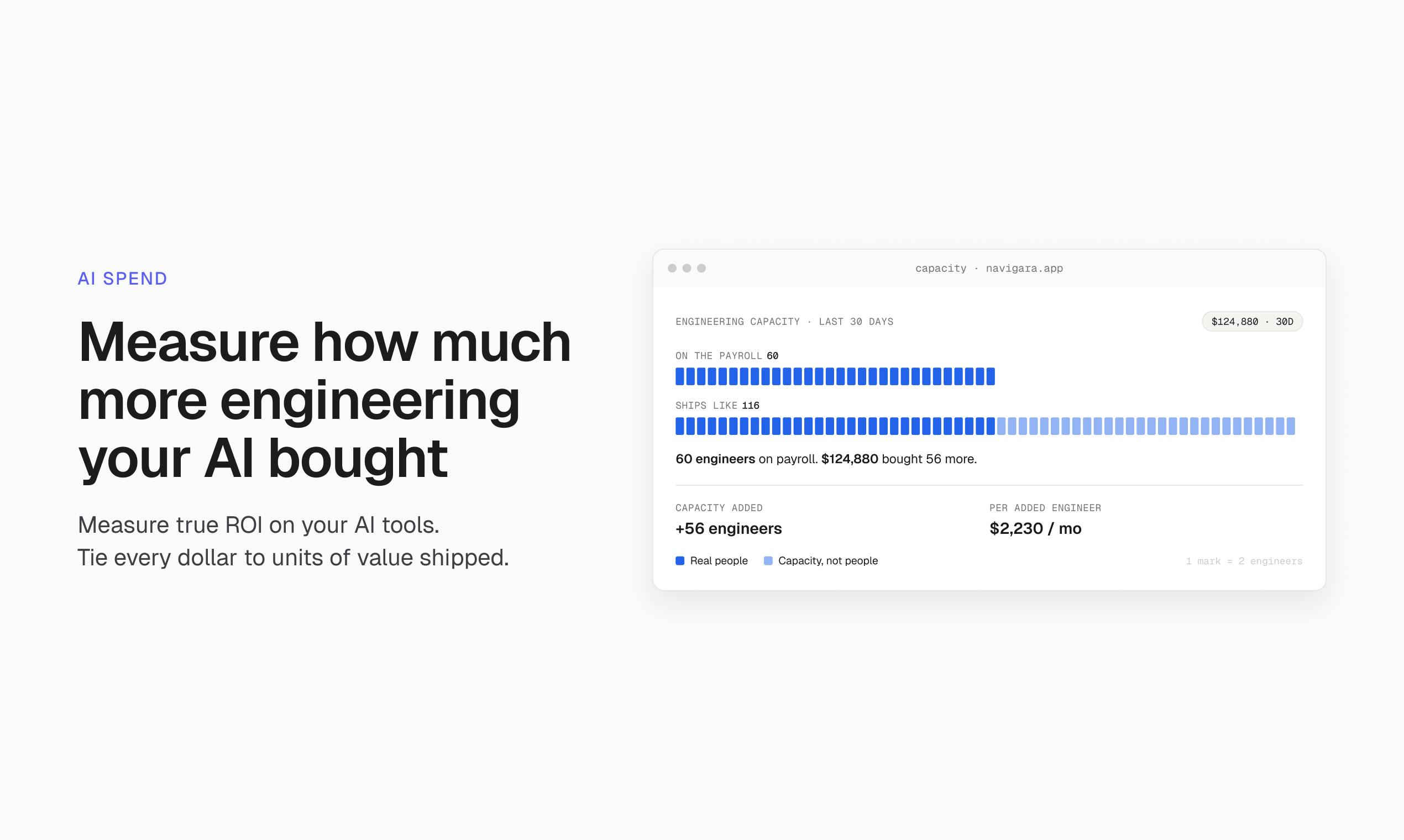
Navigara's Core Capabilities
Analyzing Code Like a Senior Engineer
Navigara's most distinctive feature is that it doesn't settle for simply counting "how many lines of code were committed" or "how many AI calls were made." According to its official description, it "analyzes code like a senior engineer" to demonstrate real capacity gains.
The logic behind this is worth noting: the volume of AI-generated code doesn't correlate proportionally with code value. A large portion of AI output might be boilerplate template code, while other portions might be critical implementations solving core business challenges. Navigara attempts to evaluate the actual worth of these outputs using an approach closer to human engineering judgment, rather than being misled by superficial activity metrics.
Traditional engineering productivity measurement has long relied on DORA metrics (deployment frequency, lead time for changes, change failure rate, time to restore service) or proxy metrics like Lines of Code. But these metrics expose fundamental flaws in the AI-assisted coding era: AI can generate hundreds of lines of code in seconds, rendering line-count metrics completely meaningless. The deeper issue is that assessing the business value of code fundamentally requires semantic understanding — distinguishing whether a piece of code implements a core algorithm, builds scaffolding, or handles edge cases requires contextual business judgment. This is precisely the technical moat behind Navigara's claim to "analyze code like a senior engineer," likely involving code semantic analysis, AST (Abstract Syntax Tree) parsing, and cross-correlation with task management systems across multiple technical layers.
Precisely Attributing Costs to Roadmap Items
Another core function of Navigara is tracking exact costs per roadmap item. This means managers can see exactly how much AI coding budget was consumed to deliver a specific feature.
Going further, it can also:
- Isolate off-roadmap waste: Identify AI usage that doesn't correspond to any planned objectives but is quietly consuming budget;
- Identify maintenance burn: Separately flag AI costs spent on routine maintenance and bug fixes, giving teams clear visibility into how much resource isn't being invested in new value creation.
This attribution system is essentially performing a granular "financial decomposition" of AI coding spend, turning what was previously one large blurry bill into a structurally clear, accountability-mapped cost landscape. This approach is also a natural extension of FinOps (Financial Operations) thinking into the R&D domain — FinOps originally emerged in cloud computing cost management, designed to help engineering, finance, and business teams collaboratively optimize cloud spend. Its core three-phase model — Inform (visibility), Optimize (optimization), Operate (operations) — aligns closely with Navigara's feature design. As AI becomes part of the R&D infrastructure, the boundaries of FinOps are extending from IaaS/PaaS to AI toolchains, creating a clear market window for this new product category.
Further Compressing Costs with Intelligent Routing
Beyond making spend "visible," Navigara also aims to help teams bring spend "down."
It offers an automation capability: automatically routing routine CRUD tasks to low-cost models without sacrificing quality.
This is a highly pragmatic design philosophy. In real-world development, a large proportion of tasks are repetitive CRUD operations (Create, Read, Update, Delete — the four basic types of database operations) that don't require the most expensive, most powerful flagship models. Industry estimates suggest that approximately 60%-70% of code changes in enterprise applications are CRUD-related routine operations. Yet many teams, lacking granular scheduling mechanisms, apply expensive models indiscriminately to all tasks, resulting in obvious resource misallocation.
Current AI model pricing varies enormously: taking OpenAI as an example, GPT-4o's API call cost is roughly 15-20x that of GPT-4o-mini; a similar cost gradient exists between Anthropic's Claude 3.5 Sonnet and Claude 3 Haiku. The core idea behind Intelligent Routing borrows from cloud computing's tiered storage strategy — hot data on SSD, cold data on HDD — matching task complexity to model capability, avoiding the wasteful use of heavy artillery on trivial targets. Navigara's intelligent routing automates the principle of "using the right model for the right job," finding a better balance between quality and cost.
Extremely Low Integration Barrier
For analytics tools targeting engineering teams, integration cost is often the make-or-break factor for adoption. Navigara markets itself as connecting "in minutes."
Its data sources cover three critical nodes in the development workflow:
- Git history: Reconstructing actual development trajectories from code commit records;
- JIRA / Linear: Integrating with mainstream project management tools to map code activity to roadmap items and tasks;
- Any AI coding license: Capturing spend data from AI tool subscriptions.
By connecting the "code — task — spend" data chains, Navigara achieves the precise cost attribution described above. This integration approach, built on existing toolchains without requiring large-scale workflow changes, lowers the psychological barrier for teams to try it out.
Why This Category of Tools Is Perfectly Timed
From an industry perspective, Navigara's emergence is no accident. Over the past two years, the procurement logic for AI coding tools has shifted from "should we use it" to "is our usage worthwhile." Early on, enterprises focused on quickly adopting AI capabilities. Now, as investment scales grow, ROI (Return on Investment) and cost controllability have become increasingly important topics for CTOs and engineering leaders.
Engineering productivity measurement itself is undergoing a paradigm shift. The first phase was individual output metrics (lines of code, commit counts), which have been proven to suffer from severe Goodhart's Law effects — once a metric becomes a target, it ceases to be a good metric. The second phase was process efficiency measurement (DORA metrics, SPACE framework), focusing more on systemic delivery capability. The third phase is evolving toward Value Stream measurement, concerned with end-to-end value flow efficiency from idea to delivery. The cost attribution Navigara performs essentially belongs to this third phase of practice — it cares not only about "how much was done" but also about "how much is what was done worth, and how much did it cost."
The space Navigara occupies — spanning Analytics, Developer Tools, and Artificial Intelligence — sits precisely at the intersection of this trend. It represents an emerging category: AI R&D productivity and cost governance platforms. These tools don't produce code; they help teams understand and optimize the input-output ratio of AI in their development processes. Gartner predicts that by the end of 2025, over 60% of large enterprises will establish dedicated AI cost governance mechanisms, creating clear market demand for tools like these.
Of course, as a newly launched product, Navigara still needs to prove several things in practice: how reliable its "analyzing code like a senior engineer" capability truly is, how accurate the cost attribution is, and whether intelligent routing can genuinely deliver on "without sacrificing quality" in complex business scenarios. All of these require validation through long-term use by real teams.
Conclusion
Navigara has seized on a real and widespread management challenge that emerges after AI coding scales up: money is being spent, but the value is hard to articulate. By precisely aligning AI spend to the product roadmap, isolating waste, identifying maintenance burn, and compressing costs through intelligent model routing, it attempts to transform AI R&D investment from a "blurry bill" into a "clear map."
For engineering teams that are scaling up their AI coding adoption while starting to worry about cost visibility, tools like this may signal the beginning of a new phase — where AI coding is no longer just about capability, but also about governance.
Related articles

Gaussian Process Bandit Optimization: Exploration Strategies and Inference Regret Guarantees
Cumulative regret guarantees in Bayesian optimization fail to reflect final recommendation quality. This article examines a new study that provides inference regret guarantees for Gaussian process bandit optimization through exploration query strategies and fill distance analysis, validated on hyperparameter optimization and control tasks.

The Most Detailed Codex Guide on Bilibili: From Installation to Real-World Practice
The most detailed Codex guide on Bilibili: from app store installation to daily work mode configuration, with a real coffee shop project demonstrating file organization, data extraction, dashboard creation, and other practical tasks. Learn to use Plan Mode and desktop pets to leverage Codex efficiently.

Appearance Compensation in Volume Rendering: Why RGB Accuracy Cannot Guarantee Density Correctness
Volume rendering research reveals that volumetric data perfectly reproducing external RGB views may still contain density errors: appearance compensation can double central density and keep external rays unchanged even when L2 error exceeds 14.52%. Density recovery depends on appearance capacity, spatial resolution, and measurement design.