Navigent: A Geometry-Anchored Agent Framework for More Reliable Vision-Language Navigation

Navigent combines a frozen MLLM with a geometry-grounded execution critic to improve long-horizon reliability in vision-language navigation.
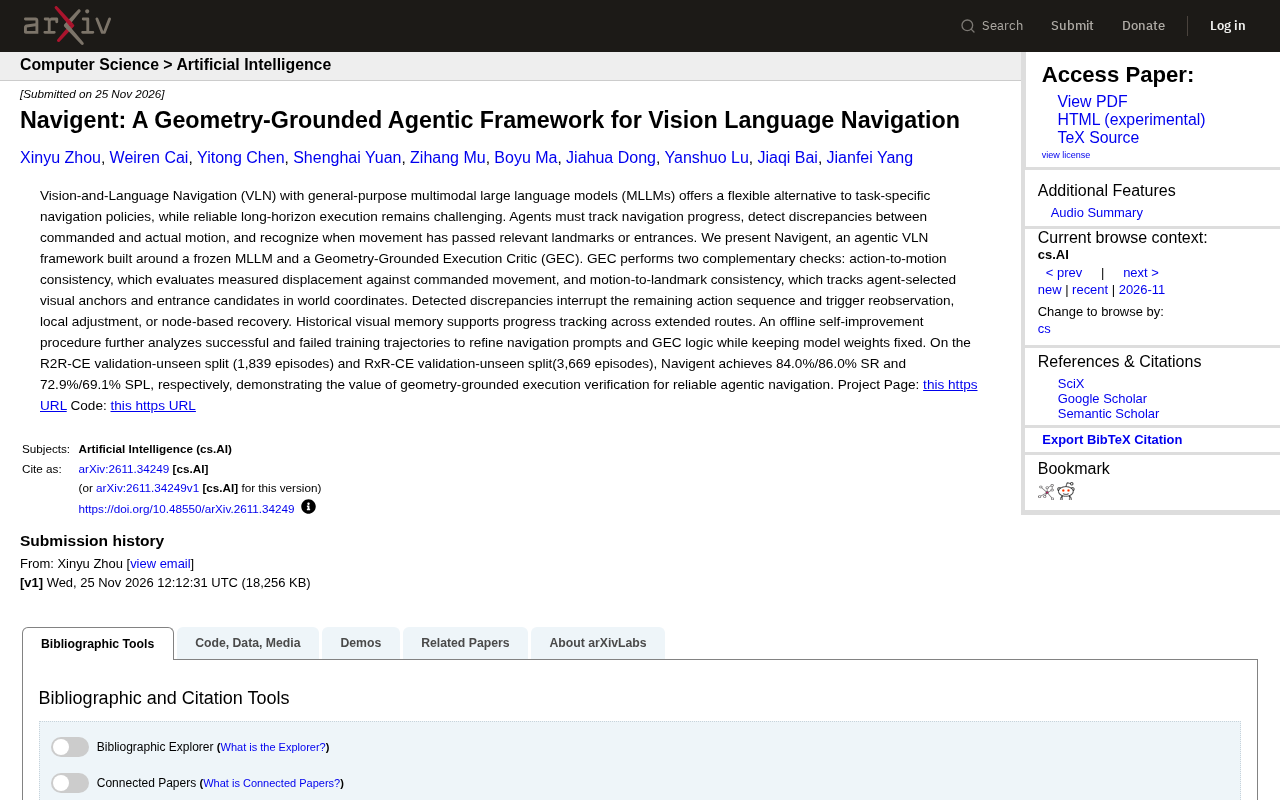
Navigent is an agent framework for vision-language navigation (VLN) that uses a frozen multimodal large language model (MLLM) for semantic understanding and planning, and introduces a Geometry-Grounded Execution Critic (GEC) to validate execution in real time. The GEC performs action-to-motion and motion-to-landmark consistency checks to determine whether the agent executes actions accurately and crosses key landmarks; when inconsistencies are detected, it interrupts actions and triggers re-observation, local adjustment, or node recovery. The framework also supports offline self-improvement, optimizing prompts and GEC logic without updating model weights. On the R2R-CE and RxR-CE validation unseen environments, Navigent achieves 84.0%/86.0% success rates and 72.9%/69.1% SPL, demonstrating that geometric validation improves both long-horizon reliability and path efficiency.
Vision-language navigation (VLN) is a key challenge in embodied intelligence: agents must understand natural language instructions and plan and execute long action sequences in real environments. In recent years, general-purpose multimodal large language models (MLLMs) have provided a flexible new paradigm for navigation tasks, but reliability in long-horizon execution remains a bottleneck. To address this, researchers have proposed Navigent, an agent framework built around a frozen MLLM and augmented by a Geometry-Grounded Execution Critic (GEC), achieving leading success rates and path efficiency across multiple benchmarks.
Core Idea: Geometry-Grounded Execution Critic
The key innovation of Navigent is the GEC module. Rather than fine-tuning a large model, it performs two types of geometric consistency checks in real time to validate navigation behavior:
- Action-to-motion consistency: compares the agent's actually measured displacement with the distance and direction required by the command. If there is a deviation, it indicates that the execution stage may be disturbed or error-prone.
- Motion-to-landmark consistency: tracks the visual anchors and entrance candidates selected by the agent in the world coordinate system to determine whether the agent has crossed key landmarks or entrances.
These two checks are complementary, covering both "whether execution is accurate" and "whether the correct location has been reached." Once an inconsistency is detected, the system immediately interrupts the remaining action sequence and triggers re-observation, local adjustment, or node-based recovery strategies. Historical visual memory helps the agent continuously track progress along long routes.
VLN Benchmarks and Evaluation Metrics: R2R-CE and RxR-CE, which repeatedly appear in this article, are commonly used Continuous Environment benchmarks in the VLN field. R2R (Room-to-Room) provides shorter, room-based instructions, while RxR (Room-across-Room) contains longer, multilingual path descriptions and is more difficult. "Validation unseen" (val-unseen) refers to evaluation in scenes the agent has not encountered during training, used to test generalization ability. In terms of metrics, success rate (SR) measures whether the agent reaches the target within a threshold distance; SPL (Success weighted by Path Length) weights SR by the ratio of the actual path length to the shortest path length, penalizing detours and thus better reflecting navigation efficiency. Understanding these two metrics helps interpret what numbers such as 84.0% SR / 72.9% SPL actually mean.
Frozen MLLM and Prompt Engineering: Navigent completely freezes the weights of the multimodal large model (MLLM), meaning no gradient updates or fine-tuning are performed; the model receives task instructions and context only through input prompts. This approach leverages the semantic understanding and commonsense reasoning acquired during MLLM pretraining while avoiding the computational cost and catastrophic forgetting associated with fine-tuning. The accompanying "offline self-improvement" is actually search and optimization at the prompt level: the system adjusts prompt templates and GEC rules based on trajectory analysis results rather than changing model parameters. This paradigm of "frozen model + external rules/prompt evolution" is gradually becoming popular in embodied intelligence because it shifts the learning burden from parameters to interpretable, auditable external logic.
Offline Self-Improvement: Evolving Without Updating Weights
Another highlight of Navigent is its offline self-improvement process. The system analyzes successful and failed training trajectories to optimize navigation prompts and GEC logic, while model weights remain frozen throughout. This means the framework can continuously learn from experience while avoiding expensive fine-tuning costs and reducing the risk of catastrophic forgetting. This evolution at the "prompt + rules" level offers a new approach for iterating agent systems.
Experimental Results: Validated on Both R2R-CE and RxR-CE
On the R2R-CE validation unseen environment (1,839 episodes), Navigent achieved 84.0% success rate (SR) and 72.9% path-efficiency-weighted success rate (SPL). On the more challenging RxR-CE validation unseen environment (3,669 episodes), it achieved 86.0% SR and 69.1% SPL. These numbers show that geometry-anchored execution validation significantly improves long-horizon navigation reliability while maintaining high path efficiency.
In-Depth Analysis: Why Geometric Validation Works
Traditional MLLM-based navigation solutions often delegate the entire task to the model end-to-end, lacking fine-grained monitoring of the execution process. The GEC introduced by Navigent acts as an independent "auditor" between "thinking" and "acting," using geometric information for objective validation. This design leverages the MLLM's semantic understanding and planning capabilities while compensating for the model's shortcomings in numerical precision and spatial reasoning through geometric constraints.
In addition, the offline self-improvement mechanism allows the framework to learn from failures without updating model parameters, which is highly attractive for real-world deployment—the system can continuously improve without worrying about damaging existing capabilities.
Technical Meaning of Geometric Consistency Checks: Action-to-motion consistency essentially compares the action commands issued by the agent (e.g., move forward 0.25 meters, turn left 30 degrees) with the actual displacement measured by odometry or a SLAM system; if the deviation exceeds a threshold, execution is judged abnormal, allowing detection of slipping, collisions, or control delays. Motion-to-landmark consistency relies on visual anchor tracking in the world coordinate system: during exploration, the agent selects several salient landmarks (such as door frames or furniture) and records their relative positions; when an instruction requires "turn left after passing the sofa," the system can determine whether the agent has crossed that landmark. These two types of checks correspond respectively to "whether low-level execution is correct" and "whether high-level spatial progress meets expectations," forming a complementary pair. Their effectiveness stems from geometric quantities being more objective and quantifiable than the implicit spatial reasoning of language models, thereby compensating for the inherent shortcomings of MLLMs in numerical precision.
Limitations and Future Outlook
Despite impressive results, Navigent still relies on predefined geometric check rules and visual anchor selection strategies, which may be limited in highly dynamic or texture-poor environments. Future work could explore more adaptive anchor generation and richer recovery behaviors.
Overall, Navigent offers a path for vision-language navigation that balances flexibility and reliability, and its geometry-grounded execution critic design is worth attention. The project page and code have been released for the community to reproduce and extend.
Challenges of Visual Anchors in Texture-Poor and Dynamic Environments: Visual anchor tracking depends on repeatably detectable feature points or semantic objects. In texture-poor environments (such as white-walled corridors or empty halls), feature matching easily fails, and anchors may be lost or drift; in highly dynamic scenes (such as people walking around or doors opening and closing), anchors may be occluded or moved, causing false positives in motion-to-landmark consistency checks. In addition, predefined geometric check rules require manually set thresholds and recovery strategies, making it difficult to cover all edge cases. These limitations explain why future work points toward adaptive anchor generation—for example, using semantic segmentation or depth information to select more robust anchors—and richer recovery behavior libraries, thereby reducing dependence on fixed rules.
Related articles

A 19-Year-Old's Rental Horror Story: Ceiling Collapse, Bug Infestation, and the Lessons It Taught Me
At 19, my first off-campus rental brought bug infestations, no heat, a collapsed ceiling, and a ruined laptop with no renter's insurance. Here are the hard-won lessons for first-time student renters.

Veda Nurse's Cranial Nerve Exam: Why ASMR Role-Play Is Going Viral
Bilibili creator Veda's cranial nerve exam ASMR video goes viral, blending humor and sensory triggers through nurse role-play. This article analyzes its unique appeal and the audience psychology behind ASMR role-play.

LG Cinebeam AI Review: 120-Inch Giant Screen + 3000 Lumens, a New Choice for the Living Room Theater
LG Cinebeam AI projector review: 3000 ANSI lumens, 4K, 100 inches from about 8 cm and 120 inches from about 18 cm. Built-in webOS, AI Concierge voice recommendations, AI Sound Pro 11.1.2 virtual surround, and Game Optimizer—positioned for fixed living room installation, complementing the portable Cinebeam S.