NeatRL: An Open-Source Library That Implements Reinforcement Learning Algorithms from Scratch

NeatRL implements DQN, REINFORCE, PPO, SAC, and other RL algorithms from scratch with clean, readable code.
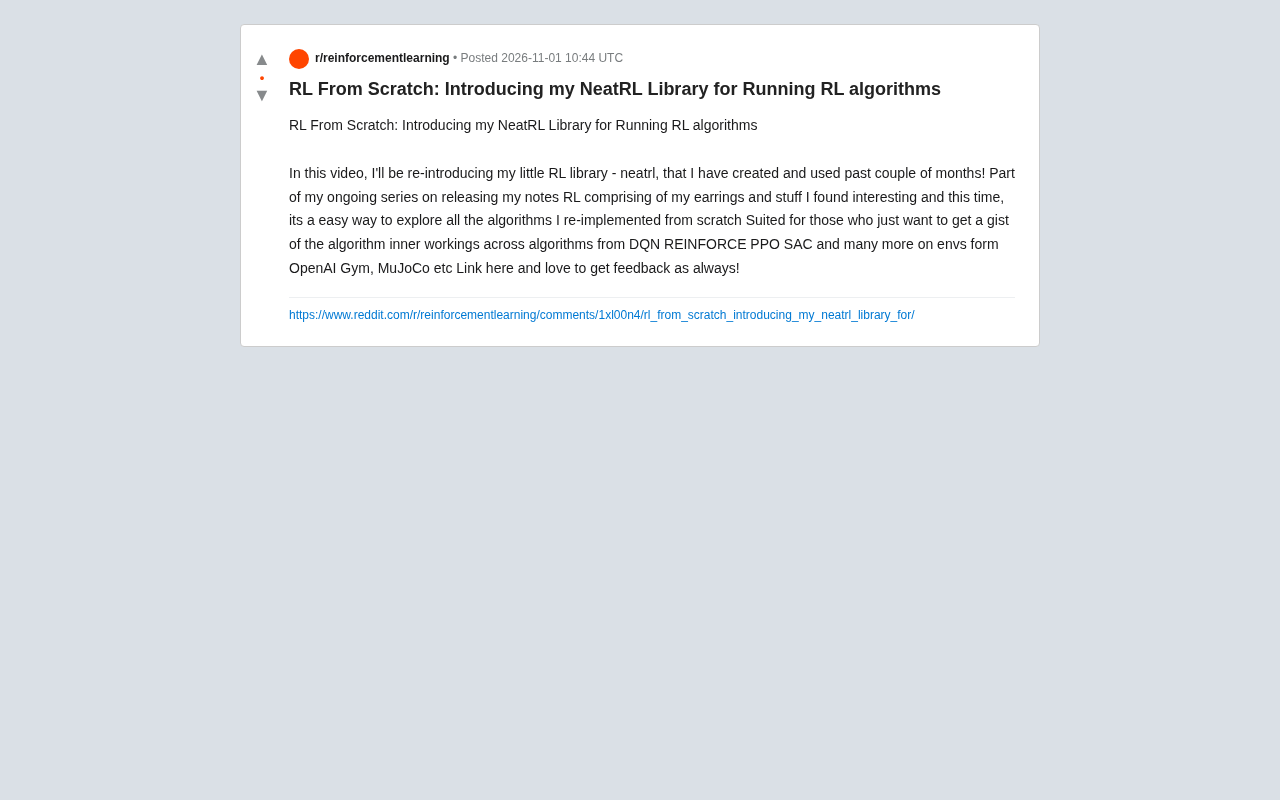
NeatRL is an open-source reinforcement learning algorithm library designed to lower the barrier for beginners trying to understand how algorithms work internally. It reimplements classic algorithms such as DQN, REINFORCE, PPO, and SAC from scratch without depending on high-level RL frameworks, so every line of logic is clearly visible. All algorithms are implemented in standard environments like OpenAI Gym and MuJoCo, making them easy to run and debug. The library targets learners and developers who already have RL fundamentals and want to deeply understand or modify algorithms; the author reintroduced the project on Reddit, encourages feedback, and plans to keep adding more algorithms and notes.
Why NeatRL?
The field of reinforcement learning (RL) has a wealth of classic algorithms, but beginners are often intimidated by complex mathematical formulas and enormous codebases. The NeatRL library, shared by a Reddit user, was created to solve exactly this pain point — it implements algorithms such as DQN, REINFORCE, PPO, and SAC from scratch, with concise code that's ideal for quickly understanding the core of each algorithm. The author reintroduced this library in a video and shared insights from several months of use.
Covered Algorithms and Environments
NeatRL covers a range of algorithms from value functions to policy gradients:
- DQN (Deep Q-Network)
- REINFORCE (the foundation of policy gradients)
- PPO (Proximal Policy Optimization)
- SAC (Soft Actor-Critic)
- And more (the author didn't list them all)
These algorithms are all implemented in standard environments such as OpenAI Gym and MuJoCo, so users can run and debug them directly. The author emphasizes that the library's code is "reimplemented from scratch" and doesn't rely on high-level RL libraries, so every line of logic is clearly visible.
OpenAI Gym and MuJoCo are the two most commonly used experimental platforms in reinforcement learning. OpenAI Gym provides a standardized environment interface (such as reset(), step(), and render()), allowing different algorithms to run and be compared under a unified API; it includes classic control tasks (CartPole, MountainCar), Atari games, and other discrete or continuous tasks. MuJoCo (Multi-Joint dynamics with Contact) is a physics simulation engine commonly used for continuous control tasks (such as HalfCheetah, Hopper, and Walker2d), where states and actions are continuous, high-dimensional vectors that place higher demands on algorithmic exploration and stability. Gym handles the environment interface and task management, while MuJoCo serves as the backend physics simulator providing realistic dynamics. Together, they enable NeatRL to cover both discrete-action (DQN) and continuous-action (PPO, SAC) scenarios.
DQN, REINFORCE, PPO, and SAC each represent a different paradigm in reinforcement learning. DQN (Deep Q-Network) is a value-function method that uses a neural network to approximate the action-value function Q(s,a), stabilizing training through experience replay and a target network, and is suited to discrete action spaces. REINFORCE is the most basic policy gradient algorithm, directly performing Monte Carlo gradient estimation on policy parameters; it has high variance but is conceptually clear. PPO (Proximal Policy Optimization) builds on policy gradients by introducing importance sampling and a clipped objective to limit how much the policy changes with each update, balancing sample efficiency and stability — it is one of the most commonly used baselines today. SAC (Soft Actor-Critic) belongs to maximum-entropy reinforcement learning, additionally encouraging policy entropy in the reward, and uses dual Q-networks and a stochastic policy, performing excellently in continuous control tasks. Understanding these four essentially covers the four main threads: value functions, policy gradients, trust region/clipping, and maximum entropy.
Who Is It For?
NeatRL's target users are those who "just want to quickly understand how algorithms work internally." If you're already familiar with RL fundamentals but want to dig into the details, or want to modify algorithms yourself, this library provides an excellent starting point. The author demonstrated some examples in the video and encourages user feedback.
Open Source and Feedback
NeatRL is open source, and the author included a link in the Reddit post (the original text didn't provide a specific address). He mentioned that this is part of a "continuing series," and more algorithms and notes may be added in the future. For anyone who wants to learn RL implementation, this is a project worth following.
Summary
NeatRL stands out for its simplicity and from-scratch implementation, lowering the barrier to learning reinforcement learning algorithms. If you're interested in RL, this small library is a great place to start exploring.
Related articles

Qwen 3.8 Beats Opus at Coding—But Can Your Mac Run It?
Open-source Qwen 3.8 beats Opus 4.6 at coding at just 18GB, but how much Mac memory do you need? 24GB crashes; 32GB is the sweet spot. Full config guide inside.

Claude Code + Agent: Building a Fully Automated AI Testing Loop
Bilibili course breakdown: how test developers can use Claude Code terminal-based Agents to build a fully automated AI testing loop. Compares permission boundaries of terminal vs. device Agents, explains why enterprise projects choose Claude Code over Open Claude-type tools, and outlines the Node.js environment setup and DeepSeek model integration path.

Working with AI Agents Requires Nerves of Steel
The more autonomous AI agents become, the heavier the user's psychological burden. Drawing from a Hacker News discussion, this article analyzes black-box anxiety, behavior drift, and monitoring fatigue in agent collaboration, and offers practical approaches like sandbox isolation, permission control, and task granularity management to reduce cognitive load.