Nebius Bets $40 Billion on AI Infrastructure: The Prepayment-Plus-Loan Model Faces a Stress Test

Nebius bets $40B on AI infrastructure using customer prepayments and loans as delivery delays test the model.
Nebius plans to invest $40 billion in AI infrastructure, funded mainly by customer prepayments and loans rather than cash flow or equity. The model is common among neoclouds, but Nebius's scale magnifies the risk. Recent Microsoft data center delays have raised doubts: prepayments depend on fixed delivery timelines, and delays can undermine customer confidence and payment willingness, affecting loan repayment and construction. Neoclouds lack hyperscalers' diversified cash flow and credit ratings, making the $40 billion plan a stress test of the business model.
Nebius is pushing ahead with its AI infrastructure expansion in a rather controversial way—planning to invest $40 billion, funded primarily through customer prepayments and loans rather than traditional equity financing or its own cash flow. This model is not uncommon among the neocloud camp, but the sheer scale of Nebius's plan—combined with the ripple effects of recent delays in a Microsoft data center project—has prompted outsiders to re-examine whether this "build your own cloud with your customers' money" approach is sustainable.
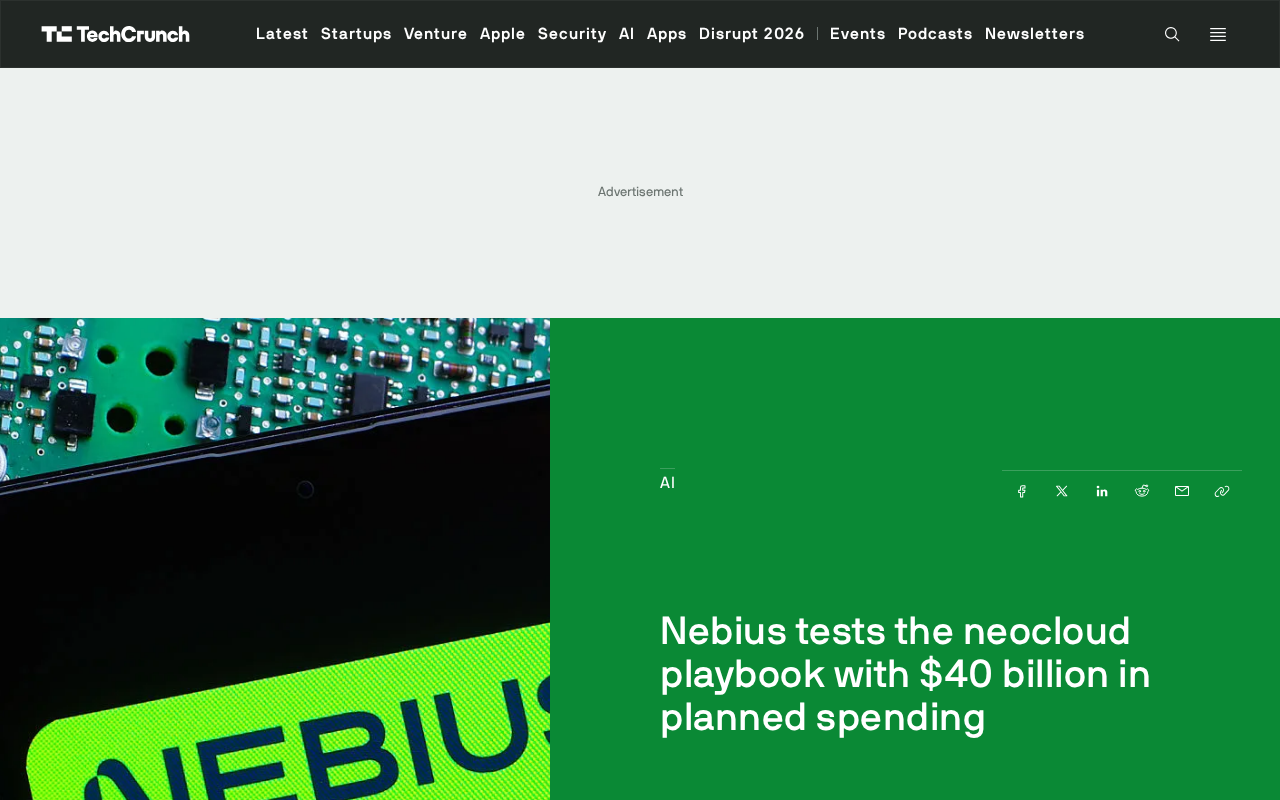
Prepayments + Loans: The Neocloud Capital Game
The core of Nebius's financing structure lies in two things: first, having customers pay compute fees upfront to form a substantial prepayment pool; second, using that as a foundation to leverage loans and amplify financial leverage. The benefits of this model are obvious—when GPU procurement and data center construction require massive upfront investment, prepayments amount to interest-free or low-interest financing, while loans further accelerate the pace of expansion.
The problem is that this logic relies heavily on the certainty of customer fulfillment. If customers delay going live or reduce their orders, the prepayment rhythm gets disrupted, which in turn affects loan repayment and subsequent construction. Nebius is not the only neocloud player using this model, but the $40 billion scale means any loosening in any link will be amplified.
The Warning From Microsoft Data Center Delays
According to the original report, Nebius experienced delays in a Microsoft-related data center project, which directly raised market questions about its financing model. Data center delays themselves are not uncommon in the AI infrastructure space—power access, supply chains, and construction permits can all become bottlenecks—but when combined with the "prepayment-driven expansion" model, the risk is amplified: customer prepayments correspond to a fixed compute delivery timeline, and delays mean delivery commitments may fall through, thereby undermining customer confidence and willingness to make subsequent payments.
This incident also exposes a common challenge facing the neocloud camp: unlike hyperscale cloud providers, they do not have diversified cash flow sources. Once the rhythm of a single major customer or a single project deviates, the flexibility of the entire funding chain comes under scrutiny.
Neocloud (emerging cloud service providers) refers to emerging cloud service companies focused on GPU compute leasing, as opposed to hyperscale cloud providers such as AWS, Microsoft Azure, and Google Cloud. Typical representatives include CoreWeave, Lambda Labs, Together AI, and Nebius, which is discussed in this article. The common characteristics of these companies are: smaller scale, highly concentrated business in AI training and inference compute, and customers that are mostly large model developers and enterprise research teams. Compared with traditional cloud providers, neoclouds typically lack diversified cash flow sources and mature credit ratings, and therefore rely more heavily on external financing and customer prepayments to support GPU procurement and data center construction. Their opportunity lies in being able to respond to niche compute demands faster than hyperscalers, but the cost is weaker risk resilience, with funding chains highly sensitive to the pace of customer fulfillment.
From contract signing to compute delivery, an AI data center involves a series of long-cycle steps: land and power access approvals, substation and cooling system construction, GPU server procurement and racking, and network interconnection commissioning. Power access is often the biggest source of uncertainty—applications for electricity for high-power data centers may need to queue for years, and the GPU supply chain (especially NVIDIA's high-end chips) also has fluctuating delivery cycles. Any delay in any of these steps will push back the compute delivery timeline. For neoclouds using the prepayment model, delivery delays are not just an engineering problem—they directly undermine customer confidence in the payment schedule, which in turn affects the financing chain that uses prepayments to leverage loans.
The Industry Context of the $40 Billion Bet
Placed within the current AI infrastructure boom, Nebius's expansion plan is not hard to understand. Demand for GPU compute for large model training and inference continues to climb, and hyperscale cloud providers' capacity may not fully cover all niche demands, leaving room for neoclouds. Locking in long-term customers with prepayments and accelerating capacity construction with loans is essentially a bet that the growth curve of AI compute demand will not suddenly flatten.
But the other side of the bet is: if the AI compute market experiences a period of oversupply, or if customers begin to commit long-term spending more cautiously, then expansion supported by prepayments and loans will face refinancing pressure. Nebius's $40 billion plan is, to some extent, a stress test of the entire neocloud business model.
A Differentiated Path From Hyperscalers
It is worth noting that the path Nebius has chosen is clearly different from that of hyperscalers. The latter typically support capital expenditure with their own cash flow and mature credit ratings, with relatively controllable expansion pace; neoclouds like Nebius rely more on external funding and customer prepayments, expanding more aggressively but with weaker risk resilience. This differentiation is both the opportunity for neoclouds—being able to respond to customer needs faster—and their structural weakness.
The reason hyperscale cloud providers can keep their capital expenditure pace controllable is that they have mature investment-grade credit ratings and massive operating cash flow, enabling them to issue bonds at lower interest rates or directly cover construction costs with their own funds without relying on customer prepayments to start projects. In addition, their customer structures are highly diversified, making it difficult for fluctuations in a single customer or project to shake the overall funding chain. Neoclouds are the opposite: high customer concentration, uneven credit quality, and higher financing costs, so they must lock in demand through prepayments and amplify leverage through loans to seize the compute window at a more aggressive pace. This structure is an accelerator during periods of rising demand, but may become an amplifier during downturns.
Implications for the AI Infrastructure Market
The Nebius case serves as a reminder for the AI infrastructure market: the speed race in compute expansion must ultimately come back to the alignment between the funding chain and delivery capability. Prepayments and loans can accelerate construction, but they cannot replace stable delivery execution. The delay in the Microsoft data center project may be just an episode in a single project, but the questions it raises about the financing model will prompt more neoclouds to re-examine their capital structures.
For practitioners and investors focused on AI infrastructure, Nebius's upcoming delivery progress and customer fulfillment will be an important window for observing whether the neocloud model can work. The $40 billion planned expenditure is already on the table, and the real test is whether that money can be turned into deliverable compute on time.
One-line Summary
Nebius plans to support its $40 billion AI infrastructure expansion with customer prepayments and loans, while delivery delays raise questions about the model's sustainability.
Paragraph Summary
Nebius plans to invest $40 billion in expanding AI infrastructure, funded primarily through customer prepayments and loans rather than its own cash flow or equity financing. This "build your own cloud with your customers' money" model is not uncommon among neoclouds, but Nebius's sheer scale significantly amplifies the risk. Recent delays in a Microsoft-related data center project have directly raised market doubts about the model: prepayments correspond to a fixed compute delivery timeline, and delays may undermine customer confidence and subsequent willingness to pay, thereby affecting loan repayment and construction pace. The article notes that neoclouds generally lack the diversified cash flow and mature credit ratings of hyperscalers, making them less resilient to risk. The $40 billion plan is essentially a bet on continued growth in AI compute demand and a stress test of the neocloud business model, whose success depends on the alignment between delivery execution and the funding chain.
Related articles

VP ≠ VNP: A Major Breakthrough in Computational Complexity Theory
A study claiming to prove VP ≠ VNP over every field sparks heated discussion on Hacker News. This article analyzes the algebraic complexity background of VP and VNP, the proof approach, community controversy, and its potential impact on computational complexity theory.

Developer Naming Woes: The Technical Names That Drive Us Crazy
Why is technical naming so maddening? From Nginx and Vite to Qt and Sudo, a YouTube creator rants about the chaos of developer naming and pronunciation, revealing the tug-of-war between creators' intentions and community habits, and the cultural roots behind spelling traps like PyPI and GNOME.

Figma Workplace Scandal: Employee Sues CEO for Forcing Confrontation with Harasser
Figma and its CEO are sued by a current employee alleging sexual harassment and discrimination, and forcing the victim to confront her harasser. This article outlines the background, potential impact, and industry reflection.