Neural Expansion: Deciphering the Unified Geometric Mechanism of Deep Neural Network Generalization

Neural Expansion framework unifies deep network generalization via directional ray coverage expansion in input space.
The study proposes "Neural Expansion," a unified geometric framework explaining deep network generalization via directional ray coverage in input space. Traditional global theories (margin bounds, PAC-Bayesian, NTK) lack mechanistic insight. The authors introduce Generalization Intervals (GIs) to quantify direction-specific stable prediction regions around training samples, finding training expands these regions, especially along directions with small Jacobian singular values. The framework unifies explanations for correct classification, adversarial examples, mislabeled samples, and OOD samples, avoiding the instance memorization hypothesis and linking input space curvature to prediction stability. Neural Expansion complements global theories, offering fine-grained mechanistic explanations from training dynamics.
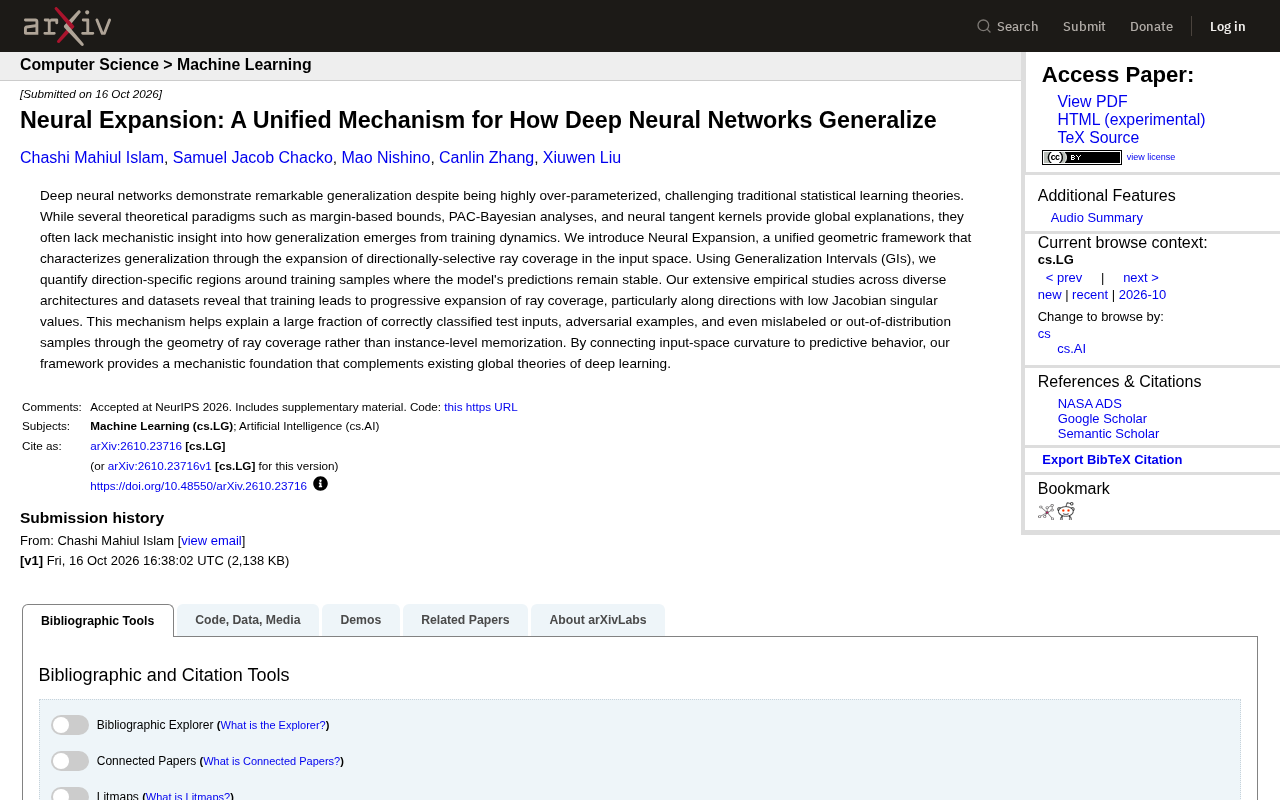
Deep neural networks exhibit remarkable generalization capabilities despite being highly overparameterized, a fact that has long challenged traditional statistical learning theory. Although theories such as margin-based bounds, PAC-Bayesian analysis, and neural tangent kernels provide global explanations, they often lack mechanistic insight into how generalization emerges from training dynamics. A recent study titled "Neural Expansion: A Unified Mechanism for How Deep Neural Networks Generalize" proposes "Neural Expansion," a unified geometric framework that attempts to explain generalization from the perspective of directional coverage in input space.
From Global Theories to Mechanistic Explanations
Traditional theories such as margin bounds and PAC-Bayesian methods typically provide generalization guarantees from the perspective of hypothesis space or parameter distributions, but these global descriptions struggle to answer the question of "how networks specifically acquire generalization ability during training." Although neural tangent kernel (NTK) theory links training dynamics to generalization, its linearization assumption limits its explanatory power for the complex behavior of deep nonlinear networks.
This research takes a different approach, shifting focus from parameter space to the geometric structure of input space. The authors propose that the training process leads to the progressive expansion of "directionally-selective ray coverage" in input space, thereby forming stable prediction regions around training samples. This geometric perspective provides a more fine-grained mechanism for understanding generalization.
PAC-Bayesian analysis is a generalization bound theory based on the probably approximately correct (PAC) learning framework. It bounds generalization error by considering the KL divergence between a posterior distribution over hypothesis space (typically a Gaussian centered on the trained network parameters) and a prior distribution. Unlike traditional VC dimension or Rademacher complexity, PAC-Bayesian bounds can leverage data distribution and algorithmic randomness, and are often used to analyze stochastic neural networks or models trained with SGD. The core idea is: a hypothesis that performs well on the training set and whose posterior distribution does not differ much from the prior will also have small generalization error. However, such bounds are often loose and do not directly reveal how training dynamics shape generalization.
Neural tangent kernel (NTK) is the kernel limit of infinitely wide neural networks under gradient descent training. As network width tends to infinity, parameter updates can be approximated as a linear model, whose kernel function is determined by the inner product of the network's Jacobian at initialization. NTK theory connects training dynamics to kernel regression, thereby precisely characterizing the training and generalization behavior of infinitely wide networks. However, the linearization assumption of NTK ignores feature learning during training (i.e., representations changing with training), making it difficult to explain the complex generalization phenomena of finite-width nonlinear networks.
Generalization Intervals: Quantifying Direction-Specific Stable Regions
To characterize the aforementioned ray coverage, the researchers introduce the concept of "Generalization Intervals" (GIs). For each training sample, a GI is defined as a ray segment starting from that sample along a specific direction, within which the model's prediction remains stable (i.e., the predicted class does not change).
Through extensive empirical studies across different architectures (e.g., fully connected networks, convolutional networks, residual networks) and datasets (e.g., MNIST, CIFAR-10, ImageNet subsets), the authors find that the training process continuously expands ray coverage, especially in directions with smaller Jacobian singular values. This means the network tends to enlarge its stable prediction regions in directions insensitive to input perturbations, thereby covering more test samples.
Jacobian singular values here refer to the magnitudes of the derivatives of the model output (typically logits or predicted probabilities) with respect to the input along various directions. Specifically, for an input sample x, the Jacobian matrix of model f is J = ∂f/∂x, and its singular value decomposition yields a set of orthogonal directions in input space, each corresponding to a singular value representing the rate of change of model output along that direction. Directions with smaller singular values mean the model output is insensitive to input perturbations, i.e., the input space is "flatter" in that direction. In the Neural Expansion framework, ray coverage in these low-singular-value directions expands more easily because model predictions remain stable over longer intervals along these directions. Jacobian singular values thus become a key quantity connecting local curvature of input space to prediction stability.
Explaining Multiple Phenomena with Geometric Coverage
The appeal of this framework lies in its ability to unify seemingly different phenomena. Experiments show that the geometric structure of ray coverage can explain a large fraction of correctly classified test inputs, as well as the prediction behavior of adversarial examples, mislabeled samples, and even out-of-distribution (OOD) samples.
Specifically, adversarial examples often lie at the edge or outside of ray coverage, while mislabeled samples may be covered within the expanded regions of training samples, causing the model to confidently make incorrect predictions. OOD samples may fall outside the coverage, thus exhibiting high uncertainty. This geometric coverage-based explanation avoids the simplistic "instance-level memorization" hypothesis and provides a more mechanistic perspective.
Out-of-distribution (OOD) samples refer to inputs appearing at test time that do not belong to the training data distribution. For example, a model trained on CIFAR-10 encountering MNIST images or anomalous objects in natural scenes. OOD detection is an important problem in machine learning safety, as model predictions on OOD samples are often unreliable. The Neural Expansion framework interprets OOD samples as inputs falling outside the ray coverage of training samples, so the model lacks stability in predicting them, potentially exhibiting high uncertainty or random predictions. This provides a geometric coverage-based criterion for OOD detection: if a test sample is not within the generalization interval of any training sample, it is more likely an OOD sample.
Connecting Input Space Curvature to Prediction Behavior
Another contribution of the Neural Expansion framework is linking input space curvature (characterized by Jacobian singular values) to prediction behavior. Low Jacobian singular value directions correspond to "flatter" regions in input space, where model predictions are more stable, making ray coverage easier to expand. This provides new geometric intuition for understanding the trade-off between robustness and generalization in deep networks.
The authors note that this framework is complementary rather than alternative to existing global theories (such as margin bounds). Global theories provide necessary conditions or upper bounds for generalization, while Neural Expansion explains from the perspective of training dynamics how generalization is concretely realized. This complementarity helps build a more complete theoretical picture of deep learning.
Implications and Outlook
The Neural Expansion research provides a new geometric perspective on the deep learning generalization problem, with its core contribution being the attribution of generalization mechanisms to the expansion of directional ray coverage in input space. This framework not only helps explain existing phenomena but may also inspire new regularization methods and model design principles—for example, enhancing generalization by encouraging coverage expansion in low-curvature directions.
Although this research is still in its early stages, its unity and mechanistic explanatory power deserve attention. Future work can further explore how to apply Neural Expansion to more complex tasks (such as object detection and language models), and how to integrate it with fields such as adversarial robustness and continual learning. For AI researchers and engineers, understanding this geometric framework may provide new ideas for model analysis and improvement.
One-line Summary
Neural Expansion framework unifies explanation of deep network generalization via expansion of directionally-selective ray coverage in input space.
Related articles

When Did Paid Childcare Become the Norm? Working Mothers and the Evolution of Childcare
When did paid childcare become the norm? This article traces the evolution from the rise of childcare centers in the 1970s–80s and the 1990s linking of federal subsidies to work requirements, to declining stigma and rising costs, and explores advocates' 25-year effort to catch up with other countries on childcare and paid parental leave.

Red Flags for Product-Market Fit: A Practical Guide from Top VCs and the Superhuman Founder
Investors from Iconiq and Sapphire Ventures and Superhuman founder Rahul Vohra share PMF red flags and practical methods, including the 40% disappointment rule, retention curves, and acquisition costs.

What Task Should AI Agents Take Over Most? Heated Reddit Discussion
Reddit discussion: Which task do you most want AI agents to take over completely? Cross-app data migration, CRM updates, and report generation top the list, but insufficient reliability and the trust gap are the biggest obstacles to automation adoption.