Neural Network Calibration in One Go: Jointly Optimizing Accuracy and Reliability

Bilevel Stackelberg game enables end-to-end joint optimization of neural network accuracy and calibration with a single extra hyperparameter.
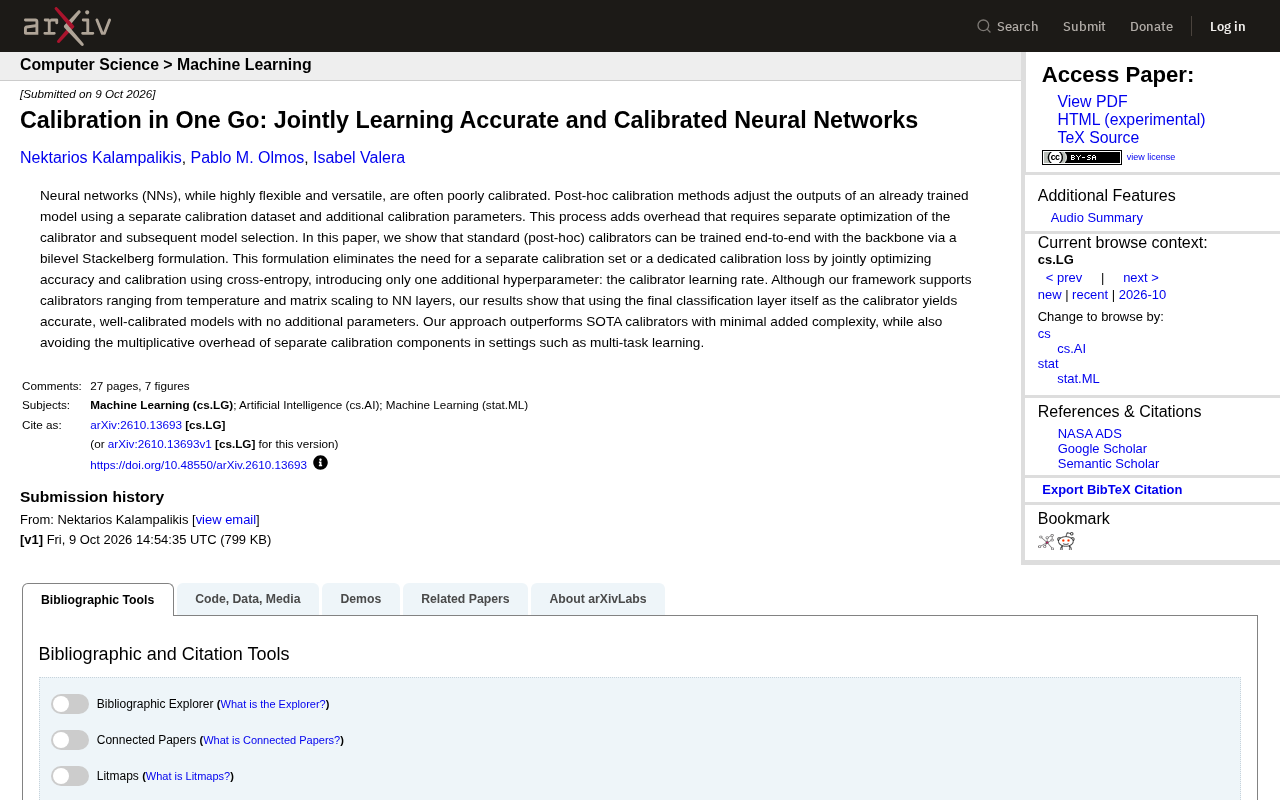
Neural networks are often overconfident — their output probabilities tend to overestimate actual prediction reliability, posing risks in high-stakes settings like healthcare and autonomous driving. Traditional post-hoc calibration (e.g., temperature scaling) addresses this after training using a separate dataset, but introduces extra data, optimization steps, and management overhead. This paper proposes jointly training a calibrator with the backbone network via a bilevel Stackelberg game, using only cross-entropy loss and a single additional hyperparameter (the calibrator's learning rate). Experiments find that using the model's final classification layer as the calibrator works best — requiring no extra parameters while outperforming current SOTA post-hoc methods, especially in multi-task learning scenarios.
Why Neural Networks Need Calibration
Neural networks have demonstrated remarkable flexibility across tasks like image recognition and natural language processing, but a long-overlooked problem persists: they tend to be "overconfident." The probability outputs they produce don't faithfully reflect how trustworthy their predictions actually are — when a classifier claims 99% confidence, the real accuracy might fall far short of that. This gap between predicted probabilities and true accuracy is known as the "calibration problem."
In high-stakes domains like medical diagnosis, autonomous driving, and financial risk management — where decision reliability is paramount — an uncalibrated model can pose serious risks even if its raw accuracy is high. As a result, making neural networks output "honest" probabilities has been an ongoing focus of research.
The Pain Points of Traditional Post-Hoc Calibration
The dominant calibration approach today is "post-hoc": train a model first, then use a separate calibration dataset to adjust the trained model's outputs by introducing additional calibration parameters. Temperature scaling and matrix scaling are classic examples of this paradigm.
While this seems straightforward, it comes with considerable overhead. It requires:
- Setting aside an independent calibration dataset, reducing samples available for training;
- Running a separate optimization process for the calibrator;
- Performing additional model selection after calibration is complete.
Things get even messier in complex settings like multi-task learning, where each task may need its own calibration component — multiplying the computational and management burden. In short, calibration becomes an awkward add-on that drags behind the main training pipeline.
Temperature scaling is one of the most widely used post-hoc calibration methods. It works by dividing the model's output logits (unnormalized scores) by a scalar temperature parameter $T$ before applying softmax. When $T > 1$, the probability distribution is "flattened," reducing overconfidence; when $T < 1$, the effect is reversed. Matrix scaling generalizes this by replacing the scalar with a full linear transformation matrix — more expressive, but with parameter count that grows quadratically with the number of classes. The most common metric for calibration quality is Expected Calibration Error (ECE): predictions are grouped into confidence bins, and ECE measures the weighted average difference between mean confidence and actual accuracy within each bin — lower ECE means the model's probabilities are more "honest." Reliability diagrams are the visual counterpart: a perfectly calibrated model traces a diagonal line. Understanding these baseline methods helps clarify the motivation for the improvements proposed in this paper.
Core Idea: Embedding Calibration into Training Itself
The approach proposed in this paper breaks away from the two-stage "train first, calibrate later" paradigm. The researchers show that standard post-hoc calibrators can be jointly trained end-to-end with the backbone network via a bilevel Stackelberg formulation.
The elegance of this framework lies in how it completely eliminates the need for a separate calibration dataset and a dedicated calibration loss. The entire optimization uses only cross-entropy loss while simultaneously targeting both accuracy and calibration quality — at the cost of introducing just one additional hyperparameter: the calibrator's learning rate.
Compared to traditional methods that typically demand independent data, independent losses, and independent optimization pipelines, this "one-go" design is considerably cleaner from an engineering standpoint.
Why Bilevel Optimization Works Here
Bilevel optimization decomposes the problem into two nested levels: the outer level (leader) handles backbone network learning, while the inner level (follower) handles calibrator adjustment — both converging collaboratively within the same training loop. This structure naturally constrains the reliability of output probabilities as the model learns feature representations, rather than patching things up after the fact.
The Stackelberg game originates from game theory and describes a sequential leader-follower competitive structure: the leader makes a decision first, and the follower then responds optimally after observing the leader's action. Bilevel optimization is its mathematical formulation, where the outer objective function nests an inner optimization problem, and the inner solution serves as a constraint or input to the outer level. This class of problems has seen wide application in meta-learning, neural architecture search (NAS), and hyperparameter optimization. The key challenge lies in gradient propagation through the inner problem: since the inner solution depends on outer variables, computing outer gradients requires the implicit function theorem or approximate unrolling, which is typically expensive. One of this paper's contributions is proving that, in the specific context of calibration, the calibrator's optimal response has a sufficiently tractable analytical structure — making joint training computationally feasible with just one additional hyperparameter.
The Simplest Solution Is Often the Most Effective
The framework is broadly applicable and supports calibrators ranging from temperature scaling and matrix scaling to full neural network layers. But the experimental results yield an interesting finding: simply using the network's final classification layer itself as the calibrator produces models that are both accurate and well-calibrated — without adding any extra parameters.
This means you don't even need to build a dedicated calibration component — the model's existing structure is sufficient. This "minimalist" design philosophy lowers the implementation barrier while avoiding parameter bloat.
Results and Impact
Experiments show that this method surpasses state-of-the-art (SOTA) calibrators in calibration performance while introducing negligible additional complexity. More importantly, in settings like multi-task learning, it sidesteps the multiplicative overhead that comes with independent calibration components in traditional approaches.
For real-world applications, the significance of this work is that it transforms "reliability" from an afterthought patch into an intrinsic part of the training objective. Developers no longer need to repeatedly trade off between accuracy and calibration, nor maintain a separate calibration pipeline, to obtain a model with trustworthy probability outputs.
For high-stakes applications that require models to express "honest confidence," this end-to-end, low-overhead, parameter-free calibration approach offers a more practical path to deployment.
Summary
This paper revisits the conventional paradigm of neural network calibration and embeds calibration directly into training via a bilevel Stackelberg game — jointly optimizing accuracy and calibration at the cost of a single hyperparameter. The finding that "using the final classification layer as the calibrator" is particularly noteworthy: it suggests that in many cases, solving the calibration problem doesn't require stacking complex components, but rather reorganizing the optimization process.
Related articles

macOS Is No Longer UNIX: Apple Didn't Renew Certification, But the Technology Is Unchanged
Apple did not renew macOS's UNIX certification, and the Open Group has removed Apple's entry. This article analyzes the technical reality behind the expiration, Apple's possible intentions, and the practical impact on developers.

Building Stateful Multi-Agent Systems with Azure Cosmos DB
Based on the official Azure Cosmos DB tutorial, this article explains how to use the Agent Memory Toolkit to add shared persistent memory to a multi-agent travel planner, covering short-term, long-term, episodic, and semantic memory plus cross-session state continuity.

Production AI Agent Operations: A Three-Step Framework for Observing, Evaluating, and Optimizing
Azure Cosmos DB team proposes a three-step framework for production AI Agent operations: observe trace tracking, evaluate with LLM as a judge and regression testing, optimize cost across RU, retrieval, memory, and LLM layers.