New AI Governance Initiative: Mandatory Independent Audits and Pre-Deployment Safety Proof
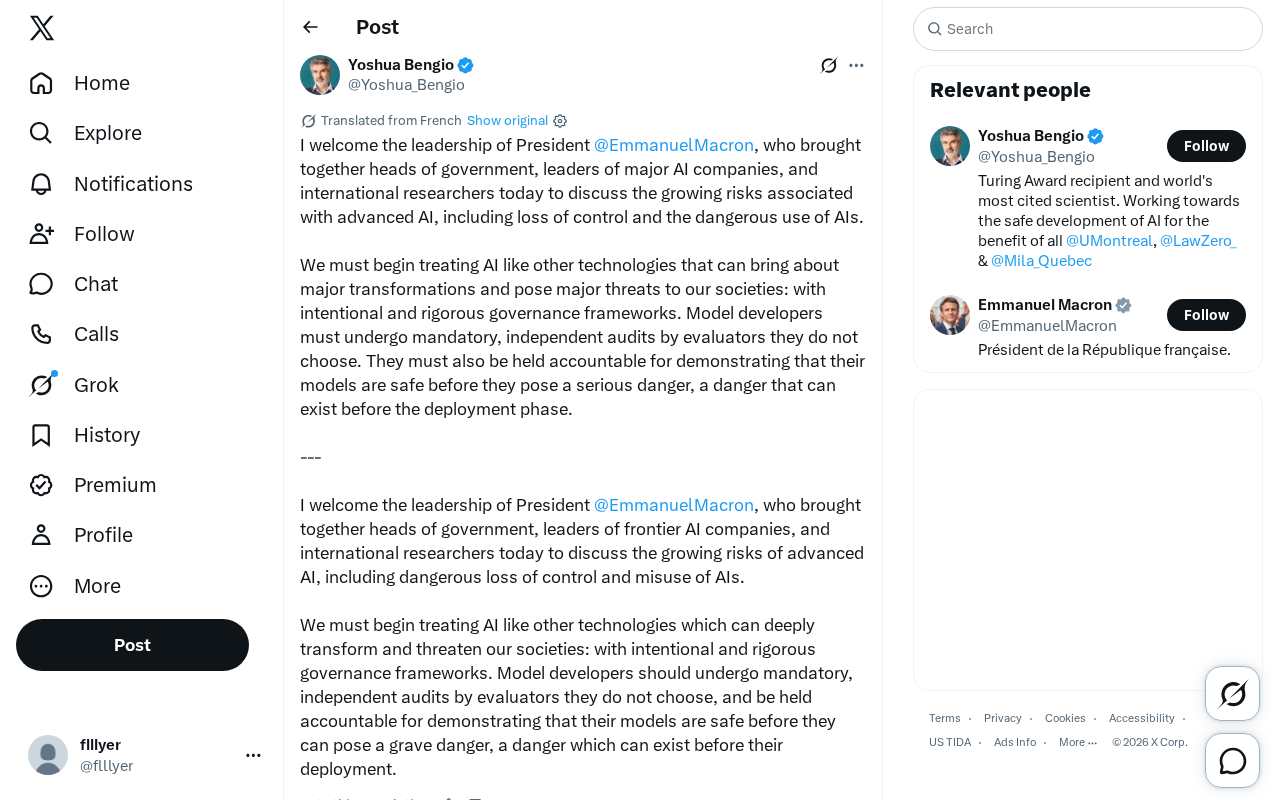
Macron convenes multi-stakeholder talks on AI risk, pushing for institutionalized mandatory independent audits and pre-deployment safety proof.
The article discusses the meeting convened by Macron bringing together government leaders, AI company executives, and researchers, noting that AI governance is shifting from ethical principles and voluntary commitments to enforceable institutional design. Core propositions: developers must undergo mandatory, independent audits with evaluators not self-selected; and must prove safety before models cause serious danger that may already exist pre-deployment. This challenges the 'deploy first, patch later' convention and moves the safety threshold earlier. Perceptions of risk among government, industry, and researchers are converging toward institutionalization; if implemented, compliance costs will rise and accountability will become clearer, making safety a prerequisite for market access. It also notes unresolved challenges: independent evaluation capacity, standard unification, cross-border coordination, and defining 'serious danger' thresholds.
An Urgent Discussion on AI Risk
Recently, French President Macron convened heads of government, leaders of frontier AI companies, and international researchers to jointly discuss the growing risks posed by advanced AI, including loss-of-control risks and dangerous misuse of AI. This meeting triggered widespread responses from the industry, with one statement from a social platform particularly noteworthy—the speaker praised Macron's leadership and called for treating AI as a technology that could profoundly transform society and constitute a major threat, requiring an intentional and rigorous governance framework.
This statement is not an empty appeal. It explicitly puts forward two core propositions: model developers should undergo mandatory audits conducted by independent evaluators, and the evaluators cannot be chosen by the developers themselves; at the same time, developers have a responsibility to prove safety before the model could cause serious danger—and such danger may already exist before deployment.
From Principles to Mechanisms: Hard Constraints in AI Governance
For a long time, AI governance discussions have mostly remained at the level of ethical principles and voluntary commitments. What makes this voice stand out is that it points to enforceable institutional design.
Mandatory Independent Audits
The statement emphasizes "audits de manière obligatoire et indépendante par des évaluateurs qu'ils ne choisissent pas"—that is, mandatory, independent audits, with evaluators not selected by developers. This directly targets a structural flaw in current AI safety evaluation: when companies choose their own evaluation institutions, the independence and rigor of the evaluation are difficult to guarantee. Introducing a third-party audit mechanism that cannot be self-selected means safety evaluation will shift from "self-declaration" to "external verification."
In the context of AI governance, third-party independent audits usually refer to evaluations of a model's capabilities, limitations, and potential harms by external institutions with no conflict of interest with the model developer, based on public or consensus standards. The key difference from developers' internal "red team testing" is that the objective function of internal testing often leans toward product release, while the authority for independent audits comes from regulators or public interest representatives. There are already several prototype practices internationally, such as the UK AI Safety Institute and the US AI Safety Institute Consortium, which attempt to establish government-side pre-deployment testing channels for frontier models. But the requirement that "evaluators are not chosen by developers" goes further—it seeks to eliminate the systemic bias brought by "shopping for evaluation institutions," similar to the logic of mandatory rotation of accounting firms in financial audits. The implementation difficulty lies in the fact that only a handful of institutions worldwide have the capacity to evaluate frontier models, and most have talent flows and business dealings with leading companies. How to ensure substantive rather than formal independence is a question institutional design must answer.
Pre-Deployment Safety Proof
Another key proposition is that developers must prove safety before the model causes serious danger, and such danger "may already exist before deployment." This effectively challenges the industry convention of "deploy first, patch later." It requires moving the threshold for safety proof earlier, completing risk verification before the model enters real application scenarios, rather than remedying after problems are exposed.
"Pre-deployment safety proof" is conceptually close to a combination of ex-ante regulation and reversal of the burden of proof. Traditional software governance mostly relies on ex-post accountability: products are recalled or penalized after problems arise following launch. But for frontier AI models whose capabilities may rapidly jump, the window for ex-post remediation may not exist—once a model is widely integrated or its weights leak, the harm may be irreversible. Therefore, this proposition requires developers to proactively submit safety evidence before launch, rather than regulators searching for violations afterward. This is consistent with the direction of the EU AI Act's systemic risk assessment obligations for "general-purpose AI models," but the latter currently still relies mainly on documentation filing and self-regulatory declarations, and does not yet generally require independent verification. The real challenge lies in operationalizing "proof": the AI safety field still lacks a widely accepted statistical testing paradigm like pharmaceutical clinical trials. The emergent behavior of models and out-of-distribution generalization make "safety" difficult to prove exhaustively, so in practice it is more likely to evolve into "proving that sufficient risk management measures have been taken" rather than "proving absolute safety."
Multi-Stakeholder Consensus Is Forming
Interestingly, this statement is not an isolated voice. The meeting convened by Macron itself brought together government, industry, and the research community, indicating that AI safety has risen from academic discussion to a high-level political agenda. According to the social platform statement, the meeting discussed specific risk categories such as "loss of control" and "dangerous use" of advanced AI, rather than speaking in general terms.
Cross-referencing multiple sources, perceptions of AI risk among different actors are converging: governments worry about regulatory lag, companies face trust pressure, and researchers continue to warn about the unpredictability brought by capability leaps. The fact that all three parties are dialoguing within the same framework is itself a signal that governance mechanisms are becoming institutionalized.
The "loss of control" and "dangerous use" mentioned in the text correspond to two widely distinguished risk categories in AI safety research. Loss of control risk refers to situations where a model surpasses effective human oversight in capability, and its goals or behavior deviate from the designer's intent. This falls under the category of existential/systemic risk, with typical discussions including deceptive alignment, power-seeking, and autonomous replication. Misuse refers to humans intentionally using model capabilities to cause harm, such as assisting with bioweapon design, large-scale cyberattacks, and social engineering fraud. The governance tools for the two are not the same: loss of control risk relies more on capability evaluation, interpretability, and pre-deployment red-line testing; misuse risk relies more on access control, usage monitoring, and accountability tracing. Discussing the two side by side reflects that current policy discussions have moved from vague "AI risk" to risk classifications that can be mapped to specific evaluation dimensions. This is also the premise for mandatory audits to be implemented—audits need clear testing objectives.
Practical Impact on Developers
If mandatory independent audits and pre-deployment safety proof become institutionalized, developers' compliance costs will rise significantly. But the more profound impact lies in clarifying accountability: developers can no longer avoid the obligation to provide safety evidence on grounds of "technology neutrality" or "user responsibility."
This logic is consistent with the governance traditions of other high-risk technology fields—drugs require independent approval before market launch, and aircraft require airworthiness certification before entering service. Bringing AI into a similar framework means acknowledging that its social impact has reached a level requiring ex-ante safety verification.
Challenges and Unresolved Questions
Of course, there is still a distance from proposal to implementation. Capacity building for independent evaluation institutions, unification of evaluation standards, and coordination of cross-border regulation are all practical difficulties. In addition, how to define the threshold for "serious danger" and how to balance safety proof with the pace of innovation still require more specific institutional design.
But the direction is clear: AI governance is moving from the stage of declaring principles to the stage of mechanism building centered on mandatory audits and ex-ante safety proof. The meeting convened by Macron, and the public statements formed around it, provide high-level momentum for this shift. For AI developers, safety is no longer just a bonus—it is becoming a prerequisite for market access.
One-line Summary
Macron convened multiple parties to discuss AI risk, promoting the institutionalization of mandatory independent audits and pre-deployment safety proof.
Paragraph Summary
The article centers on the meeting convened by Macron bringing together heads of government, AI company leaders, and researchers, pointing out that AI governance is shifting from ethical principles and voluntary commitments to enforceable institutional design. There are two core propositions: model developers must undergo mandatory, independent audits with evaluators not self-selected; developers must prove safety before the model causes serious danger, and such danger may already exist before deployment. This challenges the industry convention of "deploy first, patch later" and moves the safety threshold earlier. The article argues that perceptions of risk among government, industry, and the research community are converging, and governance is becoming institutionalized; if the propositions are implemented, developers' compliance costs will rise, accountability will become clearer, and safety will shift from a bonus to a prerequisite for market access. It also points out that independent evaluation capacity, standard unification, cross-border coordination, and defining the threshold for "serious danger" remain unresolved challenges.
Related articles

Gemini 4 Hydrogen vs Sonnet Comparison Test: Uses Only 1% of Weekly Quota, Performance on Par
Hands-on test: Gemini 4 Hydrogen vs Sonnet on the same CRUD task—Hydrogen used only 1% weekly quota with comparable performance and better UI details, while Anthropic's model used 7%. Developer says daily tasks don't require expensive models.

Gemini 4 Neon Released: Beats Opus 5.5 on Multiple Benchmarks, Google Returns to the Top Tier
Google DeepMind releases Gemini 4 Neon: 61 on the Artificial Analysis intelligence index (3rd) and 1st on the coding index, beating Opus 5.5 on multiple benchmarks. $3/$15 per million tokens; available in the Gemini API and AI Studio.

Gemini 4 Neon Review: Benchmark Scores Rival Carbon, API Cost-Performance Analysis
Full review of Google Gemini 4 Neon: benchmark scores rival Carbon, API priced at 2x Hydrogen, yet Antigravity quota consumption is only 1x (vs Carbon's 3x). Real tests show it replaces 90% of Carbon use cases. Includes channel restrictions, ban risks, and combination strategy analysis.