New AI Job Trends: How Non-Engineers Can Break Into AI Careers
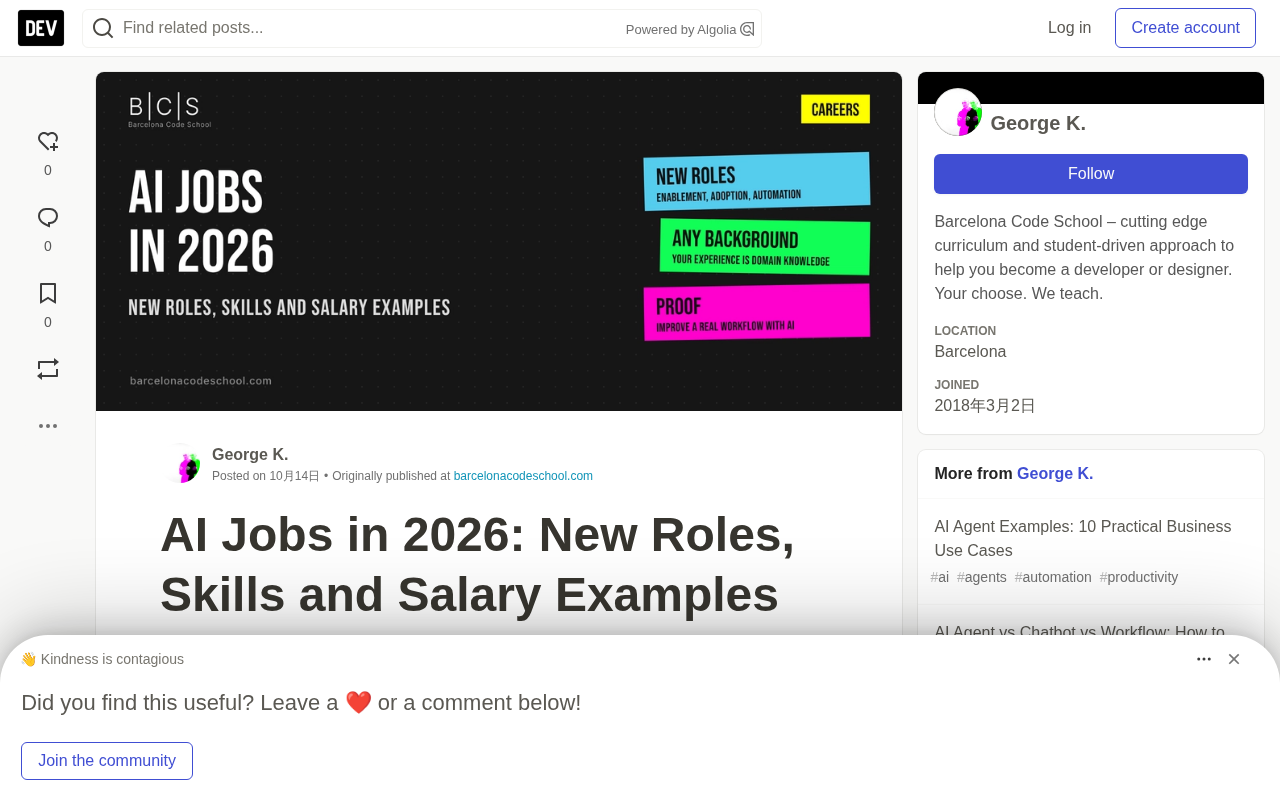
AI hiring is expanding from purely technical roles to enablement, transformation, and automation—transitions rely on project evidence, not courses.
Based on LinkedIn, WEF, and PwC reports, AI hiring is moving beyond the single narrative of only recruiting ML engineers. Companies are increasingly hiring AI enablement leads, AI transformation leads, and AI automation engineers across technology, strategy, operations, learning, and product. WEF ranks AI and Big Data as the fastest-growing skill through 2030, and PwC reports a 62% average wage premium for AI-skilled roles—though this is a statistical association, not a guarantee of individual raises. Real cases from Siemens Energy and waterdrop show employers value cross-functional hands-on delivery over titles. For career changers, the article proposes a "lateral step" path: combining existing domain knowledge with practical AI building skills, and establishing credible evidence through mapping real business processes, building runnable workflows, testing failure scenarios, deploying, and measuring.
AI hiring is moving beyond the single narrative of "only hiring machine learning engineers." Companies are increasingly recruiting for roles that redesign workflows, drive organizational AI adoption, train teams, and build AI-native operating systems. According to data compiled by Barcelona Code School, multiple reports from LinkedIn, the World Economic Forum, and PwC cross-validate this trend.
Market Signals: The Boundaries of AI Roles Are Still Forming
LinkedIn's "Jobs on the Rise 2026" analysis shows that both technical and strategic AI roles hold prominent positions among the fastest-growing occupations in Europe. In Spain's rankings, AI Engineer takes the top spot, with Director or Head of AI ranking second.
A broader demand signal comes from the World Economic Forum. The organization surveyed over 1,000 employers representing more than 14 million workers and ranked "AI and Big Data" as the fastest-growing skill through 2030. PwC's 2026 AI Jobs Barometer, based on large-scale job posting data, reports two key findings: roles "specialized" by AI are growing at twice the rate of roles "democratized" by AI; and jobs requiring AI skills carried an average wage premium of 62% in 2025.
It's worth noting that the wage premium is a statistical association within comparable roles—it doesn't mean an individual can get a raise just by taking a course.
Wage premium is a common indicator in labor economics, referring to the percentage difference in pay between workers who possess a particular skill and those who don't, after controlling for variables like industry, geography, and seniority. The "62% premium" in PwC's report comes from statistical analysis of a large volume of job postings and reflects the market's overall pricing tendency toward AI skills—not causation. In other words, this figure shows employers are willing to pay more for AI skills, but it doesn't guarantee that any individual will receive a comparable raise through training—individual pay still depends on job fit, depth of experience, and negotiation outcomes.
Roles "specialized" by AI vs. "democratized" by AI is a distinction framework proposed by PwC. Specialized roles are positions where AI serves as a core skill threshold requiring dedicated training (such as AI engineers and automation architects); democratized roles are positions where AI is widely embedded as a general-purpose tool (such as marketing, customer service, and administration). PwC found that the former is growing at twice the rate of the latter, meaning companies currently favor creating dedicated AI roles over simply distributing AI tools to existing employees.
The Emerging AI Job Landscape
The most obvious change is that AI work is expanding beyond model research. Searching for "AI automation jobs" leads to positions across technology, strategy, operations, learning, product, and the founder's office. Since job titles are still unstable, job descriptions reveal more than titles themselves.
The role categories currently appearing on the market include:
- AI/ML Engineer: Responsible for models, data pipelines, evaluation, deployment, and production reliability; requires deep technical expertise
- AI Automation Engineer: Connects business workflows, agents, APIs, data, and monitoring; medium-to-high technical depth
- AI Enablement/Adoption Lead: Responsible for use case discovery, training, internal champions, workflow deployment, and adoption metrics; medium technical depth
- AI Transformation Lead: Leads operating models, enterprise-level workflows, executive alignment, and ROI measurement
- AI-native business generalist: Builds GTM, finance, and operations systems with AI
AI-native operating system doesn't refer to a technical operating system, but rather an organizational operations metaphor: treating AI agents, automated workflows, and structured data as the foundational layer of daily business operations—not as add-on tools. In this model, repetitive decisions, information routing, data entry, and preliminary analysis are handled by AI, while humans focus on exception handling, strategic judgment, and relationship maintenance. Roles that build such systems typically require understanding both business processes and the boundaries of AI capabilities, so they're often filled by people with operations or consulting backgrounds who also know automation tools.
GTM is short for Go-To-Market, referring to a company's overall strategy for bringing a product or service to market and reaching customers, covering pricing, channels, sales processes, marketing messaging, and customer success. AI GTM roles use AI tools to restructure these areas—for example, using agents to auto-generate personalized outreach, data pipelines to sync customer signals in real time, and automated workflows to shorten sales cycles. These roles require both business acumen and hands-on ability with AI tools.
What Real Job Listings Reveal
Looking at actual open positions, these roles have far broader background requirements than one might imagine.
Siemens Energy's AI Enablement Lead position in Budapest requires managing a community of 500+ people, executive AI upskilling, learning path design, and responsible AI briefings. The posting explicitly lists backgrounds in L&D, internal communications, change management, or digital enablement.
waterdrop's similar role in Vienna requires evaluating AI tools, prioritizing initiatives, training teams, and building workflows using Make, Airtable, and internal APIs. The core requirement is cross-functional hands-on delivery capability, not just familiarity with tools.
A UK retail tech company's AI Enablement Lead position (6-month contract) offers an annual salary range of £95,000–£98,500. The company already has AI policies, a steering committee, and actual deployments in place—the purpose of the hire is to turn the foundation into genuine adoption.
cloro's Founder's Associate role (EU remote) requires building AI agents, reading P&Ls, and using SQL and APIs, with a salary of $50,000–$80,000 base plus performance bonus.
These cases collectively point to one conclusion: companies have already allocated real budgets for this work, but salaries vary enormously by role, geography, seniority, and employment type.
The Recurring Skill Checklist
Across multiple job postings, the capabilities employers actually care about cluster around the following areas:
Workflow analysis—Finding costly manual processes and defining the real bottlenecks. Portfolio evidence includes current-state diagrams, exception cases, owners, and baseline metrics.
AI and agent fluency—Using models with clear context, tools, boundaries, and failure handling. Need to demonstrate working agents with logs and evaluation cases.
Automation and APIs—Connecting business systems rather than manually copying outputs. n8n or code-based workflows are common requirements.
Data and business judgment—Ability to read metrics, P&Ls, or operational data and make prioritization decisions.
Change and enablement—Role-based training, supporting champions, ensuring sustained usage. Need to demonstrate deployment plans and adoption metrics.
Reliability and governance—Permissions, approvals, privacy, monitoring, and safety stop mechanisms.
n8n is an open-source workflow automation platform that connects different applications, APIs, and AI models through visual nodes—ideal for building multi-step business processes without writing code from scratch. Compared to Zapier, n8n emphasizes self-hosting, complex logic branching, and the flexibility of code nodes, making it widely adopted in enterprise scenarios that require conditional logic, data transformation, and error retries. Job postings often list n8n alongside Make and Airtable as a signal of whether candidates can translate business logic into runnable workflows.
Prompt injection is a class of security risk facing AI systems: when AI agents process external inputs, malicious content may enter through input channels, attempting to override or bypass the system's original instructions and induce the agent to perform unintended actions. For example, an apparently normal email might contain hidden instructions telling the agent to forward sensitive data or invoke unauthorized tools. The "safety stop mechanisms" and "human approvals" emphasized in the reliability and governance checklist are precisely designed to mitigate such risks at the architectural level—keeping external messages, financial operations, and major decisions under human control, and setting clear boundaries on agents' tool-calling permissions.
You Don't Need to Start From Scratch: How Your Experience Transfers
For those considering a transition, the key question isn't "Can I start over?" but "Which parts of my experience can combine with practical AI skills?"
People with operations, administrative, or project management backgrounds already understand handoffs, delays, exceptions, and KPIs—they can move toward AI automation specialist or AI adoption manager roles by learning process mapping, n8n, APIs, and structured data.
People with teaching, L&D, HR, or internal communications backgrounds understand how people learn and why behavior doesn't change—they can move toward AI enablement lead roles by adding working prototypes, role-based AI use cases, and adoption metrics.
People with marketing, sales, or customer success backgrounds understand customers, messaging, and business outcomes—they can pivot toward AI GTM, AI product marketing, or revenue automation.
People with consulting, product, or business analysis backgrounds excel at diagnosing problems and turning ambiguity into plans—they can target AI transformation consultant or AI product manager roles.
People with finance, accounting, or legal operations backgrounds bring structured thinking, risk awareness, and control experience—suited for AI operations, governance, or domain automation roles.
People with software, data, or no-code automation backgrounds already understand systems and APIs—they can move toward AI automation engineer or AI agent engineer roles by adding model behavior, tool use, retrieval, evaluation, and monitoring capabilities.
The Path From Interest to Credible AI Work
Regardless of your background, the way to build credibility is the same: don't stay at the "learning" stage—build verifiable evidence.
Specifically: map a real business process, identifying triggers, inputs, decisions, systems, exceptions, owners, and baselines; learn structured data and APIs, understanding JSON, authentication, webhooks, and data exchange between systems; build deterministic automation first, connecting triggers to data checks and outputs; add AI where judgment is needed, for classification, extraction, research, or tool selection; define permissions and human approvals, keeping external messages, financial operations, and major decisions under human control; test both normal and failure scenarios, including missing data, conflicts, tool downtime, prompt injection, and duplicate events; deploy and measure, tracking completion rates, escalation rates, time saved, and error rates; package evidence into portfolio cases showing the business problem, architecture, live workflows, test matrix, limitations, and results.
One credible project can support your transition to an AI-enhanced version of your current role. Multiple deployed projects plus a stronger technical foundation are needed to support a jump to a dedicated AI automation or transformation role. Senior titles like AI Transformation Lead or Head of AI Enablement typically also require prior leadership, product, consulting, or engineering experience.
Reality Check
These signals indicate that a skills shift is happening and new roles are emerging—but they don't prove that competition is low in every region, nor do they guarantee employment outcomes. Job rankings show direction, not the number of openings available to each candidate.
Companies are indeed paying real salaries for AI enablement and transformation work, but a UK contract, an EU remote startup position, and a San Francisco on-site role come with different taxes, benefits, cost of living, and work authorization rules. Each salary figure can only serve as a reference sample for its own market.
One-line Summary
AI hiring is expanding from purely technical roles to new positions in enablement, transformation, and automation—career transitions rely on project evidence, not courses.
Paragraph Summary
Based on multiple reports from LinkedIn, the World Economic Forum, and PwC, the article notes that AI hiring is moving beyond the single narrative of only recruiting machine learning engineers. Companies are increasingly recruiting for new roles such as AI enablement leads, AI transformation leads, and AI automation engineers, spanning technology, strategy, operations, learning, and product. The World Economic Forum ranks AI and Big Data as the fastest-growing skill through 2030, and PwC reports that jobs requiring AI skills carry an average 62% wage premium—though it emphasizes this is a statistical association, not a guarantee of individual raises. Through real hiring cases from Siemens Energy, waterdrop, and others, the article shows that employers value cross-functional hands-on delivery over titles. For career changers, the article proposes a "lateral step" path: combining existing domain knowledge in operations, education, marketing, or consulting with practical AI building skills, and establishing credible evidence by mapping real business processes, building runnable workflows, testing failure scenarios, deploying, and measuring.
Related articles

Meta vs. Publishers: The AI Data Battle Over Terms of Service Changes and the Future of the Internet
Meta changed its business account terms to allow AI training on linked website data, sparking backlash from publishers and creators. Industry groups demanded negotiations, forcing Meta to remove 'training' wording and delay the effective date. The dispute reveals the deeper battle over data authorization and the future of the internet in the AI era.

When Outside Xbox Meets Blood on the Clocktower: A Legion Match in Minecraft
Outside Xbox guests Ellen and Mike play Minecraft Blood on the Clocktower in a Legion game. How can three good players fight an evil majority amid information noise? This article breaks down Legion mechanics, information-role mind games, and the endgame reversal.

Kimi K3.1 Hands-On Test: Open-Source Model Nears Opus, Video Generation Steals the Show
Kimi K3.1 completed motion graphics, 3D rendering, mini-games, and video generation in a live test. Analysis of its 2.8T MoE architecture, gap vs Opus/GPT, and hidden video generation.