New Breakthrough in Black-Box Uncertainty Quantification: Dual-Level Ensemble Disentangles LLM Ambiguity from Knowledge Gaps
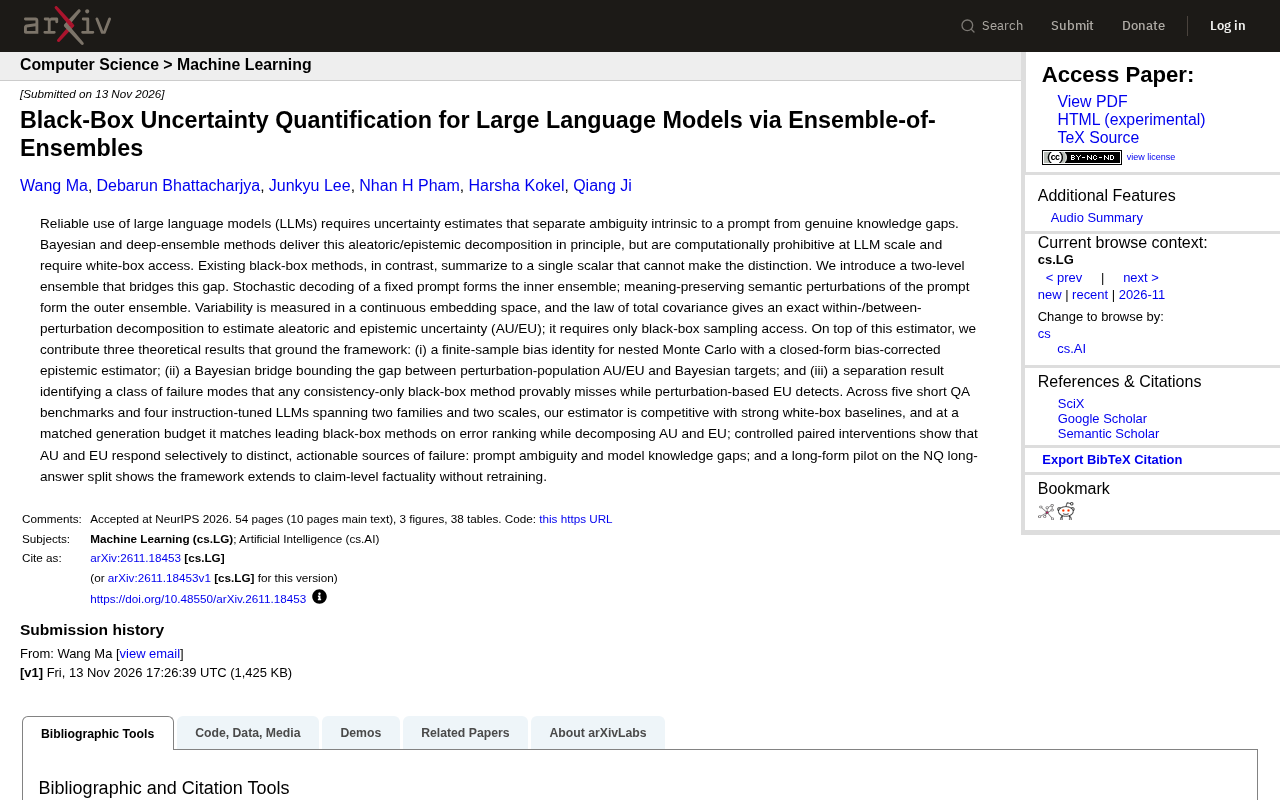
Dual-level ensemble framework decomposes LLM aleatoric and epistemic uncertainty using only black-box sampling.
The article presents a black-box uncertainty quantification framework for LLMs using an ensemble-of-ensembles: inner stochastic decoding and outer semantic prompt perturbations. The law of total covariance decomposes variability in embedding space into aleatoric and epistemic uncertainty. It offers bias correction, Bayesian bridging, and separation theory, and validates competitiveness with white-box baselines and selective AU/EU responses to prompt ambiguity and knowledge gaps.
Reliable deployment of large language models (LLMs) hinges on accurate uncertainty estimation. However, existing methods either rely on costly Bayesian inference and deep ensembles or require white-box access to model internals—both difficult to achieve at LLM scale. A recent paper proposes a dual-level ensemble framework that decomposes uncertainty into aleatoric and epistemic components using only black-box sampling, offering a new approach to LLM uncertainty quantification.
Why Distinguish Two Types of Uncertainty?
Uncertainty quantification (UQ) is critical for LLM applications, especially in high-stakes scenarios. Ideally, we want to know not only how "uncertain" the model is, but also where that uncertainty comes from: is the prompt itself ambiguous (aleatoric uncertainty, AU), or does the model lack relevant knowledge (epistemic uncertainty, EU)? This distinction has practical implications—the former can be resolved by clarifying the question, while the latter requires additional knowledge or retrieval augmentation.
Bayesian methods and deep ensembles can in principle achieve this decomposition, but they are computationally expensive and require access to model weights or gradients (white-box). Black-box methods are more broadly applicable but typically output only a scalar uncertainty score, unable to distinguish AU from EU. This tension motivates the paper's core question: can meaningful uncertainty decomposition be achieved using only black-box sampling?
Aleatoric Uncertainty (AU) arises from randomness or observational noise inherent in the data generation process; even with infinite knowledge and perfect parameters, this uncertainty cannot be eliminated. In LLM settings, AU manifests primarily as semantic ambiguity, unclear reference, or multiple interpretations in the prompt itself—for example, "apple" can refer to either a fruit or a company, and output fluctuations here reflect the task's inherent ambiguity.
Epistemic Uncertainty (EU) stems from the model's limited knowledge and parameters, and can theoretically be reduced by adding data, knowledge, or model capacity. In LLMs, EU corresponds to the model "not knowing" or being "undertrained" on a fact or concept. The distinction matters because the response strategies differ sharply: AU is mitigated by clarifying prompts, adding context, or constraining the output space, whereas EU requires retrieval augmentation, knowledge injection, or retraining. Confusing the two leads to misguided interventions—for example, mistaking a knowledge gap for prompt ambiguity and repeatedly rewriting the prompt to no avail.
Dual-Level Ensemble: From Stochastic Decoding to Semantic Perturbation
The proposed solution is an "ensemble-of-ensembles" architecture. The inner ensemble generates multiple outputs via stochastic decoding of the same prompt, capturing the model's randomness during generation. The outer ensemble applies meaning-preserving semantic perturbations to the original prompt—such as synonym substitution or syntactic restructuring—to produce multiple semantically equivalent prompt variants.
The key innovation is that variability is measured in continuous embedding space rather than simple surface-level text differences. Using the law of total covariance, the framework precisely decomposes total variability into within-perturbation and between-perturbation components, corresponding to aleatoric and epistemic uncertainty respectively. This decomposition requires only black-box sampling access, with no dependence on model internal states.
The paper also provides three theoretical results to support the framework's validity: first, a finite-sample bias identity for nested Monte Carlo, yielding a bias-corrected epistemic uncertainty estimator; second, a Bayesian bridge that characterizes the gap between the perturbation population AU/EU and the Bayesian target; third, a separation result proving a class of failure modes that consistency-only black-box methods necessarily miss but perturbation-based methods can detect.
Law of Total Covariance is the multidimensional generalization of variance decomposition in probability theory: for random vectors X and Y, Cov(X) = E[Cov(X|Y)] + Cov(E[X|Y]). The first term is the expectation of the conditional covariance of X given Y, corresponding to "within-group" variation; the second term is the covariance of the conditional expectation itself, corresponding to "between-group" variation. In this framework, inner stochastic decoding corresponds to the conditional distribution and outer semantic perturbation corresponds to the grouping variable, so total embedding variability can be precisely split into a within-perturbation component (capturing generation randomness, i.e., AU) and a between-perturbation component (capturing systematic shifts caused by prompt semantic changes, i.e., EU). This identity is the mathematical cornerstone that makes the decomposition valid without requiring model internal access.
Nested Monte Carlo is a two-level sampling estimation method: the outer level samples the grouping variable (here, semantically perturbed prompts) and the inner level samples the conditional distribution (here, stochastic decoding outputs), thereby estimating nested expectations or covariances. Directly using sample covariance decomposition incurs bias due to finite inner and outer sample sizes; the paper's finite-sample bias identity characterizes how bias varies with inner and outer sample counts and constructs a bias-corrected estimator accordingly. This allows AU/EU estimation to remain statistically consistent under a fixed generation budget, rather than relying solely on large-sample asymptotic properties.
Experimental Validation: Competitiveness and Actionability
Across five short-form QA benchmarks and four instruction-tuned LLMs (covering two families and two scales), the estimator is competitive with strong white-box baselines. Under matched generation budgets, it matches leading black-box methods in error ranking while also decomposing AU and EU.
More specifically, through controlled paired interventions, the authors show that AU and EU respond selectively to different failure sources: prompt ambiguity primarily affects AU, while model knowledge gaps primarily affect EU. This actionability means developers can take targeted measures based on uncertainty type—clarifying prompts or retrieving knowledge. Additionally, preliminary experiments on the NQ long-answer split show that the framework can extend to claim-level factuality evaluation without retraining.
Paired Interventions is a causal validation design: two types of controlled variants are constructed for the same underlying question—one introducing prompt ambiguity (e.g., adding multi-interpretation expressions), the other introducing knowledge gaps (e.g., asking about facts rare in the model's training data)—then observing whether the AU and EU estimators respond selectively as expected. If AU rises mainly with ambiguity interventions and EU mainly with knowledge-gap interventions, this demonstrates that the decomposition is actionable and discriminative, not merely numerically separated. This design provides stronger evidence of semantic validity than simply comparing correlations with white-box baselines.
Significance and Limitations
This work provides a practical black-box approach to LLM uncertainty quantification, balancing theoretical rigor with computational feasibility. Its core contribution lies in combining ensemble ideas with semantic perturbation and achieving AU/EU separation through embedding-space decomposition. However, the paper also notes that the method depends on the quality of semantic perturbation generation and requires sufficient perturbation diversity in the outer ensemble to ensure estimation stability. Future work may explore more efficient perturbation strategies and cross-task generalization.
For practical applications, this framework promises to help developers more precisely diagnose model failure causes, thereby building more reliable LLM systems.
One-line Summary
A dual-level ensemble framework decomposes LLM aleatoric and epistemic uncertainty using only black-box sampling.
Paragraph Summary
The article introduces a black-box uncertainty quantification framework for large language models, addressing the challenge that existing methods are either computationally expensive or require white-box access. The framework adopts an "ensemble-of-ensembles" structure: an inner ensemble captures generation randomness via stochastic decoding, while an outer ensemble introduces systematic variation through meaning-preserving prompt perturbations, and the law of total covariance is used to decompose total variability in embedding space into aleatoric uncertainty (AU) and epistemic uncertainty (EU). The paper presents three theoretical results—bias correction, Bayesian bridging, and separation—and validates on multiple QA benchmarks and instruction-tuned models that it is competitive with white-box baselines, and that AU/EU respond selectively to prompt ambiguity and knowledge gaps, providing a basis for targeted developer interventions.
Related articles

Daybreak Red Deployment Guide: A Reference Architecture for Supervised Security Investigation
A breakdown of the Daybreak Red reference architecture: security control design, deployment configuration process, and runtime monitoring for supervised security investigation.

Gemini 4 Neon Tops the Models Engineering Index
Gemini 4 Neon tops the Models Engineering Index, sparking Hacker News debate over ranking credibility and evaluation methods. Here's what it means for developers.

Apple's Self-Developed AI Agent: An Agent That Can Operate Your Mac Is Coming
Apple is reportedly developing an AI agent that can operate a Mac, targeting Meta Muse, Claude, OpenAI Dots, and others. This article analyzes Apple's system-level advantages, the competitive landscape, and likely rollout paths in the agent race.