New Breakthrough in Hierarchical World Models: Implicit Dynamics Decoupling for Long-Horizon Planning

ID-WM decouples state reachability from local control, significantly improving long-horizon planning performance.
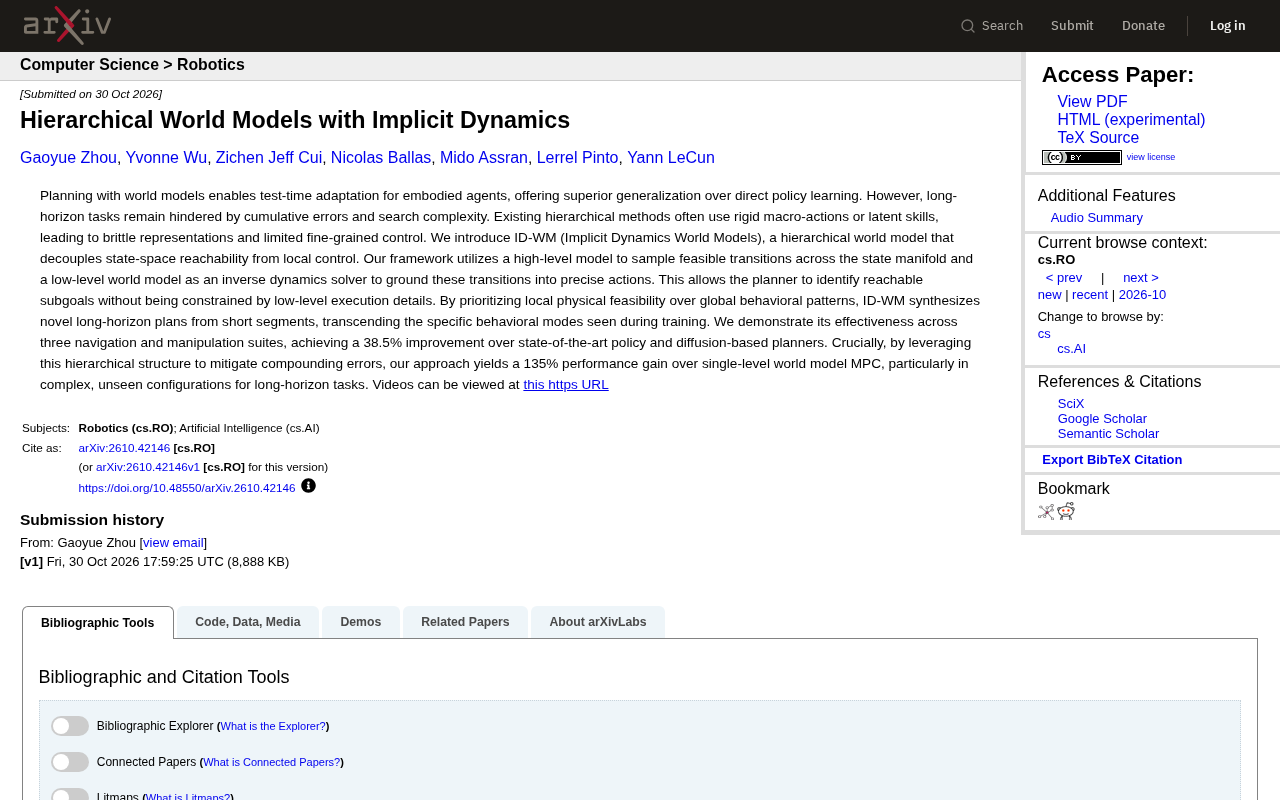
ID-WM (Implicit Dynamics World Model) addresses cumulative errors and search complexity in long-horizon planning with a hierarchical decoupling scheme: the high-level model samples feasible state transitions on the state manifold, while the low-level model acts as an inverse dynamics solver to ground subgoals into precise actions. Without relying on rigid macro-actions or explicit skill discovery, it prioritizes local physical feasibility, synthesizing long-horizon plans unseen in training from short segments. It achieves 38.5% improvement over advanced policy and diffusion planners across three suites, and 135% gain over single-layer world model MPC in complex unseen tasks, validating hierarchical error suppression.
The Dilemma of Long-Horizon Planning and the Opportunity for Hierarchical World Models
In the field of embodied intelligence, world models enable agents to adapt through planning at test time, offering better generalization than direct policy learning. However, long-horizon tasks remain plagued by cumulative errors and search complexity: small deviations at each step get amplified over many steps, ultimately causing planning failure. Existing hierarchical methods often rely on rigid macro-actions or latent skills, which reduce the search space but sacrifice fine-grained control, making representations fragile.
According to the research, the core innovation of ID-WM (Implicit Dynamics World Model) lies in decoupling state-space reachability from local control. The high-level model is responsible for sampling feasible state transitions on the state manifold, while the low-level model acts as an inverse dynamics solver, grounding these transitions into precise actions. This design frees the planner from low-level execution details, allowing it to directly identify reachable subgoals.
World models are a class of models in reinforcement learning and embodied intelligence that learn environment dynamics (state transitions and observation generation), enabling agents to predict the future and evaluate actions "in imagination" without repeated trial and error in the real environment. Based on their use, they can be divided into predictive (forward dynamics) and inverse dynamics models; the latter reverse-engineer actions from current and goal states. In test-time planning settings, agents use world models to search for action sequences online, which typically yields better generalization than direct policy learning. However, model predictions contain errors, and errors gradually accumulate in long-horizon planning—a core bottleneck limiting their application.
Decoupling State Reachability from Local Control
Traditional hierarchical reinforcement learning often predefines skills as macro-action sequences, but this approach tends to fail in scenarios outside the training distribution. ID-WM's solution prioritizes local physical feasibility over global behavioral patterns. Specifically, the high-level model learns which transitions in the state space are feasible, while the low-level model reverse-engineers specific actions from the current state and goal state. This "inverse dynamics" perspective enables the model to synthesize entirely new long-horizon plans from short segments, surpassing specific behavioral patterns seen during training.
The research team validated the method on three navigation and manipulation suites. Compared to state-of-the-art policy planning and diffusion-based planners, ID-WM achieved a 38.5% performance improvement. Behind this figure is the hierarchical structure's effective suppression of compound errors—by decomposing long-horizon tasks into sequences of reachable subgoals, each short planning segment can independently correct deviations, preventing errors from accumulating along the time axis.
Model Predictive Control (MPC) is an online optimization control method: at each time step, it optimizes an action sequence over a finite future horizon based on an environment model, executes only the first step, and then rolls out repeatedly. When applied to world models, the planner samples or optimizes action sequences in a latent state space to minimize the cost of reaching the goal. MPC's advantage is its ability to combine the model for lookahead reasoning, but computational cost grows with horizon length and search space; in long-horizon tasks, single-layer MPC is prone to being limited by search depth or getting stuck in local optima—exactly the problem hierarchical methods aim to mitigate.
Performance Validation: Synthesizing New Plans from Short Segments
More critically, in complex and unseen long-horizon task configurations, ID-WM achieved a 135% performance gain over single-layer world model MPC (Model Predictive Control). This comparison highlights the value of hierarchical decoupling: single-layer world models easily fall into local optima or are limited by search depth in long-horizon planning, whereas ID-WM significantly reduces search complexity through the division of labor—high-level sampling of reachable states and low-level action solving.
From a technical roadmap perspective, ID-WM aligns with the recent trend of using world models for planning, but it does not rely on large-scale video pretraining or explicit skill discovery; instead, it achieves flexible hierarchy through implicit dynamics modeling. This approach is particularly valuable for long-horizon tasks requiring fine manipulation, such as navigating and manipulating objects in cluttered environments, where the precision of low-level actions is crucial.
Inverse dynamics models are contrasted with forward dynamics models: forward models predict "given a state and action, what is the next state," while inverse models answer "from the current state to the goal state, what action should be taken." In hierarchical planning, the inverse dynamics model serves as a low-level controller/solver, translating subgoals from the high level into specific actions, thereby decoupling "where to go" from "how to go." Its advantage is that it does not require predefined macro-actions and can learn local controllability from arbitrary short segments; its disadvantage is that it places higher demands on modeling multimodal action distributions (the same state transition can be achieved by multiple actions).
Implications for the Embodied Intelligence Planning Paradigm
ID-WM offers a new design paradigm for hierarchical world models: rather than forcing the learning of macro behavioral patterns, let the high level focus on "where to go" and the low level focus on "how to go." This separation enables the planner to generate behavioral combinations unseen during training, thereby improving generalization. For long-horizon tasks such as robotic manipulation and autonomous driving, suppressing cumulative errors is the core challenge, and ID-WM's hierarchical error control strategy provides a path worth emulating.
Of course, the method still relies on sampling efficiency on the state manifold, and how to maintain the scalability of the high-level model under high-dimensional visual inputs is a direction worth attention in the future. The research team has published a project page showcasing planning videos on multiple tasks, providing a foundation for subsequent reproduction and comparison.
For more details, visit the project homepage: https://id-wm.github.io
One-line Summary
ID-WM decouples state reachability from local control, significantly improving long-horizon planning performance.
Paragraph Summary
ID-WM (Implicit Dynamics World Model) addresses cumulative errors and search complexity in long-horizon planning by proposing a hierarchical decoupling scheme: the high-level model samples feasible state transitions on the state manifold, while the low-level model acts as an inverse dynamics solver to ground subgoals into precise actions. This method does not rely on rigid macro-actions or explicit skill discovery but prioritizes local physical feasibility, enabling the synthesis of long-horizon plans unseen in training from short segments. On three navigation and manipulation suites, ID-WM outperforms advanced policy planning and diffusion planners by 38.5%; in complex unseen long-horizon tasks, it achieves a 135% performance gain over single-layer world model MPC, validating the hierarchical structure's effectiveness in suppressing compound errors.
Related articles

Codex in Practice: A Complete Guide to Enterprise-Grade Agent Skills Development
An in-depth analysis of a Bilibili Codex practical course covering core capabilities, agents.md configuration, MCP protocol, multi-agent collaboration, and enterprise plugin development—building a complete framework for enterprise AI coding tool adoption.

A Beginner's Guide to LLM Fine-Tuning: From Principles to Industry Implementation
Starting from the layered structure of general LLMs, this guide systematically covers the motivations, cost comparisons, and applicable scenarios of LLM fine-tuning, with three open-source cases: Bencao, LawGPT, and FinGPT, illustrating implementation paths in healthcare, law, and finance.

Claude Code in Practice: From Installation to MCP, Skills, and SubAgents
Claude Code tutorial: NPM install with Node.js prerequisites, using CC Switch to bypass account login and avoid bans, permission modes, built-in commands, MCP, Skills, SubAgents, and CLAUDE.md project files—helping developers move from natural language chat to structured AI coding workflows.