New Breakthrough in LLM Table Anomaly Detection: The DiSPaT Self-Play Fine-Tuning Framework
DiSPaT uses self-play fine-tuning instead of one-shot supervision, iteratively tightening the normality boundary via f-divergence theory for better table anomaly detection.
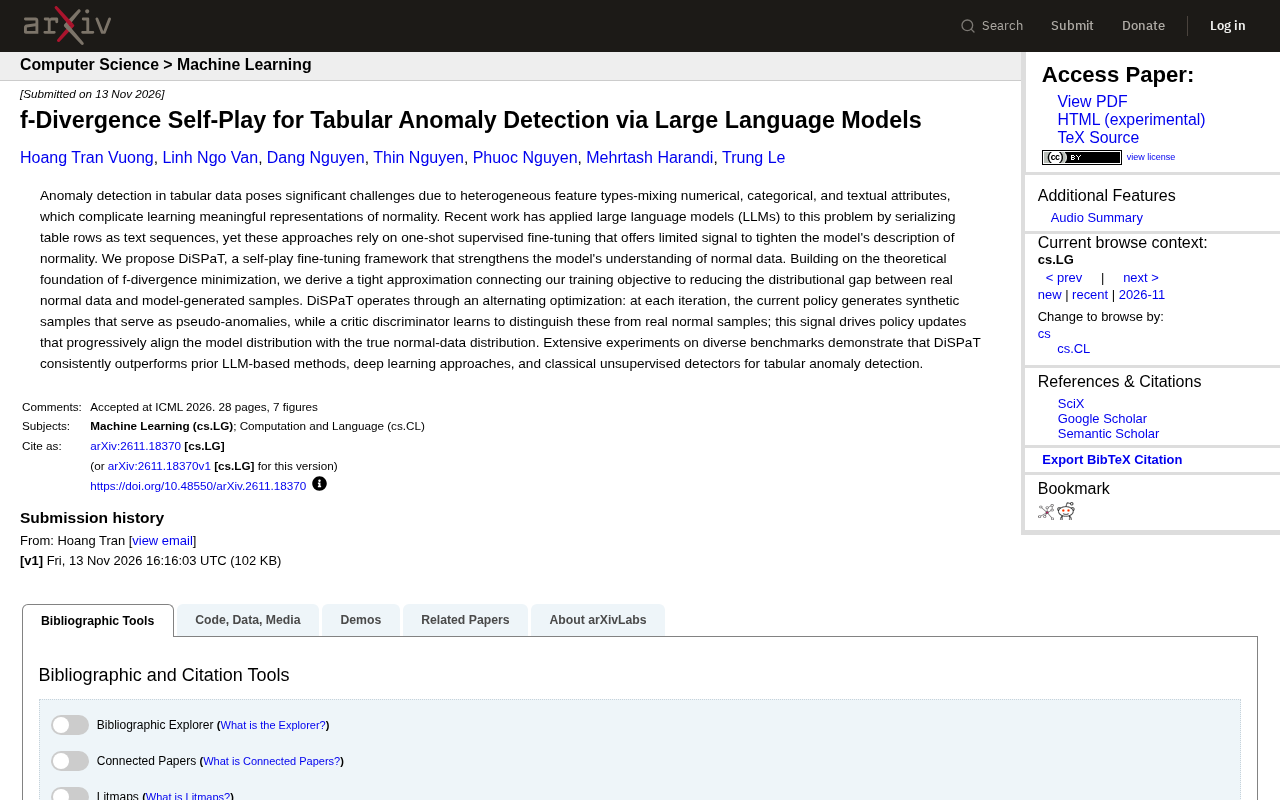
Table anomaly detection is difficult due to mixed feature types, and existing LLM methods rely on one-shot supervised fine-tuning with limited signal for characterizing normal boundaries. A new paper proposes DiSPaT, which transforms anomaly detection into distribution alignment, derives a tight approximation based on f-divergence minimization, and uses alternating optimization: a policy model generates pseudo-anomalies, a discriminator learns to distinguish them, and feedback updates the policy, iteratively tightening the description of normal data without real anomaly labels. Experiments show DiSPaT consistently outperforms prior LLM methods, deep learning methods, and classical unsupervised detectors on multiple benchmarks. The paper notes that one-shot fine-tuning has a signal bottleneck and self-play iterative optimization brings substantial gains, but computational overhead and pseudo-anomaly quality remain limitations to be verified.
Table data anomaly detection has long faced a thorny problem: mixed feature types—numeric, categorical, and textual attributes intertwined—make it difficult for models to learn a unified representation of "normality." Recent studies have attempted to use large language models (LLMs) to serialize table rows into text, but they rely on one-shot supervised fine-tuning, which provides limited signal for characterizing the boundary of "normal." A new paper proposes DiSPaT, which strengthens the model's understanding of normal data through a self-play fine-tuning framework and outperforms existing LLM-based methods, deep learning methods, and classical unsupervised detectors on multiple benchmarks.
Background: The Representation Dilemma in Table Anomaly Detection
Anomaly detection in table data differs from that in images or text: a single table may simultaneously contain continuous numeric values, discrete categories, and free text, making the feature space heterogeneous and sparse. Traditional unsupervised detectors (such as methods based on distance, density, or tree models) rely on handcrafted feature engineering or strong distributional assumptions and tend to fail when faced with high-dimensional mixed types.
The introduction of LLMs offers a new path—serializing each row into a natural language description so that the model can semantically understand "whether this row is normal." Such methods leverage the pretrained knowledge of LLMs to handle heterogeneous fields and reduce reliance on feature engineering. However, the paper points out that existing approaches generally adopt one-shot supervised fine-tuning, where the model only passively fits labeled samples and lacks a mechanism to continuously tighten the "description of normality," resulting in an insufficiently tight characterization of the distribution boundary.
One-shot supervised fine-tuning refers to performing a single round of supervised training on a pretrained language model using a batch of labeled data (here, normal/anomalous samples), so that the model directly fits the labels of these samples. Its characteristic is that the training process occurs only once, and after the model parameters are updated, they are no longer adjusted based on the model's own outputs. In table anomaly detection, this method teaches the LLM to imitate the judgments of labeled samples, but it cannot actively explore the boundary of normal data during training. Therefore, the characterization of "normality" tends to remain superficial and lacks a mechanism for iterative tightening. In contrast, self-play fine-tuning, through multiple rounds of alternating generation and discrimination, can continuously correct the model's estimate of the normal distribution.
DiSPaT's Core Idea: Self-Play under f-Divergence
The key design of DiSPaT is to transform anomaly detection into a distribution alignment problem. Based on the theoretical framework of f-divergence minimization, the paper derives a tight approximation: its training objective is equivalent to narrowing the gap between the true normal data distribution and the distribution of samples generated by the model.
The specific mechanism is alternating optimization:
- Policy generates pseudo-anomalies: In each iteration, the current policy model generates synthetic samples, which are treated as "pseudo-anomalies."
- Discriminator learns to distinguish: A critic discriminator learns to distinguish these synthetic samples from real normal samples.
- Policy update aligns distributions: The discrimination signal is fed back to drive policy updates, gradually bringing the model distribution closer to the true normal data distribution.
The cleverness of this loop lies in the fact that no real anomaly labels are needed—the model itself generates "normal deviations that look like anomalies" and then learns to identify them, thereby continuously tightening the definition of normal. This shares some conceptual similarities with generative adversarial networks, but its theoretical foundation is built on f-divergence minimization, providing a quantitative connection between the training objective and the distribution gap.
f-divergence is a class of metrics that measure the difference between two probability distributions, defined through a convex function f. Common forms include KL divergence, JS divergence, and total variation distance. Its general definition is (D_f(P||Q) = \int f\left(\frac{dP}{dQ}\right) dQ), requiring f to be convex and f(1)=0. Minimizing f-divergence means making the model distribution Q as close as possible to the true distribution P. In DiSPaT, the paper uses the variational lower bound or dual form of f-divergence to transform the distribution alignment problem into an optimizable adversarial objective, thereby deriving a tight approximation between the training objective and the distribution gap. This provides theoretical guarantees for self-play training, giving clear optimization directions for policy generation and discriminator updates.
Alternating optimization is a strategy for solving multivariable optimization problems: fixing one set of variables and optimizing another, alternating until convergence. In DiSPaT, each iteration first fixes the policy model and updates the discriminator to better distinguish real normal samples from pseudo-anomalies generated by the policy; then it fixes the discriminator and updates the policy model to generate samples closer to the normal distribution (i.e., making them harder for the discriminator to distinguish). This alternating process is similar to the training of generative adversarial networks (GANs), but the objective function is derived from f-divergence minimization rather than JS divergence. Alternating optimization ensures that each step has a clear optimization objective and requires no real anomaly labels, relying solely on pseudo-anomalies generated by the model itself to drive learning.
Experimental Performance: Consistent Advantages across Multiple Benchmarks
The paper conducts experiments on diverse benchmarks and concludes that DiSPaT consistently outperforms three categories of comparison methods: previous LLM-based methods, deep learning anomaly detection methods, and classical unsupervised detectors.
From a methodological perspective, this result indicates two things. First, one-shot fine-tuning indeed has a signal bottleneck, and self-play iterative optimization can bring substantial improvements. Second, the potential of LLMs for table anomaly detection has not yet been fully tapped, and improvements in the training paradigm are more critical than simply scaling up model size. The abstract does not disclose specific dataset names or performance numbers, but it emphasizes that the advantages are consistent across multiple benchmarks rather than being a single-point win.
Notable Insights and Limitations
The significance of DiSPaT goes beyond a single detector. It demonstrates how to combine the generative capabilities of LLMs with classical distribution alignment theory: generative models are no longer just "creating data" but become tools for characterizing the boundary of normality. For scenarios dense with table data, such as industrial quality inspection, financial risk control, and log auditing, such methods are expected to reduce reliance on anomaly labels.
It is important to view this calmly: self-play training has higher computational overhead than one-shot fine-tuning—each iteration requires generating samples and training the discriminator, and the number of rounds and cost required for convergence are not given in the abstract. In addition, the quality of pseudo-anomalies directly determines the effectiveness of the training signal; if the policy model's generative capability is insufficient, the discriminator may learn spurious boundaries. These issues await further answers from the full paper and follow-up work.
Pseudo-anomalies in DiSPaT refer to synthetic samples generated by the current policy model, which are assumed to be "deviations from normal data" and used as negative examples for the discriminator. The quality of pseudo-anomalies directly affects the training signal: if the generated samples are too similar to real normal data, the discriminator will struggle to learn an effective boundary; if the generated samples deviate too much, they may introduce spurious patterns. Therefore, the generative capability of the policy model is crucial—it needs to produce samples that have a certain degree of deviation but are not too far out of distribution. The paper does not specify how pseudo-anomalies are generated (e.g., whether based on perturbation or sampling), but emphasizes that they are the core driving force of the self-play loop. Future research could explore more controllable pseudo-anomaly generation strategies to improve training stability.
Conclusion
DiSPaT advances the training of table anomaly detection from "one-shot fitting" to "iterative alignment," using f-divergence theory to provide an interpretable objective function for self-play. In the exploration of LLMs handling structured data, this is a route worth following: rather than letting the model memorize what is normal, let it continuously ask "what counts as abnormal."
One-line Summary
DiSPaT replaces one-shot supervision with self-play fine-tuning, iteratively tightening the normality boundary through f-divergence theory to improve table anomaly detection.
Paragraph Summary
Table data anomaly detection is difficult due to mixed feature types, and existing LLM methods rely on one-shot supervised fine-tuning, which provides limited signal for characterizing the normal boundary. A new paper proposes DiSPaT, which transforms anomaly detection into a distribution alignment problem, derives a tight approximation based on f-divergence minimization, and adopts alternating optimization: a policy model generates pseudo-anomalies, a discriminator learns to distinguish them, and the discrimination signal is fed back to update the policy, iteratively tightening the description of normal data without real anomaly labels. Experiments show that DiSPaT consistently outperforms previous LLM methods, deep learning methods, and classical unsupervised detectors on multiple benchmarks. The paper notes that one-shot fine-tuning has a signal bottleneck and that self-play iterative optimization can bring substantial improvements, but computational overhead and pseudo-anomaly quality remain limitations to be verified.
Related articles

Hands-On with the Genie 4 World Model: Directing Worlds in Real Time Like a Puppeteer
Google DeepMind's Genie 4 world model in depth: Special Guest X's hands-on demo of real-time scene direction via prompts, custom interactive apps in Project Genie, and prompts-as-seeds reproducibility.

Nvidia RTX Spark Mini PCs Go on Sale, Asus, Dell, and MSI Lead the Launch
Nvidia's RTX Spark N1X chip expands to desktops, with Asus, Dell, and MSI launching the first mini PCs, followed by Acer, Gigabyte, HP, and Microsoft's Surface Dev Box, accelerating the desktop AI PC ecosystem.

If Jensen Huang Steps Down, What Happens to Nvidia's AI Empire?
Is Nvidia's AI dominance overly dependent on Jensen Huang? This article analyzes Silicon Valley's CEO personality cult phenomenon, explores Nvidia's technical moat and organizational risks, and why the AI industry must shed the savior narrative.