New Codex Skill: Let AI Coding Assistants Teach You, Not Just Write Code for You

Open-source Codex skill ONE_FOR_ALL turns AI coding assistants back into teachers: understand first, then act.
The article introduces ONE_FOR_ALL, a Codex skill by open-source developer Sagar Tarak. Targeting the common dilemma of "the code runs but you can't explain why," it positions the AI coding assistant as a mentor for junior engineers, emphasizing reasoning behind engineering decisions over runnable output. It covers six scenarios—codebase reading, tickets, debugging, system design, algorithm practice, and code review—using a layered SKILL.md plus five reference docs routed by task type. The author demos a "understand, plan, implement, verify" workflow with React form validation, admits results depend on codebase and task, and lists four open questions, the key one being how teaching tools balance novices and experts. The project is MIT-licensed on GitHub.
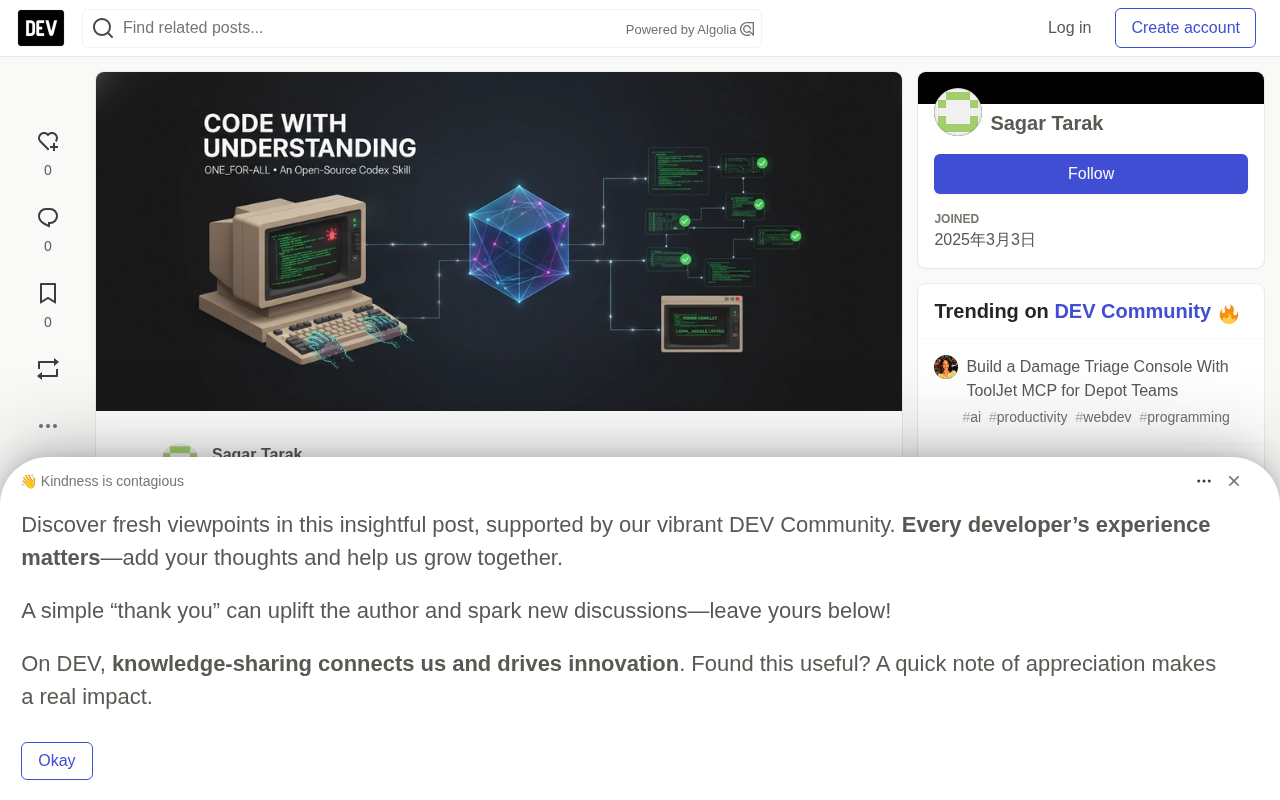
AI coding assistants have long been able to generate code, explain errors, and implement features. But an awkward situation is becoming increasingly common: the code runs, yet you can't explain why it works. Open-source developer Sagar Tarak recently released a Codex skill called ONE_FOR_ALL, targeting exactly this pain point—bringing AI-assisted development back to a learning experience rather than just accelerating task completion.
When "It Runs" Replaces "Understanding"
Facing an unfamiliar codebase, knowing where to make changes is only half the job. In the project description, the author lists a series of overlooked questions: which files are responsible for this feature? How does data flow through the application? Why is this implementation placed here? What might a change break? And how do you verify that a solution actually works?
AI assistants can answer all these questions. But the author believes that how the answer is delivered matters more than the answer itself. The workflow he wants is: understand the problem first, then plan the change, then implement it, and finally verify the result. This corresponds exactly to the steps that are repeatedly emphasized in traditional software engineering training but easily compressed in the AI era.
What Is ONE_FOR_ALL
This is an open-source skill for OpenAI Codex, positioned as a "mentor" for interns and junior engineers. It is not satisfied with merely outputting code—it tries to explain the reasoning behind engineering decisions.
Looking at the feature list, it covers the scenarios where junior engineers most often get stuck in their daily work:
- Reading a codebase: trace the files involved in a feature and clarify the data flow
- Handling tickets: break vague requirements into small, testable steps
- Debugging: gather evidence behind the error first, then choose a fix
- Learning system design: understand component responsibilities, boundaries, dependencies, and trade-offs
- Practicing data structures and algorithms: progress from a naive solution to a more efficient version
- Code review: identify potential issues, edge cases, and useful tests
The author's intent is clear—not to make every answer longer, but to make explanations useful enough that you can transfer what you learn to the next problem. This statement actually points out a common problem with current AI coding tools: many explanations appear detailed but are hard to reuse.
Codex is a coding agent product form launched by OpenAI. Unlike ordinary chat-style code generation, it can read and write files, execute commands, and run tests in local or cloud environments, autonomously completing multi-step operations around a task. A so-called "skill" can be understood as a piece of structured instructions and reference material injected into the context of such agents, used to constrain its behavior and workflow under specific tasks without requiring users to repeat instructions in every conversation. ONE_FOR_ALL is packaged in exactly this form as a teaching-oriented instruction set: it does not change the model's own capabilities, but instead solidifies the process of "understand first, plan next, implement after, verify finally" through a main instruction and reference documents, making Codex's output closer to the mentoring style of an engineer who guides you.
A Concrete Usage Scenario
Suppose you are adding validation to a signup form in a React application. The usual approach is to have the AI directly implement the entire feature. With ONE_FOR_ALL, the interaction starts with understanding:
$one-for-all Help me add validation to this signup form.

First, help me understand the existing implementation.
Identify the relevant files, explain the data flow,
and help me implement the change step by step.
The expected process is: understand the existing code, locate where the change should land, explain the implementation approach, and then provide a suitable way to verify it. The same skill can also be used for debugging errors, reviewing diffs, or learning a data structure. The author also admits that these are processes the skill is designed to support, and actual results still depend on your codebase and specific task—such restraint is rare in open-source project introductions.
Internal Structure of the Skill
ONE_FOR_ALL separates the main instruction from supporting reference materials. The repository structure is as follows:
SKILL.md: main teaching workflow and task routingreferences/project-work.md: project implementation and debuggingreferences/architecture-and-patterns.md: architecture and design patternsreferences/dsa.md: data structures and algorithm problem solvingreferences/early-career-engineering.md: tickets, onboarding, and code reviewreferences/quality-and-delivery.md: testing, edge cases, and PR readiness
This split keeps the main instruction focused while leaving room for more specific guidance for different types of engineering tasks. For those who want to extend or customize it, the structure itself conveys the author's understanding of task categorization.
This layered approach of "main instruction + reference materials" is often called progressive disclosure in practice: the main file retains only the core workflow and task-routing logic, kept within a size that the model will fully read every time; while detailed knowledge such as architecture patterns, algorithm problem solving, and code review is split into separate documents that are loaded on demand only when the task type matches. The benefit is twofold—it avoids diluting the main instruction due to content expansion and raising the context cost of each call, while also allowing guidance in different domains to be iterated and replaced independently. For secondary development, this structure effectively makes "task categorization" explicit as file boundaries; adding a new scenario only requires adding a reference document and registering the route in the main instruction.
Four Questions the Author Wants to Validate
The author explicitly states that writing the instructions does not mean the skill is complete, and he hopes to get feedback from real project users. The questions he lists include: Are the explanations useful, or do they create unnecessary verbosity? Does the workflow actually help developers understand unfamiliar codebases? Which parts of the development process need better guidance? And how can learning be encouraged without slowing down experienced developers?
The last question is especially critical. The inherent tension in teaching-oriented AI tools is that detailed explanations that are friendly to beginners may be noise to experienced users. Whether ONE_FOR_ALL can find a balance on this line determines whether it is a niche learning tool or a more general development aid.
In engineering practice, this tension between beginners and experts is usually resolved through "adaptive verbosity": the depth of explanation should adjust according to task novelty, code unfamiliarity, and the developer's self-reported familiarity, rather than being fixed at a certain level of detail. The measure should also not be answer length, but transferability—that is, whether the developer can reuse the reasoning approach from this explanation on the next problem. Another commonly cited principle is "conclusion first, reasons after": let experienced people quickly skip the background and take the decision points directly, while preserving the full chain of reasoning for those who need to learn. Whether ONE_FOR_ALL can implement such layering is the most product-significant of its four questions to be validated.
Getting Started and Contributing
The project is open source on GitHub (Sagar-Tarak/one-for-all) under the MIT license, and contributions that improve the learning experience are welcome. At the end of the article, the author discloses that AI was used to assist in drafting and editing the article, but the project and its goals come from his own development work.
If you are using Codex, or have practical experience with the topic of "learning programming with AI," this project provides a sample worth trying.
One-line Summary
Open-source Codex skill ONE_FOR_ALL brings AI coding assistants back to teaching: understand first, then act.
Paragraph Summary
The article introduces ONE_FOR_ALL, a Codex skill released by open-source developer Sagar Tarak. Addressing the common dilemma of "the code runs but you can't explain why it runs," the skill positions the AI coding assistant as a mentor for junior engineers, emphasizing explanation of the reasoning behind engineering decisions rather than merely outputting runnable code. It covers six scenarios: reading a codebase, handling tickets, debugging, system design, algorithm practice, and code review. It uses a layered structure with SKILL.md as the main instruction plus five reference documents, routed by task type. Using React form validation as an example, the author demonstrates the workflow of "understand first, plan next, implement after, verify finally," and candidly admits that actual results depend on the codebase and task. The article ends with four questions to be validated, among which the most critical is how teaching-oriented tools can balance beginners and experienced users. The project is open source on GitHub under the MIT license.
Related articles

AI Reverse-Engineers Monitor Firmware in 15 Minutes — Has the Hacking Barrier Been Flattened?
A security researcher used AI to reverse-engineer Dell monitor firmware in 15 minutes—entropy analysis, key extraction, MD5 verification—revealing encryption design flaws.

Mistral Voxtral 3: Real-Time Voice at 4 Cents per Minute, Challenging OpenAI
Mistral Voxtral 3 cuts real-time voice agent costs to 4 cents per minute, bundling three speech recognition models, a speech generation model, and a real-time voice toolkit, supporting 50+ languages and self-hosting. This article analyzes its pricing structure, sub-second response performance, and its strategic divergence from OpenAI and Gemini on data privacy versus out-of-the-box convenience.

WebMCP: Every Website as Its Own MCP Server, So AI Agents No Longer Rely on Screenshots
WebMCP lets websites expose tools via the document.modelcontext API, becoming directly callable MCP servers. This article explains its architecture, the Claude Code remote-debugging demo, Chrome's current support stage, and its impact on the agent ecosystem.