New Emergency Triage AI Evaluation Framework SAFE-Triage: Multi-Dimensional Assessment Beyond Accuracy
The SAFE-Triage framework evaluates patient-facing triage AI across three dimensions and four methods, beyond single accuracy metrics.
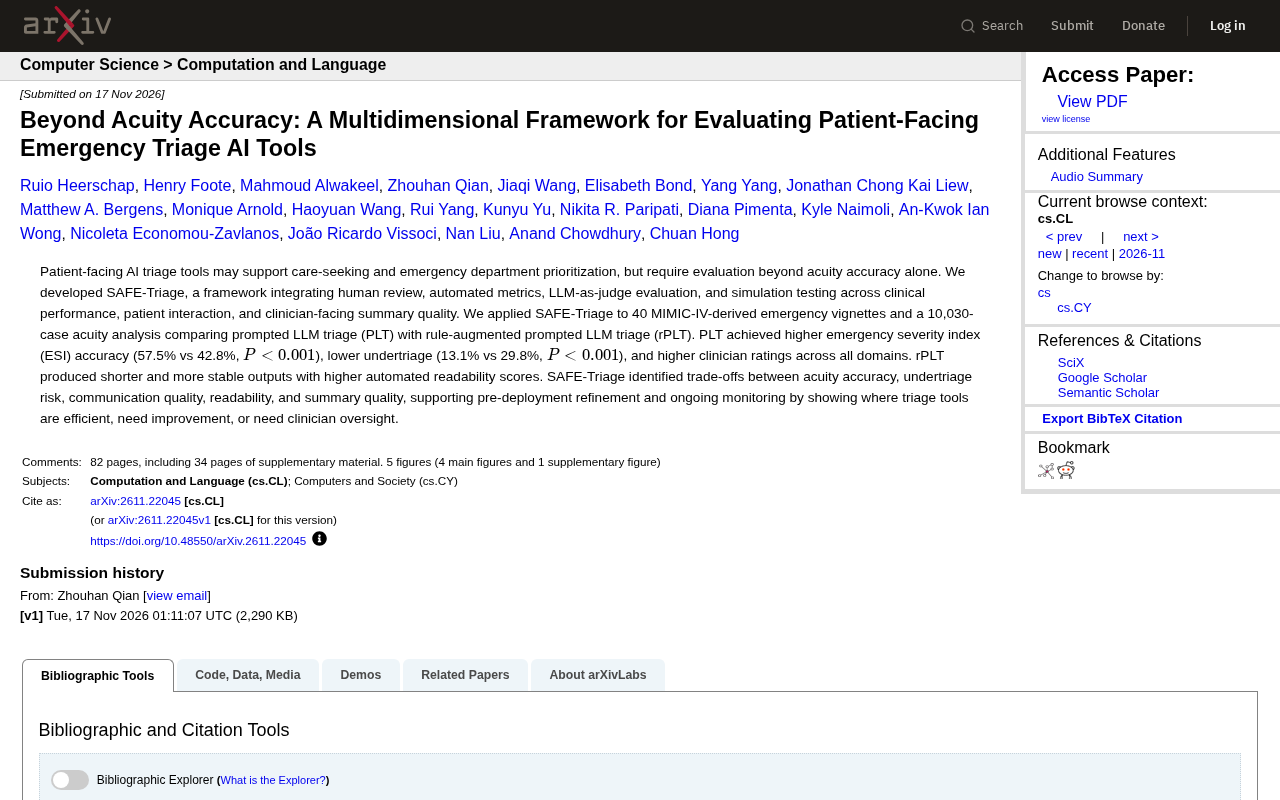
An arXiv study proposes the SAFE-Triage framework, arguing that patient-facing AI triage tools cannot be evaluated by triage accuracy alone but should be comprehensively assessed across clinical performance, patient interaction quality, and physician summary quality. The framework integrates human review, automated metrics, LLM-as-judge, and simulation testing, applied to 40 MIMIC-IV emergency case vignettes and a severity analysis of 10,030 cases. Comparative experiments show that prompted LLM triage (PLT) achieves 57.5% ESI accuracy, significantly higher than the rule-enhanced approach (rPLT) at 42.8%, with an undertriage rate of 13.1% far below 29.8%; however, rPLT outputs are shorter, more stable, and more readable, revealing a core trade-off between accuracy and communication quality. The paper positions SAFE-Triage as a tool supporting pre-deployment optimization and continuous monitoring.
Patient-facing AI triage tools are emerging as a potential means to alleviate emergency department pressure, but evaluating them solely on "triage accuracy" may obscure more critical risks. A study from arXiv proposes the SAFE-Triage framework, which attempts to redefine evaluation standards for such tools across three dimensions: clinical performance, patient interaction, and physician summary quality.
Why accuracy is not enough
Traditional triage AI evaluation typically focuses on acuity accuracy—whether the model's output severity level matches the gold standard. But the paper points out that patient-facing triage tools play a dual role: on one hand, they help patients decide whether and when to seek care; on the other, they provide triage priority references for emergency departments.
This means an "accurate" model may confuse patients in communication or omit critical information in summaries generated for clinicians. The paper explicitly states that such tools "require evaluation beyond acuity accuracy." SAFE-Triage's starting point is precisely to capture these trade-offs masked by a single metric.
Acuity accuracy is the most commonly used metric in triage AI evaluation, referring to the proportion of cases where the model's output severity level exactly matches the gold standard (typically annotated by clinical experts). In emergency triage scenarios, severity is usually classified on the five-level ESI (Emergency Severity Index) scale, from level 1 (requires immediate resuscitation) to level 5 (non-urgent). Acuity accuracy appears intuitive, but it treats all misclassifications equally—misclassifying a level 2 severe case as level 4 and a level 4 mild case as level 5 contribute the same penalty to accuracy, yet the clinical consequences are vastly different. Moreover, this metric does not reflect the communication quality, readability, or actual impact on patient decision-making of model outputs, so using it alone masks systematic risks of triage tools in real-world deployment.
SAFE-Triage's four-layer evaluation structure
The framework integrates four evaluation methods covering three assessment domains:
- Human review: clinical staff make qualitative judgments on model outputs
- Automated metrics: including ESI accuracy, undertriage rate, readability scores, etc.
- LLM-as-judge: using large models as evaluators to score output quality
- Simulation testing: end-to-end simulation based on emergency case vignettes
The three assessment domains are clinical performance, patient interaction quality, and physician-facing summary quality. This layered design moves evaluation beyond binary "right/wrong" judgments, enabling identification of where a tool performs well, where improvement is needed, and where physician oversight must be introduced.
LLM-as-judge is an evaluation method that uses large language models as automated evaluators. Specifically, the model output to be evaluated is submitted along with a scoring rubric to a more capable large model, which scores or provides qualitative assessments across dimensions. This approach is far cheaper than human review and can be executed in batches, making it suitable for frequent use during development iterations. But its limitations are also clear: the judging model itself may have biases, insufficient sensitivity to clinical details, and scoring consistency depends on prompt design. Therefore, the paper positions LLM-as-judge as a supplement to, not a replacement for, human review, emphasizing that clinical staff review remains an essential component of the framework.
Comparative experiment of PLT vs. rPLT
The research team applied SAFE-Triage to 40 emergency case vignettes derived from MIMIC-IV, plus a severity analysis of 10,030 cases. The experiment compared two approaches: prompted LLM triage (PLT) and rule-enhanced prompted LLM triage (rPLT).
Results showed that PLT achieved 57.5% ESI accuracy, higher than rPLT's 42.8% (P < 0.001); undertriage rate was 13.1%, significantly lower than rPLT's 29.8% (P < 0.001). In clinical staff ratings, PLT received higher evaluations across all dimensions.
But rPLT is not without advantages. Its outputs are shorter, more stable, and have higher automated readability scores. This reveals a core trade-off: approaches pursuing triage accuracy may compromise output conciseness and readability, while rule-enhanced approaches sacrifice some accuracy but gain more consistent expression.
MIMIC-IV is one of the most widely used public intensive care databases in medical AI research, maintained collaboratively by MIT and Beth Israel Deaconess Medical Center. It contains electronic health records of tens of thousands of anonymized patients, covering vital signs, lab results, medications, and clinical notes. The paper extracted emergency cases from MIMIC-IV and organized them into vignettes (case summaries) for simulating triage scenarios. The advantage of using MIMIC-IV is that the data is real and reproducible, facilitating peer comparison; however, note that its data comes from a single healthcare system, and case complexity and population distribution may differ from other institutions, so evaluation results based on this dataset should be extrapolated with caution.
Undertriage refers to the model incorrectly classifying patients who should be assigned a high emergency level to a lower level, causing their triage priority to be downgraded. The opposite is overtriage, i.e., classifying mild cases as severe. In emergency scenarios, the clinical consequences of undertriage are typically more serious—patients may experience delayed treatment, with risks far exceeding the resource waste caused by overtriage. Therefore, the paper treats undertriage rate as an independent high-priority metric rather than an adjunct to accuracy. In the experiment, the gap between PLT and rPLT in undertriage rate (13.1% vs 29.8%) is much larger than the accuracy gap (57.5% vs 42.8%), indicating that looking at accuracy alone would severely underestimate the substantive difference in safety between the two approaches.
What multi-dimensional evaluation reveals
The value of SAFE-Triage lies in making this trade-off explicit. The paper notes that the framework can identify trade-off relationships among acuity accuracy, undertriage risk, communication quality, readability, and summary quality. For triage tools preparing for deployment, this means teams can clarify the tool's "efficiency zone" and "supervision zone" before launch—which scenarios can run automatically and which must be reviewed by clinical staff.
This approach aligns with the current trend in medical AI evaluation: single accuracy metrics cannot reflect the compound risks in real clinical environments. This is especially true for patient-facing triage tools, as their outputs simultaneously affect patients' care-seeking decisions and emergency department resource allocation.
Implications for AI triage product development
From a product perspective, SAFE-Triage suggests several actionable evaluation principles. First, undertriage should be treated as an independent high-priority metric rather than an adjunct to accuracy—in the experiment, the gap between PLT and rPLT in undertriage rate is much larger than the accuracy gap. Second, readability and communication quality need to be included in routine evaluation, because the comprehension cost on the patient side directly affects the tool's practical utility. Third, LLM-as-judge and simulation testing can serve as low-cost supplements to human review, but the paper also emphasizes that human review remains a component of the framework.
The paper positions SAFE-Triage as a tool supporting "pre-deployment optimization and continuous monitoring" rather than one-time certification. This echoes the regulatory consensus that medical AI requires continuous monitoring. For teams developing patient-facing triage AI, the framework provides a reference multi-dimensional evaluation skeleton, with its core claim being: the quality of triage tools cannot be judged by a single metric, but must be defined by a set of mutually constraining metrics.
Related articles

Daybreak Red Deployment Guide: A Reference Architecture for Supervised Security Investigation
A breakdown of the Daybreak Red reference architecture: security control design, deployment configuration process, and runtime monitoring for supervised security investigation.

Gemini 4 Neon Tops the Models Engineering Index
Gemini 4 Neon tops the Models Engineering Index, sparking Hacker News debate over ranking credibility and evaluation methods. Here's what it means for developers.

Apple's Self-Developed AI Agent: An Agent That Can Operate Your Mac Is Coming
Apple is reportedly developing an AI agent that can operate a Mac, targeting Meta Muse, Claude, OpenAI Dots, and others. This article analyzes Apple's system-level advantages, the competitive landscape, and likely rollout paths in the agent race.