New Loom Feature: Recording Becomes the Prompt — AI Agents Take Over Your Screen

Loom launches Record for agents: record your screen to generate agent-executable prompts.
Loom introduces "Record for agents," letting users record screen interactions, audio, and interaction traces into agent-ready prompts for AI agents to execute directly. Built into the redesigned Loom for Mac app with precise region capture, 4K default, and native performance optimization, it's also available on Chrome. It solves textualizing screen states, conveying intent, and lowering barriers for non-technical users, though agent-side parsing, cost, and privacy remain constraints.
New Loom Feature: Recording Becomes the Prompt — AI Agents Take Over Your Screen
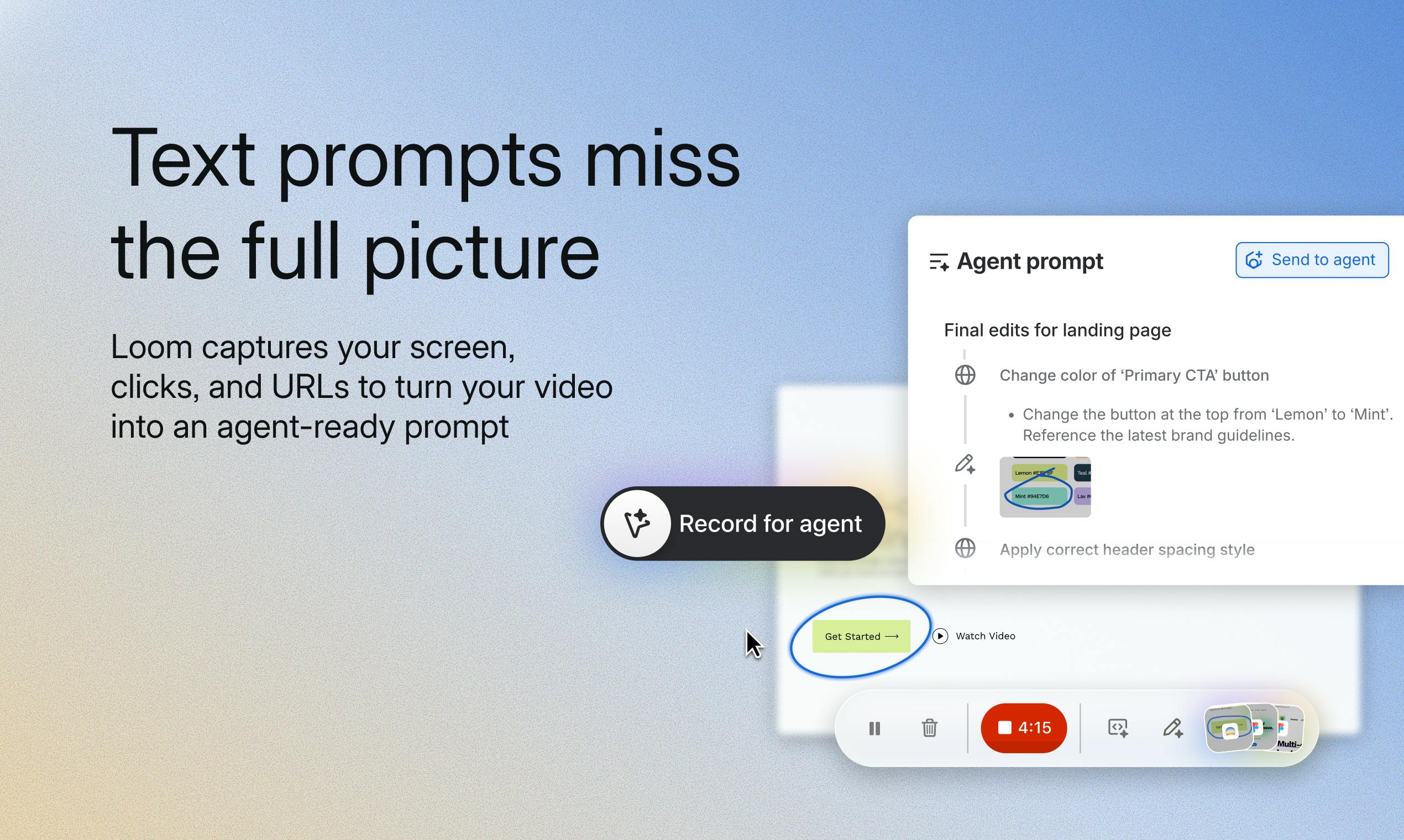
When working with AI agents, the most frustrating part is often not the AI itself, but the time you have to spend "translating" — turning on-screen state, operational intent, and context into a text prompt that is clear enough. This process is inefficient and prone to missing details. Loom's newly launched "Record for agents" feature attempts to eliminate this step entirely: record a screen interaction, and leave the rest to the AI.
From "Writing Prompts" to "Recording Prompts"
The core logic of Loom's new feature, launched on Product Hunt, is simple: instead of typing out a prompt to explain what's on the screen, just record it. Video, audio, and on-screen clicks and interaction traces are captured together and ultimately transformed into an "agent-ready prompt" that AI tools can directly execute.
This represents a shift in interaction paradigm: in the past, humans adapted to the AI's input format (text); now, AI is beginning to adapt to human expression habits (demonstration). For developers and designers who frequently need to describe complex interface states to agents, recording a 30-second demonstration likely carries higher information density than a hand-written explanation.
The New Loom Mac App: Redesigned for Agent Scenarios
This capability is not a standalone tool but is embedded in the redesigned Loom for Mac app. Several hardware-level updates from the official announcement are worth noting:
- Precise region recording: You can select only a specific area of the screen, avoiding irrelevant content being stuffed into the prompt;
- 4K by default: Recordings are captured at 4K by default, preserving more detail — especially critical for agent scenarios that need to read interface text;
- New camera shapes, filters, and backgrounds: Geared more toward content creators' habits;
- Native performance optimization: The new app is described as "faster."
The Chrome extension also offers this capability, indicating that Loom does not intend to limit it to heavy users of a single client.
Agent-ready prompt refers to structured input that requires no manual post-processing and can be directly parsed and executed by AI agents. Traditional screen recordings are just video files for human viewing, whereas agent-ready prompts typically package signals such as frames, OCR text, mouse click coordinates, keyboard events, and speech transcription into a timestamped multimodal sequence, enabling agents to locate interface elements and reproduce operation steps. Loom has not disclosed its specific packaging format, but based on the feature description, it at least preserves interaction traces and audio — the key prerequisite for letting "demonstration" replace "description."
Why "Recording for Agents" Deserves Its Own Feature
On the surface, this is just feeding screen recordings to AI. But broken down, it solves three practical problems:
First, the cost of textualizing screen states. Accurately describing the layout, error messages, and current selections of a complex web admin panel or IDE interface in text often requires hundreds of words and is prone to omissions. The combination of video, audio, and interaction traces is a data form closer to real context.
Second, conveying operational intent. Text prompts can express "what you want," but it's hard to precisely express "how I just tried it." Screen recordings naturally include the trial-and-error process, which is valuable for agents to understand the problem reproduction path.
Third, lowering the barrier for non-technical users. To get an agent to help complete an operation, you don't need to learn to write structured prompts first — just demonstrate it once.
Interaction trace in the context of screen recording generally refers to the time series of mouse movements, clicks, scrolls, keyboard inputs, and other events, potentially with coordinates and control hierarchy information. Compared to pure video, trace data allows agents to see not just the "result screen" but also infer "what the user did to reach this state," making it especially useful for reproducing problem paths and understanding error trigger conditions. However, the usability of traces depends on whether the recording tool can export structured events rather than merely burning them into video pixels; this is also a core variable determining whether such features can be reliably consumed by different agents.
A Sober Look: Multimodal Input Has Not Yet Become the Default Entry Point for Agents
Based on Product Hunt data, this launch received 69 upvotes and ranked 19th — moderately popular, with only 1 comment — discussion is not particularly high. This may suggest that "recording-based prompts" is still an experimental feature rather than a necessity.
Several practical issues remain: whether the agent side can stably parse audio, video, and interaction traces depends on the level of support from each AI tool; the transmission and storage costs of long recordings; and privacy boundaries — screen recordings naturally include everything on the screen, and the risk of accidentally capturing sensitive information is higher than with hand-written prompts.
However, the direction is clear. As multimodal models' understanding capabilities continue to improve, the interface between humans and agents will gradually shift from "typing" to "demonstrating." Loom has taken a step at the early stage of this interaction habit migration.
Multimodal input refers to models simultaneously receiving and jointly understanding multiple signals such as text, images, audio, and video. Current mainstream agent products still default to text or screenshot-plus-text as their entry point, and few tools natively support audio-video sequences — due to parsing latency, token costs, and the engineering complexity of event alignment. Therefore, the effectiveness of "recording as prompt" highly depends on whether downstream AI tools open corresponding interfaces; if the agent side only accepts text, the recorded content still needs to go through a transcription layer, reducing its convenience.
Who Should Try It
Developers who frequently work with AI coding tools and browser agents, as well as operations and design personnel who need to describe complex interface states to AI, are worth trying it out. Ordinary office users currently see limited benefits and can wait to see how quickly the agent ecosystem catches up.
One-line Summary
Loom launches Record for agents: record your screen to generate agent-executable prompts.
Paragraph Summary
Loom introduces the "Record for agents" feature, allowing users to record screen interactions, audio, and interaction traces, and convert them into agent-ready prompts that AI agents can directly execute — eliminating the need to hand-write complex prompts. The feature is embedded in the redesigned Loom for Mac app, supports precise region recording, 4K by default, and native performance optimization, and is also available in the Chrome extension. The article argues that it solves three problems: the high cost of textualizing screen states, the difficulty of conveying operational intent, and the high barrier for non-technical users. However, its Product Hunt popularity is moderate, and agent-side parsing capabilities, transmission and storage costs, and privacy risks remain practical constraints. Multimodal input has not yet become the default entry point for agents.
Related articles

LLM Application Development: A High-Paying Career Guide for Ordinary People
LLM application development offers fresh graduates up to 35K/month, with SP offers reaching 600K. This article explains the core skills, how to break in, and how ordinary people can seize AI opportunities through learning by doing.

Say Goodbye to AI Influencer Faces: A Complete Guide to Creating Visual Assets for AI Comic Dramas from Scratch
Bilibili creator shares a full workflow for zero-basics AI comic drama visual assets: use Doubao Work skills with script-first, visual references, and real-person texture to escape AI influencer faces, then lock character and scene consistency with asset sheet layouts, weapon detail images, scene nine-grids, and cinematic color palettes.

The AI Production Pipeline Behind Great Videos: From Research to Agent Validation
AI video production isn't just a model race. This article breaks down a transferable four-step pipeline: researching professional workflows, organizing a skill checklist, configuring agents, and experimental validation—and explains how general-purpose LLMs like DeepSeek can replace paid tools to run the entire process.