New York Times Staff Resist Kalshi Partnership: A Battle Over the Boundaries Between Journalistic Credibility and Prediction Markets
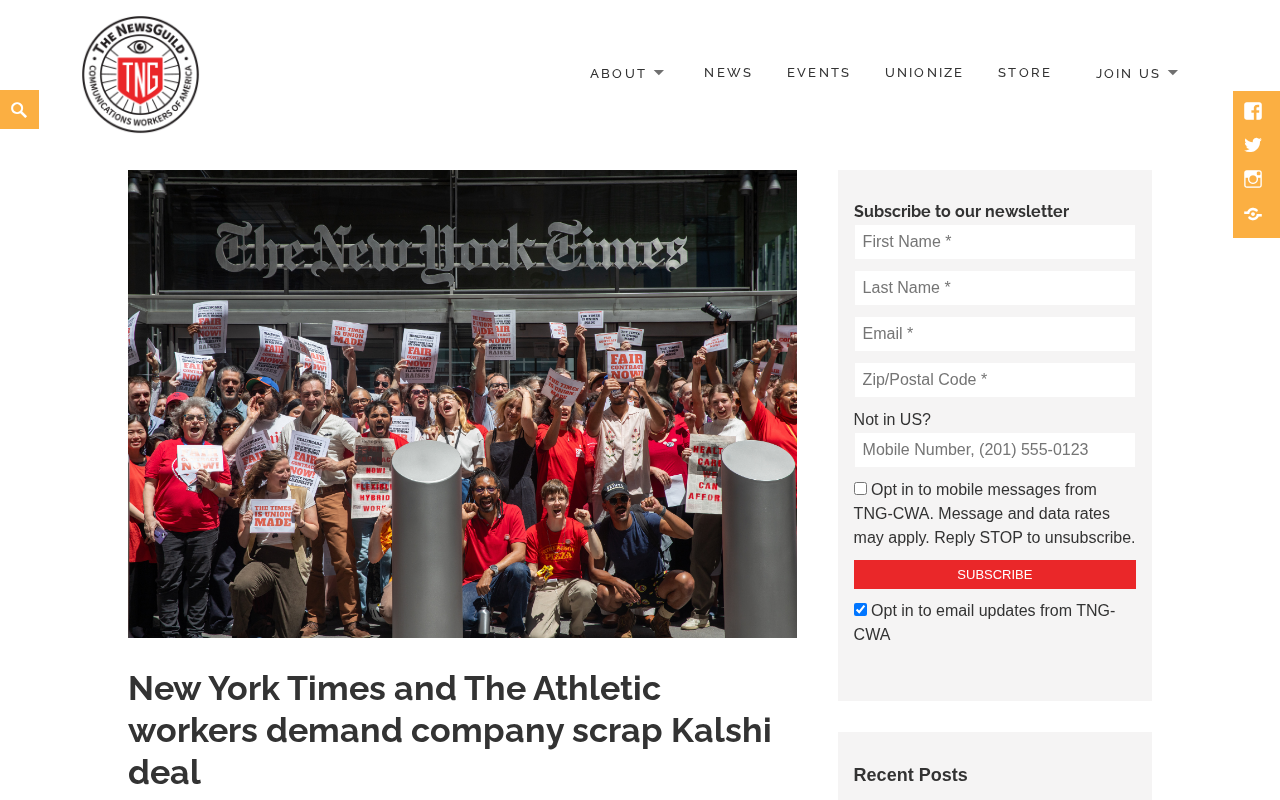
NYT staff resist Kalshi partnership over concerns that prediction market ties threaten credibility
Employees of The New York Times and The Athletic are demanding through their union that the company end its partnership with prediction market platform Kalshi, citing concerns over conflicts of interest, brand damage, and threats to editorial independence. The controversy highlights tensions between media revenue diversification and journalistic ethics.
Background: An Internal Battle Over Prediction Markets
Employees of The New York Times and its subsidiary sports media outlet The Athletic have recently spoken out publicly through the News Guild, demanding that the company terminate its partnership agreement with prediction market platform Kalshi. This appeal has sparked widespread discussion in tech communities like Hacker News, with related posts garnering 252 upvotes and nearly 200 comments, reflecting the intense attention this issue has drawn from professionals in tech and media.
The News Guild, formally known as The NewsGuild-CWA, is affiliated with the Communications Workers of America and is one of the oldest journalism unions in North America. Founded in 1933, it currently represents the rights of over 26,000 media workers. In recent years, as the digital media industry has experienced mounting turmoil—mass layoffs, wage stagnation, and deteriorating working conditions—American journalism has undergone a significant wave of unionization. From Vice and BuzzFeed News to the Los Angeles Times, more and more newsrooms have chosen to organize unions to respond collectively to unilateral management decisions. The New York Times union has been particularly active, even launching its first major strike in nearly 40 years in late 2022. This collective protest against the Kalshi partnership is a continuation of this awakening labor consciousness.
The core of this incident is not simply a labor-management dispute, but touches upon a deeper industry question: Should a serious news organization built on credibility establish commercial ties with a prediction market platform that has gambling-like characteristics?
What is Kalshi? The Rise and Controversy of Prediction Market Platforms
To understand employee concerns, it's essential to first understand Kalshi's business nature. Kalshi is a prediction market platform regulated by the U.S. Commodity Futures Trading Commission (CFTC), where users can "bet" on the outcomes of various future events—from economic data releases and election results to sports outcomes, covering an extremely broad range.
The CFTC is the federal agency responsible for regulating futures and options markets in the United States, established in 1974, with core functions of preventing market manipulation and protecting investor rights. Kalshi received CFTC's Designated Contract Market (DCM) designation in 2021, becoming the first platform in the U.S. to receive federal-level regulatory approval to legally operate event contract trading. However, this regulatory endorsement has not eliminated controversy. There has always been internal disagreement within the CFTC regarding the regulatory boundaries of prediction markets—especially concerning political election contracts. In 2023, the CFTC attempted to block Kalshi from launching U.S. congressional election contracts, arguing they constituted "illegal election gambling," and the two parties ended up in federal court. In 2024, Kalshi ultimately prevailed legally and began offering election-related contracts, but this regulatory tug-of-war itself highlighted the ambiguous zone in defining the legality of prediction markets.
The Dual Nature of Prediction Markets: Information Tool or Disguised Gambling?
Prediction markets have long existed in a gray area between financial derivatives and gambling. Their history can be traced back to 1988 when the University of Iowa created the Iowa Electronic Markets (IEM), a platform that allowed users to trade election contracts for academic research purposes and repeatedly demonstrated higher predictive accuracy than traditional polls. Subsequently, platforms like Intrade and PredictIt emerged, but the former closed in 2013 due to regulatory issues, while the latter barely operates under CFTC restrictions in the name of academic research. During the 2024 U.S. presidential election, crypto-based prediction markets represented by Polymarket rose to prominence with total trading volume exceeding $3.5 billion. Their predictions were widely cited by mainstream media outlets like The Wall Street Journal and Bloomberg, once regarded as a more sensitive barometer of election sentiment than traditional polls.
Supporters argue that such platforms aggregate collective wisdom through market mechanisms and can provide more accurate probability predictions than traditional polling, offering independent informational value. This view is theoretically grounded in economics' "efficient market hypothesis" and statistics' "wisdom of crowds" theory—when large numbers of participants express their judgments with real money, market prices often efficiently reflect a comprehensive assessment of all available information. Critics, however, point out that their operational logic is essentially no different from sports betting or political gambling—especially when platforms involve trading on sports event outcomes, the gambling nature becomes increasingly difficult to avoid. More importantly, prediction markets are also vulnerable to manipulation: well-funded participants can artificially distort market prices through large trades, creating a "false public opinion" narrative that serves their interests.
It is precisely this ambiguity that makes The New York Times' partnership with Kalshi particularly sensitive. As an authoritative media outlet renowned for investigative reporting and fact-checking, partnering with a platform that guides users to make monetary bets could erode the journalistic credibility it has accumulated over decades.
Core Employee Demands: Three Key Reasons to Terminate the Partnership
According to statements released by the News Guild, employees of The New York Times and The Athletic have cited reasons for terminating the Kalshi partnership focused on several key areas.
Journalistic Independence Faces Conflict of Interest Risks
The most fundamental concern is conflict of interest. When a news organization has commercial ties with a prediction market platform, can its coverage of related events still maintain objectivity and neutrality? The Athletic focuses on in-depth sports reporting; if its parent company partners with a platform that allows users to bet on game outcomes, then The Athletic's game analysis, injury reporting, and even predictive content could all be questioned by outsiders as having commercial motives to guide user betting.
This concern is not unfounded. In the sports media landscape, an exclusive injury report or trade rumor can instantly change betting market odds. If The Athletic's reporters belong to an organization with financial ties to a gambling-like platform, then even if the reporters themselves maintain complete professional integrity, readers and regulators have ample reason to question the timing and motives of information releases. This is why major U.S. professional sports leagues have extremely strict regulations regarding relationships between players, coaches, and gambling companies—the same logic should apply to media organizations covering these events.
Brand Reputation Faces Long-term Damage
Employees worry that such a partnership would deeply bind The New York Times brand with the gambling industry. The value of a news brand is built on reader trust, and once this trust is damaged due to inappropriate commercial partnerships, it will be extremely difficult to repair. Compared to the short-term revenue growth the partnership brings, potential reputation losses could far exceed the benefits.
The New York Times was founded in 1851, and its motto "All the News That's Fit to Print" has become a cultural symbol of serious journalism. The paper has won over 130 Pulitzer Prizes, more than any other news organization globally. In the digital age, this brand premium directly translates to commercial value—as of 2024, The New York Times' digital subscriptions have exceeded 10 million, an achievement nearly unmatched in global journalism, rooted in readers' trust in the brand's credibility. A partnership with a gambling-natured platform could shake this foundation of trust.
The Firewall Between Editorial and Business is Threatened
Traditional journalism has always emphasized the "firewall" principle between editorial and business departments to ensure that news coverage is not influenced by advertisers or commercial partners. This principle is also known in American journalism as the "separation of church and state," borrowing the metaphor of separation of religion and state to emphasize the sanctity of editorial independence. Its history traces back to the rise of journalistic professionalism in the early 20th century—when newspaper pioneers like Joseph Pulitzer and Adolph Ochs (founder of The New York Times) explicitly advocated that advertising revenue should not influence the content and direction of news reporting.
However, the digital age poses unprecedented challenges to this firewall. The rise of native advertising has blurred the boundaries between content and advertising; social media algorithm-driven traffic competition forces editorial decisions to consider business metrics; and now, data partnerships with prediction market platforms introduce an entirely new form of entanglement of interests. Employees believe that the partnership with Kalshi is a direct threat to this firewall and could subtly change the independence of editorial decision-making.
Tech Community Discussion: Divergent Perspectives
In Hacker News discussions, tech professionals have shown quite polarized views.
Some firmly support the employees' position, arguing that serious media should not be involved in any form of gambling-related business—this is a necessary step to maintain the bottom line of the journalism industry. Others point out that as digital media business models continue to face pressure, traditional media constantly seek new revenue sources, and partnerships with prediction markets and sports betting platforms have become an industry trend—sports media like ESPN have already deeply deployed in this area.
In fact, ESPN's case is particularly typical. In 2023, ESPN reached a partnership agreement worth approximately $2 billion with gambling giant Penn Entertainment, rebranding the latter's sports betting platform as "ESPN Bet." This means ESPN's brand appears directly on a gambling app, allowing users to seamlessly transition to ESPN Bet to place bets after watching ESPN's game analysis. Similarly, Fox Sports launched Fox Bet, CBS Sports established a partnership with William Hill, and even NBC Sports ventured into gambling through a partnership with PointsBet. The driving force behind this trend is obvious: after the U.S. Supreme Court overturned the federal sports betting ban (PASPA) in 2018, the legal sports betting market grew from virtually zero to annual revenues exceeding $10 billion in just a few years, presenting an almost irresistible attraction to media companies facing declining traditional advertising revenue.
Some commenters take a more pragmatic stance: prediction markets have legitimate value as information aggregation tools, and the key issue lies in how to establish clear partnership boundaries and conflict-avoidance mechanisms, rather than categorically rejecting all partnership possibilities.
Industry Implications: Where Are the Ethical Boundaries of Media Commercialization?
This incident reflects the profound dilemma facing journalism in the digital age. Beyond subscription revenue and advertising revenue, media organizations must constantly explore new commercialization paths, and these explorations often create tension with journalistic ethics.
The Ongoing Struggle Between Revenue Pressure and Value Preservation
The New York Times has achieved significant success in digital subscription transformation in recent years, but the entire news industry remains in the throes of structural transformation. Since 2005, U.S. newspaper advertising revenue has plummeted from nearly $50 billion to less than $10 billion, over 2,500 local newspapers have closed, and the number of journalism practitioners has been cut by more than half. Even a leading institution like The New York Times must actively seek revenue diversification. In 2022, the paper acquired The Athletic for $550 million, attempting to expand its user base through sports subscription content; it also acquired the globally popular word game Wordle that same year, using it as a tool to attract digital subscribers. These acquisition strategies have achieved considerable success but also reflect a reality: in the digital age, even the most successful news organizations must look for growth points beyond traditional journalism.
Partnerships with prediction markets, cryptocurrency platforms, and gambling companies represent one direction of media revenue diversification attempts, but each attempt tests the organization's value bottom line. When the tentacles of revenue diversification reach into the gambling field, how to draw a clear red line between business needs and journalistic ethics becomes a proposition the entire industry must face.
The Rise of Employee Voice and Union Power
It's worth noting that this protest is a bottom-up collective action led by the employee union. This reflects that in contemporary media organizations, practitioners' willingness to participate in and actual influence over corporate business decisions are strengthening. Journalists and editors are no longer merely content executors but stakeholders who actively speak out for the organization's long-term value and professional ethics.
This shift is also part of a broader labor movement trend. In the tech industry, employees at companies like Google, Apple, and Amazon have also launched collective protests over issues such as corporate contracts with military institutions, climate policies, and workplace culture. Journalism unionization echoes employee activism in the tech industry: in both industries, practitioners are increasingly unwilling to view corporate business decisions as "management affairs" that don't concern them, but rather believe they have the right and responsibility to voice dissent over decisions that may affect industry values and public interest.
Conclusion: Credibility is the Untouchable Foundation of News Organizations
The New York Times employees' resistance to the Kalshi partnership is essentially a debate about journalism's identity. Between commercial pressure and professional ethics, media organizations need to find a delicate balance. The ultimate outcome of this incident may provide an important reference case for how the entire industry handles relationships with emerging fintech platforms.
Regardless of the outcome, it reminds us: on the path of pursuing business innovation, the credibility upon which news organizations survive remains a foundation that cannot be lightly compromised.
Key Takeaways
Related articles

Is the Agent Harness Dead? Cursor's Early Engineer Breaks Down the Real Architecture of AI Coding Agents
Cursor early engineer Jediah breaks down the real architecture of the agent harness: why "the harness is dead" is only half right, how the data flywheel lets the harness obsolete itself, and how Grokbot, software factories, and primitive design open new frontiers for agents.

Python Visitor Pattern and Better Alternatives Explained
A deep dive into Python's visitor pattern and four alternatives: method pattern, pattern matching, dictionary mapping, and functools.singledispatch. Choose the best decoupling design by change frequency.

357 Days of Deep Experience: Why Omarchy Made Me Stop Distro-Hopping
A 357-day deep dive into Omarchy: 59-second install, out-of-the-box audio and GPU support, the Quattro QuickShell rewrite migration pains, and why Arch users should try it.