New Zelda and GTA: A Snapshot of a Bygone Gaming Era

The Stepback argues the new Zelda and GTA symbolize the end of the traditional AAA buyout era.
The Stepback newsletter analysis notes that while the new Zelda and GTA remain top-tier, the traditional AAA "one-time buyout, one release every few years" model faces structural challenges. Rising development costs force conservative iteration, while free-to-play, subscriptions, and UGC reshape player behavior. Indie and mid-sized teams fill creative gaps as industry resources shift to a multi-tier ecosystem. Flagship blockbusters won't vanish but are no longer the sole narrative center.
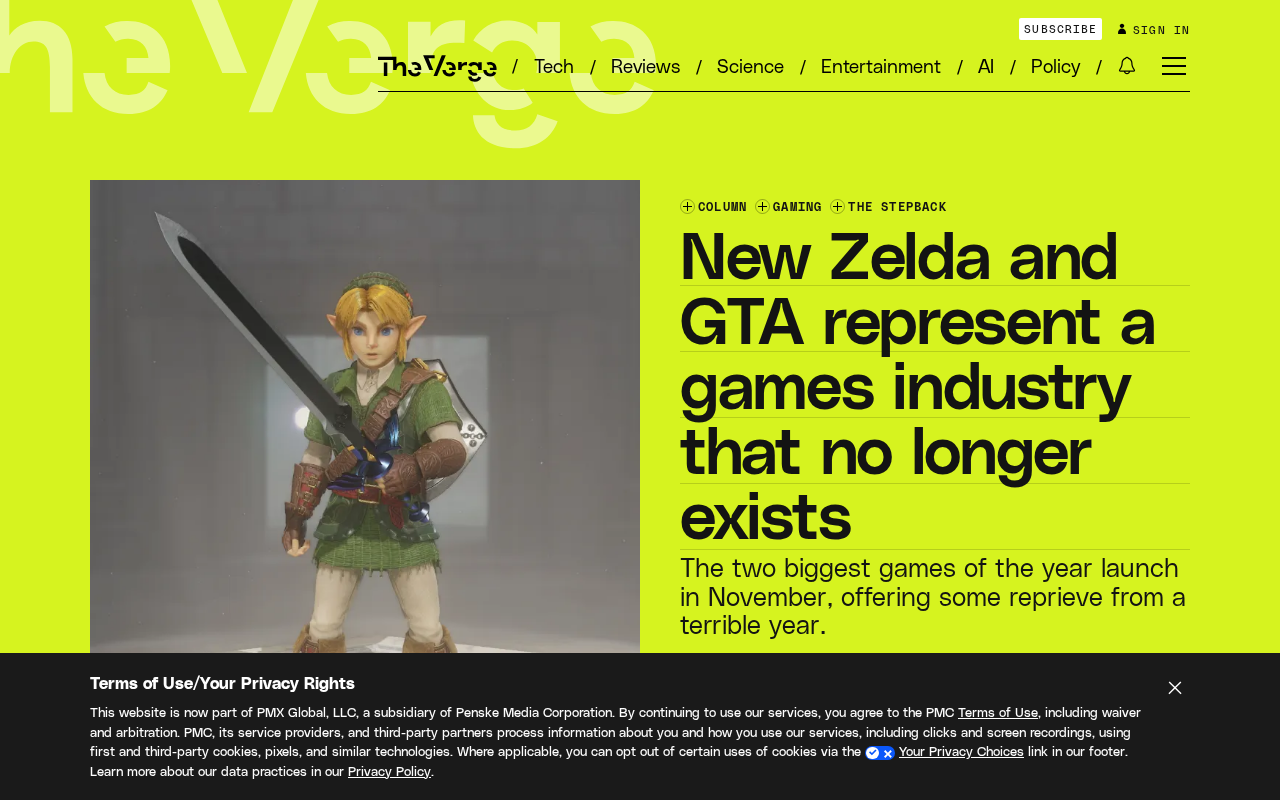
The gaming industry is undergoing a profound structural shift, and two highly anticipated titles—the new Legend of Zelda and the new GTA—have become symbols of this transformation. According to an analysis by The Stepback, The Verge's newsletter, the business models and development logic embodied by these two "biggest games of the year" may already belong to an era that no longer exists.
The Industry Fault Line Behind Two Blockbusters
In its latest issue, The Stepback points out that while the new Zelda and new GTA remain industry top-tier, the industrial environment they rely on has fundamentally changed. In the past, top-tier AAA games could count on massive single-player content, closed distribution systems, and long development cycles to secure success; today, live operations, cross-media synergy, and community ecosystems have become the new growth engines.
These two games still command unmatched brand power, but the traditional "one-time buyout, one release every few years" model they represent is being squeezed by free-to-play games, subscription services, and user-generated content. Newsletter author Andrew Webster argues that this fault line is no accident but an inevitable result of the industry's evolution to a certain stage.
AAA games is the industry term for high-cost, high-volume, high-quality (AAA) titles, typically developed by major publishers investing tens to hundreds of millions of dollars in budgets and teams of hundreds, and sold at a buyout price of around $60 on console and PC platforms. This model matured in the mid-to-late 2000s, with representative works including Call of Duty, Assassin's Creed, and the GTA and Legend of Zelda series mentioned in this article. Its commercial logic relies on high sales to amortize massive fixed costs, making it extremely sensitive to brand awareness and the launch window.
Live service, by contrast, refers to generating long-term revenue after launch through seasonal updates, in-game purchases, battle passes, and similar methods—typified by Fortnite and Genshin Impact. Unlike the buyout model's one-time cost recovery, live service pursues user retention and lifetime value (LTV), which explains the shift in what the article calls "growth engines."
The Structural Rise in Development Costs and Risk
According to The Stepback's observations, modern AAA game development costs have climbed to levels that most studios can hardly bear. Flagship projects like the new Zelda and new GTA often require teams of hundreds working over several years, and any directional misstep could send hundreds of millions of dollars down the drain. This high-risk structure pushes publishers toward conservative iteration rather than bold innovation.
Meanwhile, indie games and mid-sized teams are rising rapidly thanks to mature engines and digital distribution channels, filling the creative void left by traditional AAA. Industry resources are migrating from "a few gigantic projects" to a "multi-tier ecosystem," and the release cadence of these two flagship IPs precisely highlights the irreversibility of this migration.
Generational Turnover in Player Behavior and Business Models
The Stepback analysis also notes that how players acquire games and what they expect has changed. Younger generations of players are more accustomed to instant services, social experiences, and continuous updates rather than waiting years to buy a single-player title. While the new Zelda and new GTA remain excellent in quality, they must contend with a market reshaped by free-to-play games and subscriptions.
This generational turnover affects not only revenue models but also design philosophy. Traditional blockbusters emphasize linear narrative and closed worlds, while newer-generation products focus more on player co-creation and long-term retention. Every new announcement from these two flagship IPs becomes a window into observing this tension.
Subscription services refer to models where players pay monthly to access a game library, such as Xbox Game Pass and PlayStation Plus. It changes players' decision psychology: from "paying $60 for one game" to "trying whatever's in the library," thereby weakening the scarcity premium of any single flagship blockbuster. For publishers, subscriptions provide stable cash flow but also demand continuous content supply, further squeezing the traditional "one release every few years" cadence.
User-generated content (UGC) refers to players creating levels, mods, or gameplay using in-game tools, as in Roblox and Minecraft. UGC platforms transform players from consumers into producers, forming community-driven long-tail ecosystems—this is precisely the technical and commercial foundation of the "player co-creation" trend mentioned in the article, and an advantage that traditional closed single-player blockbusters find hard to replicate.
The End of One Era and the Beginning of Another
The Stepback's conclusion carries a certain nostalgia: the new Zelda and new GTA are poignant because they represent an old era where "blockbusters were the pinnacle." In that era, a single game could define the direction of the entire industry; today, the industry's direction is shaped jointly by countless small and mid-sized teams, platform algorithms, and community operations.
This doesn't mean flagship blockbusters will disappear, but that they are no longer the industry's sole narrative center. For players, this may be a richer, more diverse era; for traditional publishers, it means they must rethink the definition and value of "blockbuster."
This article is based on industry analysis from The Stepback newsletter, combined with publicly available information.
One-line Summary
The Stepback argues that the new Zelda and new GTA symbolize the end of the traditional AAA buyout era.
Paragraph Summary
The Stepback newsletter analysis points out that while the new Zelda and new GTA remain industry top-tier, the traditional AAA model of "one-time buyout, one release every few years" they represent is facing structural challenges. Development costs have climbed to hundreds of millions of dollars, forcing publishers into conservative iteration; meanwhile, free-to-play games, subscription services, and user-generated content are reshaping player behavior, with younger generations more accustomed to instant services and social experiences. Indie and mid-sized teams are filling creative gaps with mature engines, and industry resources are migrating from a few gigantic projects to a multi-tier ecosystem. The conclusion is that flagship blockbusters won't disappear, but they are no longer the industry's sole narrative center, and traditional publishers need to redefine the value of "blockbuster."
Related articles

AI Can Read Neural Network Weights Directly: Do Models Already Exceed Expectations?
A Reddit developer experiment shows language models can directly read neural network weights and infer their function. Astra, Opus 5.5, and Muse Spark 1.3 all passed the test, sparking discussion on model generalization and training sources.

India's Microdrama Market Explodes: EloElo Secures $80M Investment from NBCUniversal
EloElo secures $80M from NBCUniversal to boost StoryTV, its microdrama platform with over 33M monthly active users, as India's microdrama market draws global capital.

Acoustic Detection of Multi-Rotor UAVs: Fusing Handcrafted Features with Pre-Trained Embeddings
Study reveals data leakage from random splits in UAV acoustic detection, proposes source-disjoint protocol with stacked ensemble of handcrafted features and YAMNet embeddings, achieving 95.29% accuracy for low-cost drone detection.