Nexterity's Robot Takes Aim at Pipe Assembly: Automating the Most Dangerous Bolting Work

Nexterity's portable robot fits in a Pelican case and automates the dangerous bolt-torquing step in industrial pipefitting.
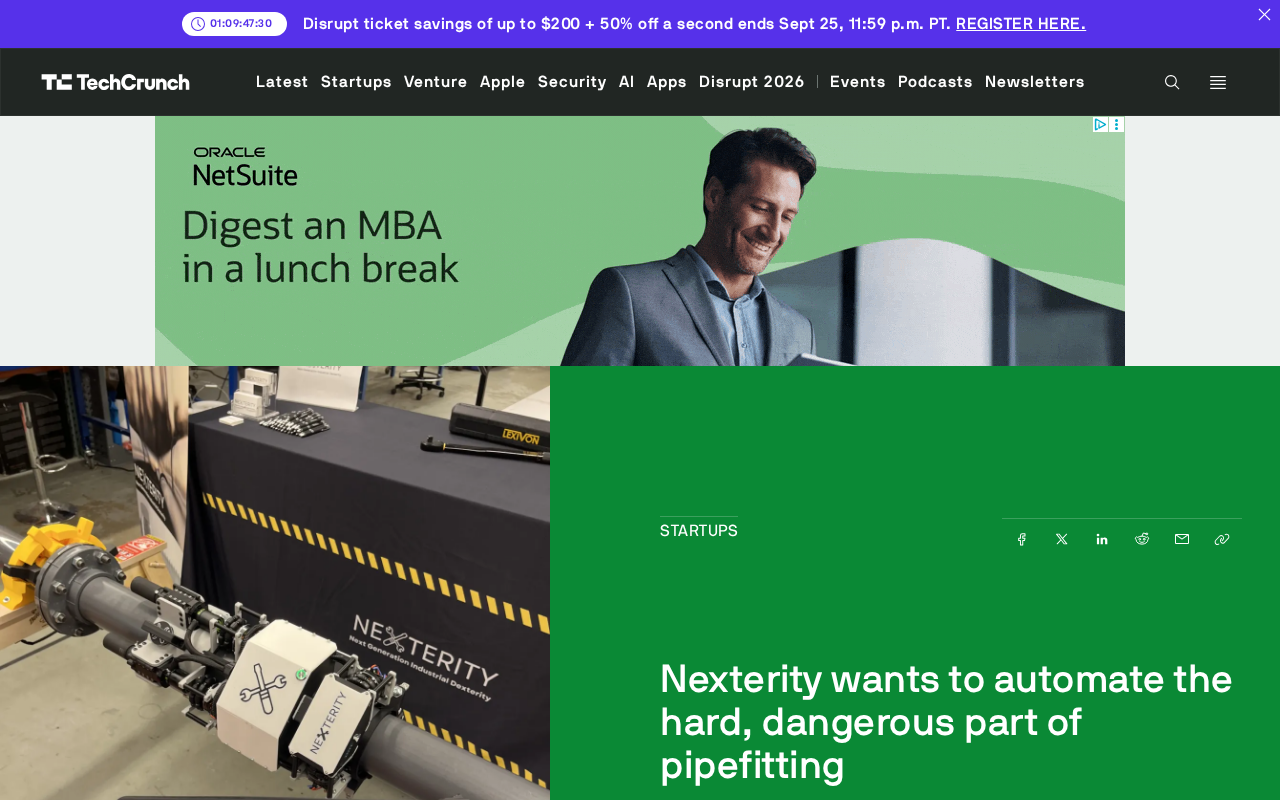
Startup Nexterity has developed a purpose-built robot for the most dangerous and physically demanding part of industrial pipefitting: tightening and loosening flange bolts. The robot can handle four bolts simultaneously and fits entirely inside a Pelican protective case, enabling true field portability for job sites like construction sites and chemical plants. It reflects a growing trend in industrial robotics toward focused, single-task automation rather than general-purpose capability — lowering the bar for commercial deployment. Key technical details such as flange alignment, torque precision, and performance in extreme environments have yet to be disclosed.
A Pipe Assembly Robot That Fits in a Protective Case
Industrial pipefitting is grueling, high-risk work. Workers must repeatedly tighten and loosen bolts on pipe flanges in cramped, high-temperature, or high-pressure environments — conditions that cause occupational injuries over time. Startup Nexterity is trying to hand off the hardest and most dangerous parts of this job to a robot.
According to disclosed information, the core capability of Nexterity's robot is the ability to tighten or loosen four bolts simultaneously. What sounds like a simple action is actually one of the most physically demanding and precision-critical steps in pipefitting — the sealing integrity of a flanged connection directly affects the safety of the entire pipeline, and bolt torque must be both uniform and up to spec.
Portability Is the Standout Feature
One of the most striking design choices is that this robot fits inside a Pelican protective case. Pelican cases are widely used in industrial and military settings for their waterproofing and impact resistance, which means Nexterity has deliberately engineered its robot to be portable and deployable in the field.
Portability is critical for pipe assembly work. Traditional automation equipment tends to be large, expensive to deploy, and suited only for fixed factory production lines. But pipefitting happens at construction sites, energy facilities, chemical plants, and other dispersed locations with complex environments. A robot that a worker can carry to a job site like a toolbox actually fits the real-world demands of this kind of blue-collar work.
Pelican is a brand under U.S.-based Pelican Products, known for its IP67-rated waterproof, impact-resistant cases with built-in shock-absorbing foam. The cases are widely used to protect military equipment, professional cameras, diving gear, and other items requiring protection in extreme environments. Using "fits in a Pelican case" as a design benchmark effectively means the robot's overall weight and volume have been brought down to something one person can carry, while also being durable enough for outdoor storage and transport in harsh conditions. In industrial circles, this design language carries an implicit reliability endorsement — it signals to potential customers that this device can be treated like a professional tool rather than a piece of precision instrumentation.
Targeting Automation Opportunities in High-Risk Blue-Collar Work
Nexterity's approach reflects an increasingly clear trend in industrial robotics: focusing automation on specific tasks with labor shortages and high injury risk, rather than pursuing a general-purpose robot for entire workflows.
Repetitive, high-intensity tasks like bolting are exactly where automation can deliver direct value — both by easing the pain point of skilled labor shortages and by freeing workers from the risk of injury. Compared to the grand ambitions of general-purpose humanoid robots, which require complex environmental perception and decision-making, purpose-built robots focused on a single high-value task are far more likely to achieve commercial deployment in the near term.
Flange bolt torquing is a critical step in pipe connection, with a core requirement of "cross-pattern even loading" — bolts must be tightened in a specific sequence and to specific torque values, gradually and evenly, to ensure the gasket is compressed uniformly without leakage or deformation. Industrial standards such as ASME B16.5 specify strict torque ranges for flanges of different pressure ratings and pipe diameters. Traditional manual work relies on hydraulic torque wrenches and worker experience, which is inefficient and prone to human error. Nexterity's design approach of tightening four bolts simultaneously directly addresses the cross-pattern even loading challenge at a process level — while improving efficiency, it also mechanically ensures consistent force application.
Open Questions Worth Watching
Based on the limited information publicly available, several key questions remain unanswered: How does the robot locate and align itself to flanges of different sizes? How is torque control precision guaranteed? In real-world conditions involving high heat, high pressure, or confined spaces, how well does it actually adapt? These will determine whether Nexterity can genuinely replace manual labor, or whether it remains a proof-of-concept demonstration.
Regardless, Nexterity represents a pragmatic approach to robotics startups: don't try to do everything — just do the dirtiest, most exhausting, most dangerous job. This targeted strategy may well be one of the most viable paths for industrial automation to make its way onto the actual job site.
Related articles

"Black October": Did AI Uncover 3% of All Critical Vulnerabilities Ever?
A Reddit post claims 3% of all critical software vulnerabilities ever were found in the past month, dubbed 'Black October.' We break down the statistical issues, how AI-assisted code auditing accelerates discovery, and how developers should respond.

Microsoft Project Gecko: Using AI to Bridge Language Gaps for African Farmers
Microsoft's Project Gecko launches PharmaChat, letting African farmers ask questions in their native language and get precise video clips and farming book chapters via AI. The project also releases three interactive manuals to advance inclusive AI.

Musk's Space Dominance: How Starlink Throttling Undermines Ukraine's Defense
SpaceX's Starshield throttling disabled Ukraine's high-speed interceptor drones, exposing how Musk's private control over low Earth orbit communications affects battlefield dynamics and national security, and highlighting the risks of commercial space militarization and space governance dilemmas.