Nexus: Seamlessly Integrate Open and Closed-Source Models into Existing AI Tools
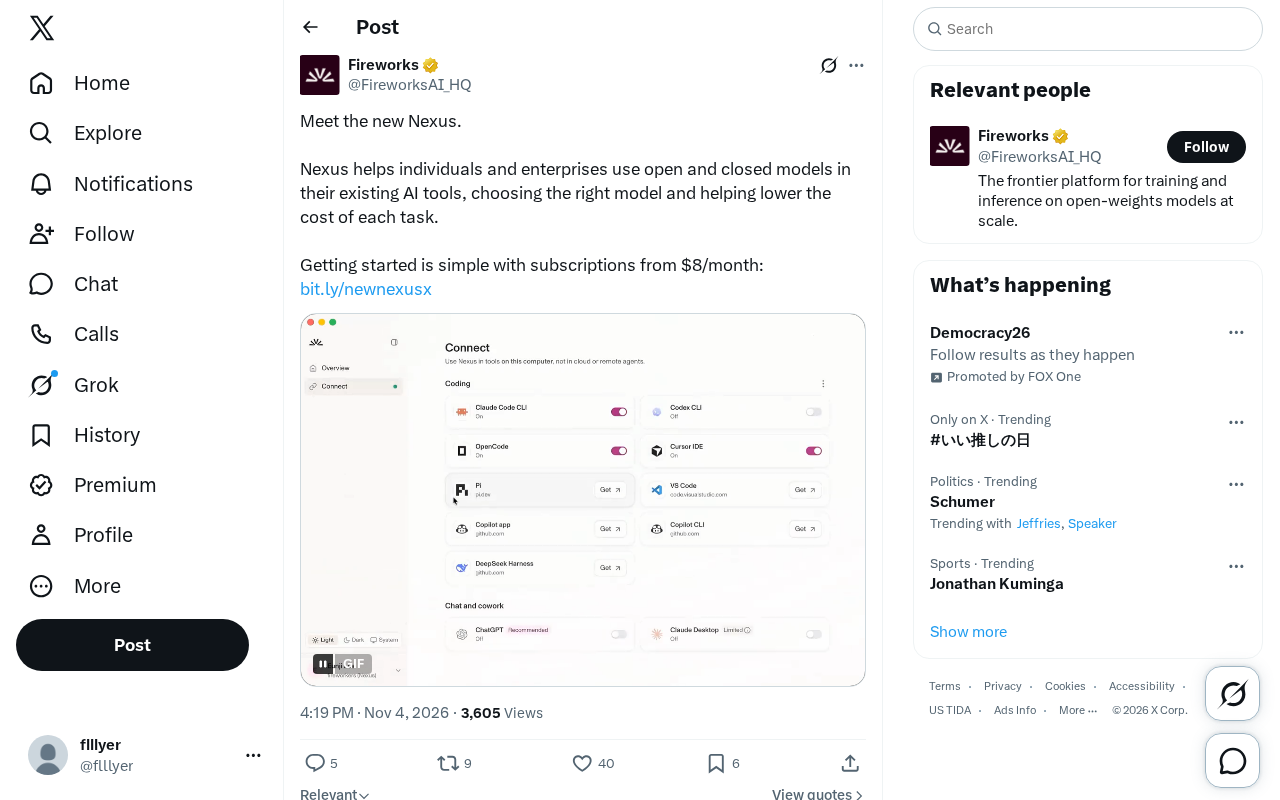
Nexus launches a model routing middle layer to integrate open and closed-source models and reduce task costs.
Nexus is a new model middle-layer platform that lets individuals and enterprises call both open-source and closed-source models within existing AI tools, automatically selecting the right model per task to lower costs. Subscriptions start at $8 per month, targeting individual developers, small teams, and enterprises. The article analyzes Nexus's core capabilities—model routing and cost optimization—and discusses its subscription model, target users, market positioning, and potential challenges. Its differentiation is embedding into existing workflows via API or plugins rather than requiring migration, but routing accuracy, output format differences, and data trust remain to be verified.
In today's landscape where AI models are flourishing, how to make open-source and closed-source models work together within existing tools has become a real challenge for individuals and enterprises. Nexus was launched precisely to address this pain point—it helps users flexibly choose different models and reduces the cost of use for each task.
What is Nexus?
Nexus is a platform designed to let users "use the right model." According to the official tweet, it supports individuals and enterprises in calling both open-source and closed-source models within their existing AI tools. The platform automatically selects the appropriate model based on task requirements, thereby reducing the cost per task while ensuring effectiveness. Subscription pricing starts at $8 per month.
This positioning hits two key pain points in current AI applications: first, difficulty in model selection—different models have trade-offs in performance, cost, and privacy; second, tool fragmentation—users often need to switch between multiple platforms, making unified management difficult. Nexus attempts to hide the complexity of model invocation through a middle layer, allowing users to focus on the task itself.
Core Capabilities: Model Routing and Cost Optimization
Nexus's most notable capability is the combination of "model selection" and "cost reduction." It does not bind to a single model provider but allows open-source and closed-source models to coexist within the same toolchain. For enterprises, this means flexible allocation based on compliance requirements or budget: sensitive tasks use local or open-source models, while high-precision needs are routed to closed-source models.
The tweet specifically emphasizes "helping reduce the cost of each task." This suggests Nexus may have task-level cost-aware routing capability—dynamically selecting the most cost-effective solution based on task complexity and model pricing. Although official technical details are not disclosed, this direction aligns with industry explorations of "model gateways" or "AI routers."
Model Routing refers to the mechanism of automatically distributing requests to different models (such as open-source small models and closed-source large models) based on task characteristics, cost budgets, latency requirements, or compliance policies. Its core logic typically includes: classification based on task complexity (e.g., simple Q&A routed to low-cost models, complex reasoning routed to high-performance models), cost-performance calculation based on model pricing and performance, and hard constraints based on user or enterprise policies (e.g., sensitive data must use local models). Common industry implementations include rule-based static routing, classifier-based dynamic routing, and adaptive routing combined with feedback learning. The value of model routing lies in avoiding the waste of "one-size-fits-all" use of the most expensive model while ensuring the effectiveness of critical tasks.
Model Gateway is a middle layer between applications and multiple model providers, uniformly encapsulating API differences across models and providing authentication, rate limiting, caching, logging, cost tracking, and routing. It allows developers to switch or combine open-source and closed-source models within existing toolchains without integrating each model separately. Model gateways also typically handle observability, helping enterprises audit model calls, analyze cost distribution, and avoid vendor lock-in. The "middle layer" positioning described by Nexus aligns closely with the model gateway concept.
Subscription Model and Target Users
Nexus adopts a subscription model with pricing starting at $8 per month. This pricing strategy clearly targets individual developers and small-to-medium teams, while also offering enterprise-level options (the tweet mentions "individuals and enterprises"). The low entry barrier helps quickly accumulate users, while the enterprise version may offer more granular management, auditing, and security features.
For individual users, Nexus's value lies in eliminating the hassle of subscribing to multiple model services separately, providing a unified entry point to use multiple models. For enterprises, the value lies in unified management of model access permissions, cost control, and avoiding vendor lock-in.
Market Positioning and Potential Challenges
The "model aggregation and routing" track that Nexus occupies is becoming crowded. There are model hosting services from cloud providers as well as open-source projects attempting to solve similar problems. Nexus's differentiation lies in emphasizing "use within existing AI tools"—meaning it may embed into users' existing workflows via API or plugins rather than requiring migration to a new platform.
Challenges are also evident: How to ensure the accuracy and transparency of routing decisions? How to handle output format differences between models? How to make enterprise customers trust a middle layer with sensitive data? The answers to these questions will determine how far Nexus can go. Currently, public information is limited, and actual experience remains to be verified.
Summary
Nexus's launch reflects a trend in the AI application layer: models are no longer scarce resources; how to use them well and use the right ones is key. By supporting the coexistence of open-source and closed-source models and optimizing costs per task, Nexus provides a pragmatic middle-layer solution for individuals and enterprises. The starting price of $8 per month also makes it worth a try. Whether it can find its place in the competition will depend on subsequent product refinement and ecosystem building.
One-line Summary
Nexus launches a model routing middle layer that enables open-source and closed-source models to work together and reduces task costs.
Paragraph Summary
Nexus is a newly launched model middle-layer platform aimed at enabling individuals and enterprises to simultaneously call open-source and closed-source models within existing AI tools, automatically selecting the appropriate model per task to reduce costs. Its subscription starts at $8 per month, targeting individual developers, small-to-medium teams, and enterprise users. The article analyzes Nexus's core capabilities—model routing and cost optimization—suggesting it may have task-level cost-aware routing, and discusses the subscription model, target users, market positioning, and potential challenges. Nexus's differentiation lies in embedding into existing workflows via API or plugins rather than requiring platform migration, but routing accuracy, output format differences, and data trust issues remain to be verified.
Related articles

Gemini 4 Hydrogen Hands-On: Google's Fastest and Cheapest AI Model
Hands-on with Gemini 4 Hydrogen: the fastest, cheapest model in the Gemini 4 family. We break down the Carbon/Argon/Hydrogen split, API pricing traps, free-tier limits, and the cost trade-offs of four thinking levels—with a real bug-debugging demo.
Gemini 4 Hydrogen vs Sonnet Comparison Test: Uses Only 1% of Weekly Quota, Performance on Par
Hands-on test: Gemini 4 Hydrogen vs Sonnet on the same CRUD task—Hydrogen used only 1% weekly quota with comparable performance and better UI details, while Anthropic's model used 7%. Developer says daily tasks don't require expensive models.

Gemini 4 Neon Released: Beats Opus 5.5 on Multiple Benchmarks, Google Returns to the Top Tier
Google DeepMind releases Gemini 4 Neon: 61 on the Artificial Analysis intelligence index (3rd) and 1st on the coding index, beating Opus 5.5 on multiple benchmarks. $3/$15 per million tokens; available in the Gemini API and AI Studio.