Nikon Photo Contest Winner Stripped of Title Over AI Traces: A Crisis of Trust Emerges
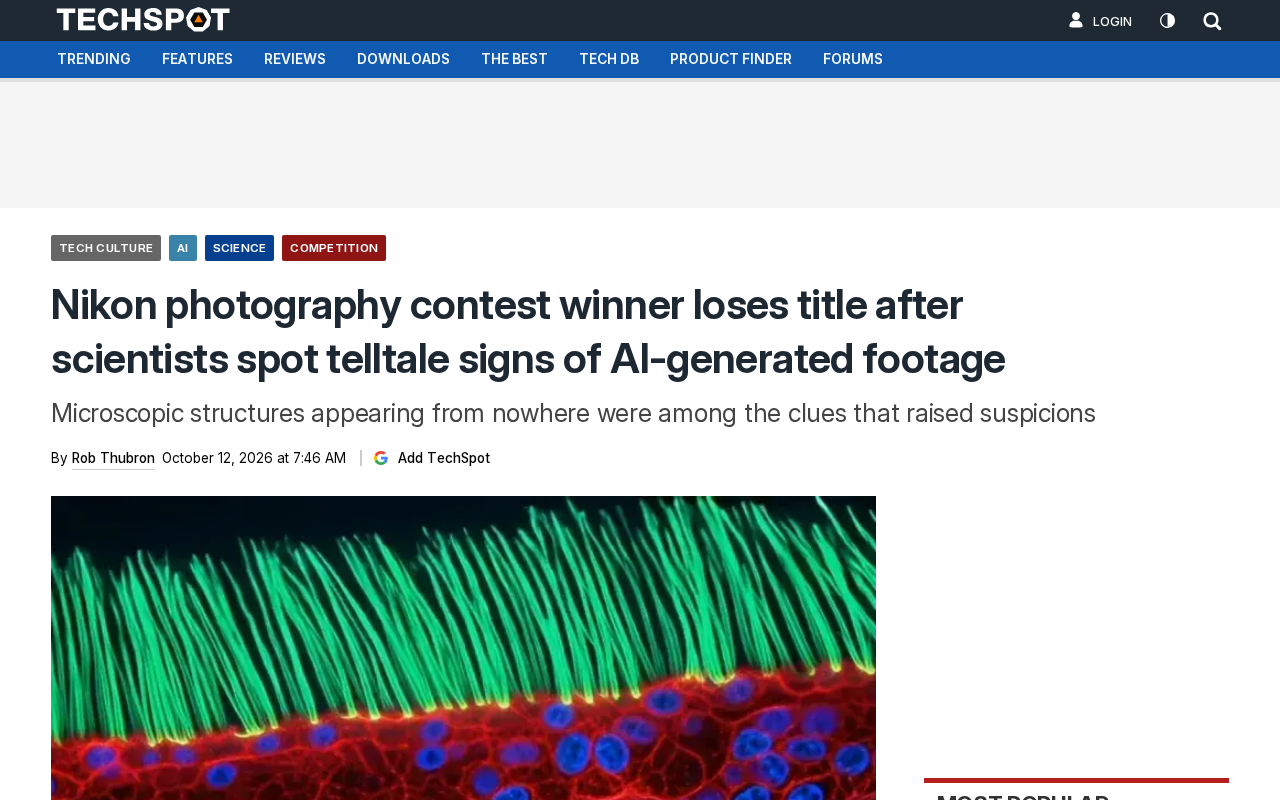
Nikon Photo Contest winner stripped of title over AI-generated traces, exposing review loopholes and a crisis of trust.
A winner of the Nikon Photo Contest was disqualified after scientists detected generative AI traces in the work. The incident arose when external image analysis experts pointed out typical AI features such as overly smooth textures and lighting contradictions, and the organizers subsequently confirmed the revocation. This exposed the lag in traditional photography competition review processes: EXIF and RAW verification methods are easily forged, and ordinary judges struggle to identify AI traces in routine judging. The incident impacts creators, organizers, and audiences alike, calling for AI detection to be moved forward and embedded into the review chain to safeguard competition credibility.
Nikon Photo Contest Winner Stripped of Title Over AI Traces: A Crisis of Trust Emerges
An international photography competition's result has been overturned—not over disputes about composition or lighting, but because scientists detected the "fingerprints" of generative AI in the winning work. According to discussions on the Hacker News community, a winner of the Nikon Photo Contest had their championship title revoked after the work was found to show signs of AI. What appears to be an isolated case has actually braided together three threads: the photography world, AI detection technology, and the credibility of competitions.
Event Recap: From Winning to Revocation
According to the original report, a winner of the Nikon Photo Contest was questioned by members of the scientific community after the results were announced. These researchers, with backgrounds in image analysis, pointed out that the work bore typical traces of generative AI, and the organizers ultimately confirmed the cancellation of the championship title. The Hacker News post received 6 points with no comments yet, indicating that discussion is still in its early stages—but the detail of "scientists identifying AI" is itself worth unpacking: it is not the intuitive judgment of ordinary viewers, but evidence pointing at the technical level.
The revocation decision means the organizers acknowledged the validity of the challenge. For a competition grounded in authentic imagery, this amounts to admitting that the review process has a loophole when faced with AI works.
How Scientists "See" AI Traces
The traces left by generative image models often lie at a level not immediately catchable by the naked eye. Researchers typically focus on several types of clues: overly smooth texture transitions, subtle contradictions in light source logic, repetitive patterns in high-frequency details, and systematic preferences of certain models in local structures. These features, when appearing individually, might be attributed to post-processing, but combined they constitute a statistical anomaly.
It is worth noting that such judgments rely on professional training and tool assistance, which ordinary judges can hardly replicate within the常规 review timeframe. This explains an awkward reality: there is a capability gap between competition judging and AI detection. According to information on Hacker News, it was the intervention of external scientists that brought the problem to light, rather than the competition's internal process intercepting it on its own.
Generative image models (such as diffusion models) work in a way that inevitably leaves statistical traces in their output. Diffusion models recover images from random noise through gradual denoising, a process that tends to produce overly consistent textures in local regions and may disrupt the physical consistency of real-world lighting. In addition, biases in model training data lead to systematic errors in specific structures (such as fingers, text, and symmetrical objects). AI detection tools typically exploit these features, using frequency-domain analysis, noise pattern detection, or training specialized classifiers to identify generated images. However, detection technology itself is engaged in an "arms race" with generative models; new models continuously reduce detectable traces, making detection reliability not absolute.
The Review Dilemma of Photography Competitions
The review logic of traditional photography competitions is built on the assumption that "the act of shooting actually happened." Participants need to submit original files and EXIF information, and some competitions also require RAW format. But when works are generated from prompts and then carefully post-processed to disguise themselves as photographic finished products, the effectiveness of these verification methods is greatly weakened. EXIF can be forged, and RAW workflows can also be reverse-engineered around generated images.
Organizers face a dilemma: too lax review allows AI works to mix in and damage the award's reputation; too strict review may inadvertently harm creators who legitimately use AI-assisted tools (such as noise reduction and outpainting). Nikon's revocation this time is a response to the former risk, but whether the process loopholes have been systematically fixed is not answered by the original information.
EXIF (Exchangeable Image File Format) is metadata embedded in image files, typically including camera model, shooting parameters, timestamp, and GPS location. Traditionally, organizers verify that a photo was taken by a real camera by checking EXIF. However, EXIF data can be easily edited or forged, and generative AI tools can output images with forged EXIF. RAW format is the unprocessed raw data recorded by the camera sensor and is regarded as more reliable evidence because it retains complete shooting information. But around generated images, attackers can reverse-engineer simulated RAW workflows—for example, using AI to generate an image, then converting it to a pseudo-RAW format through software and implanting plausible shooting parameters. Therefore, verification methods relying on EXIF and RAW face severe challenges in the AI era.
Multiple Impacts on Creators and Platforms
For participating photographers, the signal sent by this incident is clear—the "authenticity" of a work is becoming a dimension that can be scrutinized, not just artistic merit. For those relying on AI-generated content to enter competitions, the risk has risen from "might be discovered" to "already locked on by professional detection."
For competition organizers, introducing AI detection steps or requiring more complete records of the creative process may become the new standard. Behind this is a cost issue: professional detection requires manpower and technical investment, which small competitions may not be able to afford.
For audiences and sponsors, once the credibility of competition results is damaged, the cost of repair is far higher than the cost of prevention. The revocation of one championship title shakes trust in the entire award system.
Conclusion
The core of the Nikon revocation incident is not whether a certain work looks good, but whether the evaluation system can keep up with the evolution of generative technology. That scientists can identify AI traces shows that technical means exist; but the fact that detection happened after the award announcement shows that the process defense line has not been moved forward. What the photography world needs is not a one-off revocation statement, but institutional design that embeds authenticity verification into the review chain.
(This article is based on a single source of information provided by Hacker News; event details are subject to the original report.)
Related articles

Giving Coding Agents Hearing: How AirShot Closes the Audio Feedback Loop
AirShot gives coding agents audio perception: pure CPU offline operation, CLI and MCP invocation modes, with MCP avoiding 20-40s model reload delays. Critic scores against 7 professional launch videos with timestamped suggestions, registers into Cloud Code without a GPU.

MCP Protocol Explained: Giving AI Agents Tools and Memory
MCP lets AI agents securely connect to Gmail, Slack, and other tools with persistent memory. This article explains the three-step loop—connect tools, add memory, define goals—and how it eliminates repetitive work, turning AI from a chat tool into a practical productivity system.

Don't Trust AI Agent Installs? RepoGates' Five-Gate Test in Practice
RepoGates uses five gates to guard AI agents' repo clones, package installs, and MCP server additions, covering browser, Clawed Code, MCP clients, checkup, and deep scan—each with its own blind spots.