Nine-Nozzle 3D Printing: The Future of Multi-Material Color Printing Is Here
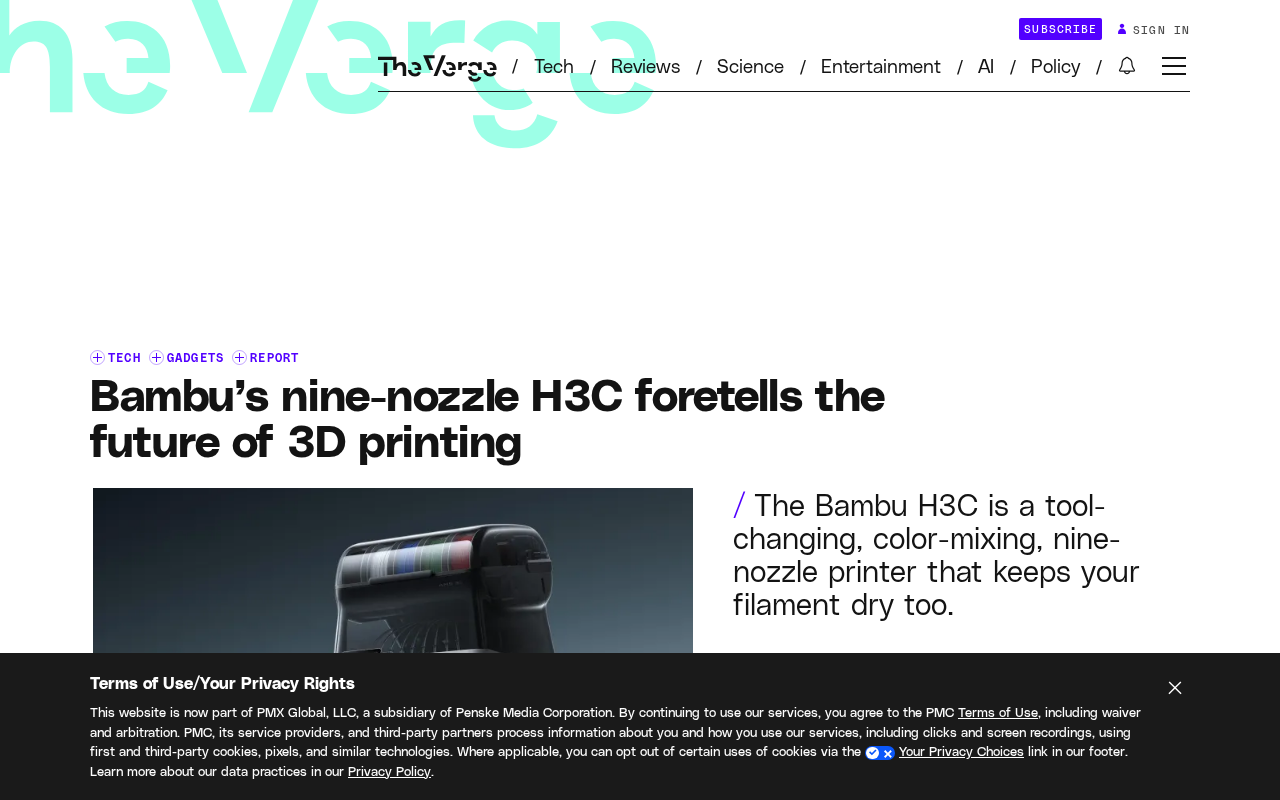
Bambu Lab's nine-nozzle H3C marks desktop 3D printing's shift from a speed race to multi-material functional manufacturing.
The article notes that consumer 3D printing's evolution is shifting from speed to multi-material capability. Bambu Lab's nine-nozzle H3C uses a multi-channel architecture for near-full-color mixing and integrated soft-hard material printing, producing functional parts with rigid skeletons, flexible seals, and colored appearance in one print. The real barrier is not nozzle count but re-architecting material-switching logic, cleaning, and path planning. The nine-nozzle approach also brings challenges like print head weight, calibration complexity, and waste costs, but signals multi-nozzle material management as the next competitive focus.
Three years ago, the main evolution of home 3D printers was still speed—parts that originally took hours or even days were compressed into minutes. Now, the next inflection point has arrived: printers are starting to switch materials mid-air, mix different colors to cover nearly the full rainbow spectrum, and even combine soft and hard materials in a single print. Bambu Lab's nine-nozzle H3C is a concentrated embodiment of this trend, signaling not an improvement in a single parameter but a shift in the entire desktop 3D printing paradigm.
From a Speed Race to Material Freedom
Over the past few years, competition in consumer 3D printing has focused on print speed. Higher-flow hotends, lighter print heads, and smarter motion planning have brought "minutes-per-part" from the lab into ordinary homes. But as speed improvements gradually approach the physical limits of mechanics and heat dissipation, manufacturers must find the next differentiation curve.
Multi-material printing is not a new concept. Early dual-extruder solutions and material-changing systems all attempted to solve this problem. But their common pain points were: slow material switching, lots of waste, harsh color transitions, and easy nozzle clogging when mixing soft and hard materials. The significance of the nine-nozzle architecture is that it turns "material switching" from a compromised add-on feature into a design premise of the print head itself.
Hotend is the core component of a 3D printer's extrusion system, responsible for heating filament to a molten state and extruding it through the nozzle. Its performance directly determines print speed and material compatibility: higher-power heater blocks and longer melt zones can increase volumetric flow rate, allowing the printer to extrude more material per unit time—this is the key hardware foundation of the recent "minutes-per-part" speed race. At the same time, hotend design also affects material switching efficiency—in multi-nozzle architectures, each nozzle is usually equipped with an independent hotend to prevent different materials from interfering with each other due to melting point differences.
What the Nine Nozzles Change
Color Mixing Approaching Full Color
Traditional multi-color printing relies on "filament switching," where each color requires an independent extrusion channel—the more colors, the bulkier the structure. The nine-nozzle approach can call on multiple channels in a single print, using combinations and ratio control of different colors to approximate a continuous color spectrum. This means that work such as gradients and realistic texture reproduction—previously requiring post-painting or segmented printing—can be completed in a single build.
Integrated Soft and Hard Materials
More noteworthy is the ability to mix soft and hard materials. Rigid structural parts provide strength, while soft materials provide cushioning, sealing, or hinge functions. Combining the two in the same part enables direct printing of functional components with moving joints or flexible contact surfaces. For scenarios such as hand-board validation, wearable device prototypes, and robot end effectors, the value is far higher than simply "looking good."
Combining soft and hard materials in FDM printing faces a fundamental challenge: interfacial adhesion. Hard materials (such as PLA, PETG, ABS) and soft materials (such as TPU) differ in chemical compatibility and thermal expansion coefficients. If the interface bond is not strong during printing, parts tend to delaminate or tear under load. In addition, soft materials tend to bend and deform during extrusion, requiring specialized extruder structures for support. The nine-nozzle approach can optimize extrusion parameters separately for soft and hard materials by assigning independent channels, but interfacial bond strength remains the key metric determining whether such parts are truly "functionally usable."
Re-architecting the Material-Switching Logic
The nine nozzles are not just "more nozzles." As the number of nozzles increases, the material-switching path, cleaning strategy, and waste control all need to be redesigned. If switching materials once requires a large amount of wiping, the cost and efficiency advantages of multi-material printing are offset. Therefore, the real barrier for such machines is not the number of nozzles itself, but the material-switching and path-planning system built around multiple nozzles.
Wiping and the prime tower are key mechanisms for controlling print quality in multi-material printing. When the printer switches from one nozzle to another, residual material may drip or string, so the nozzle needs to be wiped in a designated area and a prime tower printed to re-establish stable extrusion pressure. The volume of the prime tower and the number of wipes directly affect filament waste and print time. If the nine-nozzle architecture switches frequently, the prime tower may become very large, offsetting the efficiency advantages of multi-material printing—this is precisely the core issue that material-switching path planning needs to optimize.
What It Means for Ordinary Users
For users who treat 3D printers as "making tools" rather than "toys," multi-material capability opens up design space. A single part can simultaneously have a rigid skeleton, flexible sealing, and colored appearance markings, reducing assembly steps and post-processing. Model designers no longer need to repeatedly split models over the question of "can this structure be printed in one go?"
From an industry perspective, the nine-nozzle architecture sends a clear signal: desktop 3D printing is moving from "single-material rapid prototyping" toward "multi-material functional manufacturing." Speed still matters, but it is no longer the only narrative thread. When a machine can simultaneously handle color, hardness, and functional gradients within a single product, 3D printing takes another step closer to the goal of "directly manufacturing usable parts."
Real-World Issues Still to Watch
The nine-nozzle approach is not without costs. More nozzles increase print head weight and motion inertia, placing higher demands on stability during high-speed printing; calibration and maintenance complexity for multiple channels is also significantly higher than for single-nozzle machines. In addition, waste management and filament costs for multi-material printing remain factors ordinary users need to weigh.
What is certain is that Bambu's nine-nozzle H3C has pushed multi-material printing from "an experiment for a few players" toward "a standard direction for consumer products." In the coming years, material management, slicing algorithms, and waste optimization around multiple nozzles are likely to become the new main battlefield of desktop 3D printing competition.
One-line Summary
Bambu Lab's nine-nozzle H3C marks desktop 3D printing's shift from a speed race to multi-material functional manufacturing.
Paragraph Summary
The article points out that the main evolution of consumer 3D printing is shifting from print speed to multi-material capability. Bambu Lab's nine-nozzle H3C uses a multi-channel architecture to achieve near-full-color mixing and integrated soft-hard material printing, enabling a single print to produce functional parts with a rigid skeleton, flexible sealing, and colored appearance. The real barrier to multi-material printing is not the number of nozzles but the re-architecture of material-switching logic, cleaning strategies, and path-planning systems. The nine-nozzle approach also brings real challenges such as increased print head weight, complex calibration and maintenance, and waste costs, but it clearly signals that multi-nozzle material management will become the focus of the next stage of competition.
Related articles

Anthropic's IPO Eve: Five Risks Behind the Trillion-Dollar Valuation and the Truth About Its Governance
Breaking down Anthropic's IPO prospectus: $184M daily revenue at a trillion-dollar valuation, the truth behind $104B in paper losses, a five-class share governance structure, unusual disclosures in 94 pages of risk factors, and how the lock-up schedule may affect retail investors.

FBI Warns: Hackers Weaponize AI Agent ARTEX to Attack 200+ Organizations
FBI warns that AI penetration framework ARTEX is being used to attack 200+ organizations, with CrowdStrike tracking the VaporPanda group. We break down ARTEX's agent orchestration architecture, the real attack chain, loss data, and the FBI's five defense recommendations.

FBI Warns: Free AI Hacking Tool Artex Spirals Out of Control, Breaches Cloud Systems in Three Hours
FBI warns that the free open-source AI penetration tool Artex is being abused by criminals and state-backed hackers to breach cloud systems in as little as three hours. This article analyzes real attack cases, overlooked side-door risks, and defense measures enterprises and individuals can take immediately.