NiroHelp: An AI-Native Customer Support Tool Built for WordPress

NiroHelp is a WordPress-native AI support plugin that answers customer inquiries from your docs with a human fallback.
NiroHelp is an AI customer support tool for WordPress sites that reads existing product documentation and help center content to instantly answer customer questions and handle support tickets automatically — helping lean teams manage repetitive inquiries at lower cost. It emphasizes deep "All inside WordPress" integration to minimize friction for teams without technical resources. A built-in AI-human handoff mechanism transfers conversations to human agents when the AI lacks confidence, maintaining a quality floor. The product recently launched on Product Hunt with 14 votes and an 8th-place ranking, and is still in early stages with accuracy, pricing, and scalability yet to be broadly validated.
As customer support costs continue to rise, more and more small and mid-sized teams are looking for AI-powered solutions to handle repetitive inquiries. NiroHelp is built precisely for this need — it embeds AI customer service capabilities directly into WordPress, allowing site operators to automate documentation-driven responses without building complex external systems.
The product recently appeared on Product Hunt, earning 14 upvotes and ranking 8th on its launch day, categorized under Customer Communication, Artificial Intelligence, and CRM.
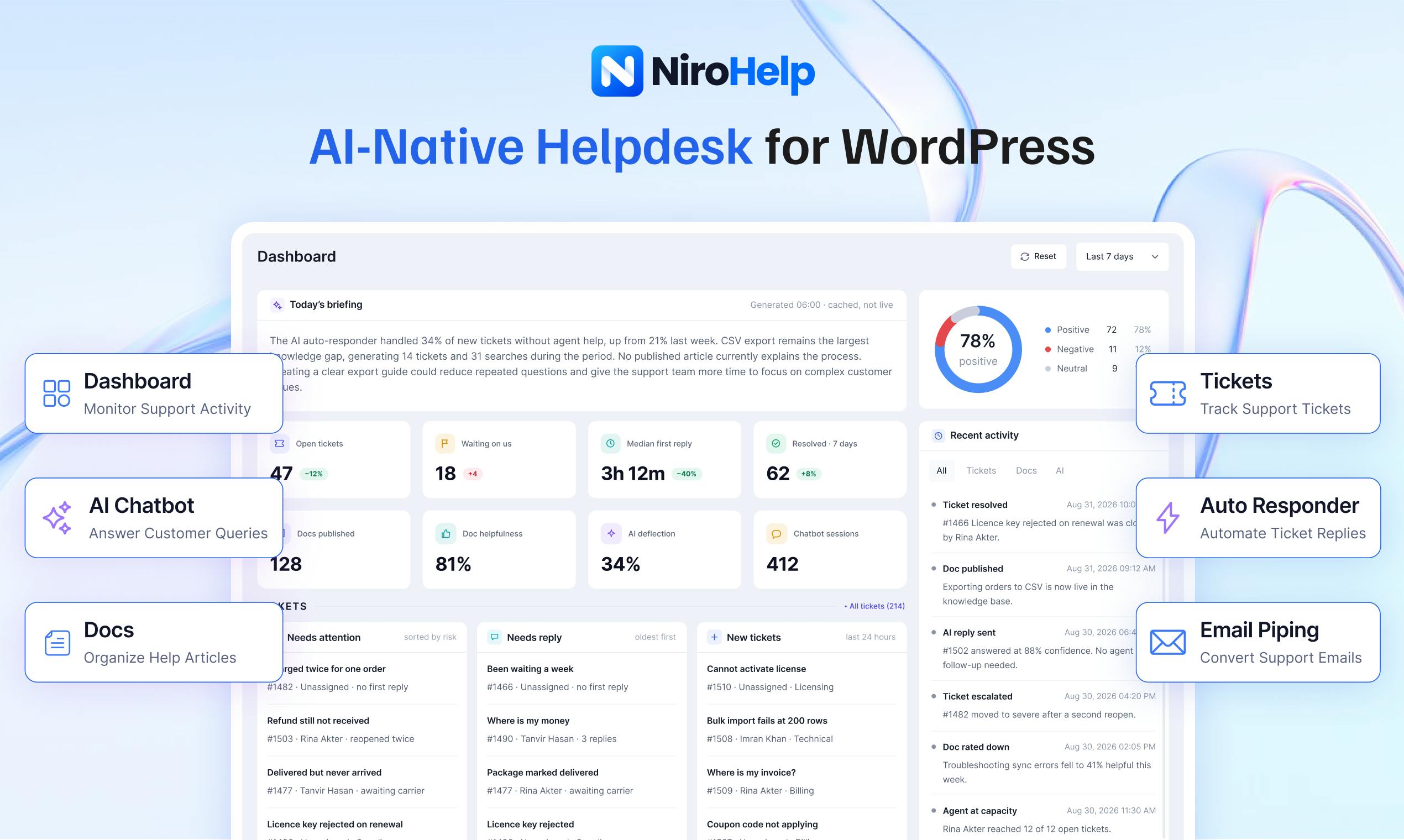
Core Concept: Answer Customer Questions With Your Own Docs
NiroHelp's positioning is clear — AI-native support for WordPress. Its underlying logic is straightforward: it reads your existing product documentation and help center content, then instantly answers customer questions in a chat widget and automatically replies to support tickets.
The real value of this approach lies in turning your knowledge base into a conversational asset. For most teams, customer questions tend to be highly repetitive — support staff spend significant time each day fielding the same inquiries. NiroHelp aims to have AI absorb this workload, freeing up human attention for genuinely complex situations that require judgment.
The official pitch points directly to two key metrics: fewer people and lower costs. Serving more customers with a smaller team, while delivering faster response times — that's the core value proposition.
This "documentation-driven" AI support model typically relies on a RAG (Retrieval-Augmented Generation) architecture under the hood: documents are chunked and vectorized into a database, and when a user asks a question, the system performs a semantic search, then feeds the matched content along with the question into a large language model to generate an answer. Compared to fine-tuning a model directly, RAG's advantage is that the knowledge base can be updated at any time without retraining. The limitation, however, is that answer quality depends heavily on the coverage and clarity of the underlying documentation — the more complete and well-structured your docs, the more consistently the AI performs. For teams considering adopting tools like this, auditing and improving their knowledge base is often the most valuable preparation before going live.
Human-in-the-Loop: Handing Off to Humans When AI Is Uncertain
One noteworthy design choice is NiroHelp's emphasis on "AI-human handoff" — when the AI isn't confident about an answer, the conversation is transferred to a human agent.
This directly addresses a common trust issue with AI-based support. Fully automated responses frequently frustrate users by missing the point, which can make customer dissatisfaction worse. NiroHelp's fallback mechanism preserves the efficiency gains of automation while using human intervention to maintain a quality floor. For teams whose documentation isn't fully comprehensive, or whose business logic is complex, this incremental approach to AI adoption is much easier to accept.
In other words, NiroHelp isn't trying to fully replace support staff — it positions AI as a first-pass filter for handling the long tail of repetitive questions.
"AI-human handoff" is an important design paradigm in customer service automation. Common triggers include: AI confidence falling below a threshold, users explicitly requesting a human, conversations involving sensitive actions like refunds or complaints, and repeated failure to resolve an issue over multiple turns. Calibrating when to hand off is a delicate balancing act — too early undermines the value of automation, too late risks frustrating users. Mature support systems typically also pass the full conversation context to the human agent at handoff, so users don't have to repeat themselves. NiroHelp's publicly available information doesn't detail how configurable these trigger rules are — this is worth asking about directly when evaluating the product.
What Deep WordPress Integration Actually Means
NiroHelp repeatedly emphasizes "All inside WordPress" — every feature runs within the WordPress environment. For its target audience, this is a compelling differentiator.
WordPress powers a massive share of small business websites, blogs, and e-commerce platforms worldwide, and these users typically lack the technical resources or budget to deploy standalone customer service systems. Bringing AI support directly into the WordPress ecosystem means a much lower barrier to entry: no switching between platforms, with documentation, chat, and ticketing all operating in the same environment.
For teams that have already built their content and operations around WordPress, this "upgrade in place" approach is far less disruptive than migrating to an external SaaS support tool. This is also the strategic rationale behind NiroHelp's choice to go deep on the WordPress ecosystem rather than building a generic customer service platform.
WordPress currently powers roughly 43% of all websites globally, and its plugin ecosystem boasts over 59,000 plugins covering everything from e-commerce (WooCommerce) to membership systems. Because of this enormous ecosystem, SaaS tools purpose-built for WordPress can establish meaningful competitive differentiation against general-purpose alternatives: plugin distribution means organic visibility in the official WordPress plugin directory, and deep integration with native objects like the Gutenberg editor and WooCommerce order data is something generic support platforms simply can't replicate through webhook integrations alone. This explains why "All inside WordPress" isn't just a tagline for target users — it genuinely reduces the learning curve and the risk of data silos.
Who It's For — and What Remains to Be Seen
Based on its positioning, NiroHelp's ideal user is a lean small-to-medium business or independent developer running a WordPress site and facing growing support demands without the headcount to match. The value proposition is clear, and the entry point is pragmatic.
That said, as an early-stage product that just debuted on Product Hunt, publicly available information is still limited. Key details — including AI answer accuracy, multilingual support, how quickly documentation syncs, and pricing — still need to be validated. The 14-upvote showing also indicates it's still in the early stages of user acquisition, with real-world performance and scalability yet to be tested by a broader user base.
For teams actively looking for a lightweight AI support solution for their WordPress site, NiroHelp is worth keeping an eye on and testing out — but it's worth assessing fit against your own documentation quality and business complexity before committing.
Related articles

Random Pruning of the DPO Computation Graph: 1.4x Training Speedup and Lower Peak Memory
DPO training too slow and memory-hungry? This paper proposes a random pruning framework for the DPO computation graph, sampling independently across position, sequence, and branch dimensions; branch pruning achieves a 1.426x step-time speedup and cuts training time by about 30%, with in-depth attribution of memory and time gains.

Why Does JEPA Underperform MLM in Longitudinal EHR Representation Learning?
New study compares JEPA and MLM for longitudinal EHR representation learning on MIMIC-IV: three JEPA variants train stably without collapse but underperform MLM; target size, not heterogeneity, drives prediction error.

Transfer Learning + Visible Light Communication: A New Approach to Energy-Efficient Indoor Positioning
A study proposes a transfer learning-based visible light communication indoor positioning method, achieving 47% accuracy improvement on the BOSCH factory dataset, 67.5% model efficiency under high noise, and introducing the ME composite metric for energy-efficient positioning in energy-constrained industrial IoT scenarios.