No Code, No Editor: The New Product Development Paradigm in the AI Era

Frontend programmers discuss the AI-era dev workflow: design-driven, no code reading, multi-model division of labor, and private distribution.
Three frontend programmers on a podcast discussed the product development workflow after AI's deep involvement. The core change is a reversed process: use MCP to connect Figma to the coding Agent, have the model produce 2-3 UI/UX proposals and minimize steps for core tasks, draw edge cases and error messages before implementation, with humans only selecting and correcting copy. Code is no longer read line by line—only config files and docs are scanned for drift, and quality relies on the model's self-run tests and continuous bug reports. Opus 5.5 is the shared main model, with Codex retained only for image generation and computer use. Projects hand off by phase: Claude Code before 1.0, Grok Bot for maintenance, releases, and SEO monitoring afterward. They also discussed the $99 Apple Developer Program shifting from a publishing ticket to a "Pro OS" subscription, and the resurgence of native, one-off, personalized apps.
When three frontend programmers got together on a podcast to discuss "do we still use IDEs," the answer was unanimous—no. One of them even wrote his own lightweight editor just to tweak configs and view Markdown. The conversation centered on one core question: when models are powerful enough to write their own docs, run their own tests, and maintain their own context, what should the product development workflow actually look like?
From "Discuss Requirements First" to "Design-Driven Development"
Over the past two years, the mainstream approach was to first discuss technical choices with AI, settle on a framework, have it implement, and finally fine-tune the interface. Now the process has reversed: start with two or three UI/UX proposals from Figma, have AI minimize the number of steps users need to complete core tasks in each proposal, then let a human pick.
In practice, Figma is connected to the coding Agent via MCP, and after requirements are discussed, the model produces multiple interaction proposals. The model writes the copy as well—and copy is precisely where AI is most likely to fall flat—so people can point out directly in Figma that "this sentence can't be written that way." Once a direction is chosen, the model is asked to draw out edge-case interactions and error messages too, forming a complete preview before implementation.
Why Figma instead of Claude's Artifact? The interviewees' judgment: continuously iterating products need a manageable Design System and Components, and Figma is more mature at managing design assets within a single file. Artifact can run, annotate, and be handed directly to a coding Agent, but it's web-first—when designing native apps, it gets forcibly downgraded to a web version, losing native interaction details.
Another developer added the other side of Artifact: the fact that it can run is actually a double-edged sword. When repeatedly adjusting prototypes, the model can't distinguish which assumptions are for demo purposes and which are real product logic, and may end up dragging garbage code into production. Figma's boundaries are clearer—it only provides visual reference, and the coding Agent absorbs a clean code architecture from it.
MCP (Model Context Protocol) is an open protocol proposed by Anthropic that connects external tools and data sources to large model applications in a unified way. Think of it as a "USB-C interface" between AI and the outside world: Figma, GitHub, local file systems, databases, etc. all expose their capabilities as MCP Servers, and coding Agents call them on demand as MCP Clients. The article's phrase "connect Figma to the coding Agent via MCP" means giving the model read access to Figma's design files, components, and artboards, so it can directly see interface screenshots and layer structures to produce interaction proposals—rather than relying on people copying and pasting screenshots. The significance of MCP's standardization is that the same tool integration can be reused across different clients like Claude Code and Cursor.
Code Isn't Read, But It Gets a Glance
When asked "do you still read code," the answer was "I don't anymore." Day to day, they only scan config files—package.json, Markdown, YAML, JSON—to quickly judge what the model changed and whether the file organization shows obvious drift. For example, when building an Agent product, if you find the model has written a large number of regular expressions to guess user intent, this kind of error won't surface during conversation, but a quick glance at the code reveals it.
How is code quality ensured? The answer is testing. Claude Code writes its own tests, runs its own tests, and accumulates new test cases with every bug fix. Developers use their own product daily and keep filing bugs until usage stabilizes and the bug report curve stops climbing steeply—that's basically when it's ready for a stable release.

The Agent's self-written, self-run test loop is the key prerequisite for whether this "don't read code" workflow can hold up. In tools like Claude Code, the model can directly execute shell commands, run test frameworks, read failure output, modify code, and rerun repeatedly, forming an autonomous "write tests—execute—fix" cycle. Its difference from traditional TDD is that test cases are mainly generated by the model inferring backward from bug reports, and the human's role shifts from writing assertions to providing failure scenarios and acceptance criteria. This also explains why the article treats "whether the bug report curve flattens" as a release signal: test coverage is generated spontaneously by the model, humans can't review it case by case, and can only indirectly assess quality by continuously exposing problems through daily use.
Model Division of Labor: Opus as the Main Force, Codex Guarding the Flanks
The three developers' main model is highly consistent: Opus 5.5. The reasons center on two points—stable completion quality, questions asked at key points, and pausing to confirm when it should. Fable 5.1 is considered valuable for early exploration on critical paths, but it burns through budget quickly; for daily tasks, Opus is sufficient.
Codex was "abandoned," but not entirely dismissed. It still wins in two scenarios: image generation and computer use—drawing logos, making icons, supporting layered vector export, and using a virtual mouse to operate the screen without seizing the real mouse. As for the experience of raising reasoning effort only making errors more absurd while guzzling tokens, that was honestly complained about too.
An interesting image-generation approach uses a relay station API plus a skill: feed the relay station API documentation for multiple image generation models to AI, have it write a skill, and when called within Claude, Claude selects the appropriate model based on the need and writes the prompt on its behalf. The result is no longer a single model's output but a multi-model collaboration.
Multi-Session Collaboration and Relay Handoffs
Once project complexity ramps up, a single session isn't enough. One browser project's approach: Mac as the main machine develops shared logic, a Windows session handles the corresponding platform's UI, and the two Claude sessions communicate directly to sync. Web version prototypes are handled by a cloud-based Cloud session.
Phase division is also clear: before 1.0, use Claude Code, requiring lots of idea collision and repeated revision; after 1.0, transition into maintenance, handing small fixes to Grok Bot. Grok Bot also handles App Store Connect CLI operations, monitors App Store reviews and automatically submits PRs to the landing page, and analyzes SEO data from Google Search Console and Analytics daily. These "manual labor" operations and operations tasks are exactly what AI excels at.

Context anxiety is largely dissolved in this workflow. The model writes all discussion conclusions and phase milestones into Markdown documents in the repository, to be looked up from docs when needed rather than relying on session history. agent.md gets shorter and shorter—now only five or six lines—because the model's own evolution outpaces the rate at which humans accumulate rules.
agent.md and context engineering: agent.md (along with files like CLAUDE.md and AGENTS.md) is a specification file placed in the repository to persistently inject project conventions into the coding Agent, including tech stack, directory structure, coding standards, and common commands. It's essentially the model's "onboarding manual," automatically loaded at the start of each session to avoid passing context through conversation history. The article mentions it "gets shorter and shorter, now only five or six lines," reflecting a shift in context engineering thinking: early on, there was a tendency to hard-code all rules explicitly, but later it was found that as model capabilities improved, lengthy rules became noise and constraints; distilling conclusions into repository docs and letting the model retrieve them on demand proved more effective than stuffing them into persistent prompts.
What $99 Buys Isn't Publishing Rights—It's a Pro Version of an Operating System
The discussion finally lands on a more interesting judgment: the meaning of the $99/year Apple Developer Program has changed. It used to be about publishing apps to the App Store to recoup costs or even make money; now it's more like subscribing to a "Pro version of an operating system"—you can arm your own iPhone and Mac, and with a prompt, modify a version for your own use.
One developer's observation is that everyone has a desire to share their work with others. He taught his non-programming wife to build a website with AI, and they got stuck at the step "what does going live mean." The barrier still exists, but if it's lowered further, platforms like TestFlight could shift from testing tools to the main venue for small-scale private distribution—a family, a group chat sharing self-made apps.

This is also why native development has become attractive again: notifications, photo library permissions, full-chain control—the web version always gives you the minimum. When AI levels the playing field for native development, frontend programmers' limitations are exposed—not a matter of ability, but of platform permissions.
Product forms themselves are also changing. One-off apps and personalized apps will become more common—for the same token usage monitoring tool, there are many competitors, and which one to use depends on personal taste, so you might as well have Opus replicate one yourself. Making an app you can't put down first, then considering scaling—that became the more endorsed path in this round of discussion.
TestFlight and the boundaries of private distribution: TestFlight is a Beta testing distribution service provided by Apple. Developers can invite external testers to install builds not yet on the store; the external tester limit is 10,000, and builds typically have a 90-day validity period. Its positioning is testing, not long-term distribution, so the article's idea of it "becoming a platform for small-scale private distribution" still has limitations under current rules. What needs to be distinguished: App Store listing review is for public distribution, TestFlight is for controlled audiences, and enterprise signing and Ad Hoc distribution are for internal devices. After AI lowers the development barrier, what's truly changed is the cost of "making it," not the compliance path for "distributing it to others."
One-line Summary
Frontend programmers discuss the AI-era development workflow: design-driven, no code reading, multi-model division of labor, and private distribution.
Paragraph Summary
Three frontend programmers on a podcast discussed the product development workflow after AI's deep involvement. The core change is a reversed process: first connect Figma to the coding Agent via MCP, have the model produce 2-3 UI/UX proposals and compress the steps users need to complete core tasks, draw out edge cases and error messages before implementation, and let humans only select and correct copy. Code is no longer read line by line—only config files and docs are scanned to judge drift—and quality relies on the model's self-written, self-run tests and continuous bug reports during daily use. On model division of labor, Opus 5.5 is the shared main force, and Codex retains value only in image generation and computer use scenarios. Projects are handed off by phase: before 1.0, Claude Code is used for repeated idea collision; afterward, Grok Bot handles maintenance, releases, and SEO monitoring. Finally, they discussed how the $99 Apple Developer Program is shifting from a publishing ticket to a "Pro version of an operating system" subscription, and the resurgence of native development and one-off, personalized apps.
Related articles
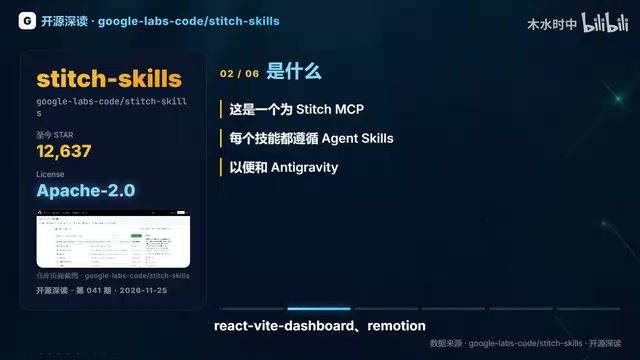
Google Stitch Skills: Connecting Coding Agents to the Design Workflow
Google Stitch Skills is an Agent Skills library following the open standard, adding a design-to-code workflow to the Stitch MCP Server. This article breaks down its three skill groups, SKILL.md directory structure, installation paths, and dependency pitfalls.

40.5-Inch Color E-Paper Art Frame: An Art Display You Charge Once a Year
The Ink Poster Tella 40.5-inch color e-paper art frame uses the E Ink Spectra 6 full-color solution: A1 format, no backlight, no noise, about one charge a year, 2,000+ licensed artworks built in, and automatic adaptation of phone photos.

Jingle Jam Memories: RT's Awkward First Encounter with Lewis
RT shares his awkward first Jingle Jam experience: unexpectedly pushed into the studio, meeting Lewis and Yogg's cast, and Toddy appearing in armor.