No Paired Data Needed: How Identifiable Alignment Revolutionizes Model Fusion

NGMA uses pullback distance of data metrics to align models without paired data.
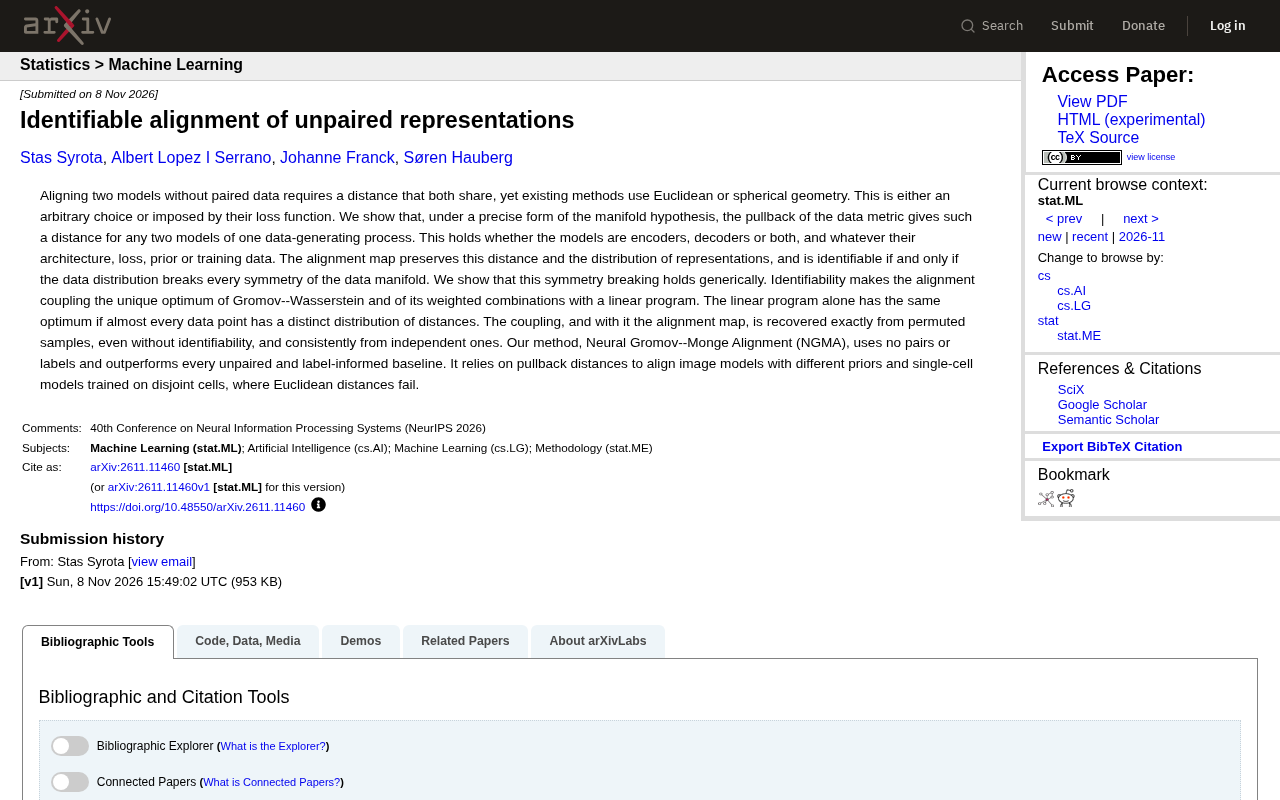
The article introduces Neural Gromov-Monge Alignment (NGMA) from an RSS study, addressing model alignment without paired data. The core insight is that under the manifold hypothesis, any two models from the same data-generating process can obtain a natural distance via pullback of the data metric, independent of architecture, loss, or prior. The authors prove identifiability when data breaks manifold symmetries, holding generically. NGMA requires no pairs or labels and outperforms all unpaired and label-informed baselines on image and single-cell alignment. The article also discusses computational efficiency debates and potential impacts on model fusion and transfer learning.
Introduction: The Challenge of Unpaired Alignment
In artificial intelligence, aligning two models often requires paired data, but in real-world scenarios paired data is scarce and expensive. How can we find correspondences between two representation spaces without paired samples? Traditional methods rely on Euclidean or spherical geometry, but these choices are either arbitrary or imposed by the loss function. A study from RSS proposes a completely new perspective: under the manifold hypothesis, the pullback of the data metric provides a natural distance for any two models originating from the same data-generating process. The method is called Neural Gromov-Monge Alignment (NGMA), and it requires no pairs or labels, yet it outperforms all unpaired and label-informed baselines.
Core Insight: Pullback Distance and Identifiability
Pullback Distance: A Natural Metric on the Data Manifold
The study points out that under the exact manifold hypothesis, the representation spaces of any two models (whether encoders, decoders, or both) can obtain a shared distance through the pullback of the data metric. This distance does not depend on model architecture, loss function, prior, or training data, as long as they originate from the same data-generating process. The alignment map preserves this distance and the distribution of representations, and its identifiability depends on whether the data distribution breaks all symmetries of the data manifold.
The authors prove that this symmetry breaking holds generically. That is, for most real data distributions, the alignment map is uniquely determined. This finding provides a theoretical cornerstone for unpaired alignment.
Manifold Hypothesis and Pullback Metric: The manifold hypothesis states that high-dimensional observed data actually lies on a low-dimensional smooth manifold—for example, although image pixel space is high-dimensional, natural images concentrate near a low-dimensional manifold. If an encoder maps data to a representation space, then distances on the data manifold can be "pulled back" to the representation space through the encoder: for two points in the representation space, one first goes back to the data space via the decoder (or inverse map), then computes the distance in the data space. This pullback metric depends only on the data-generating process and the mapping itself, and is independent of the specific network architecture, training loss, or prior. Therefore, the representation spaces of any two models originating from the same data-generating process can obtain a comparable shared distance through the pullback, which is the fundamental reason why NGMA can align without paired data.
The Mathematical Meaning of Identifiability
Identifiability means that the alignment coupling is the unique optimal solution of Gromov-Wasserstein and its weighted combination with linear programming. More surprisingly, if almost all data points have distinct distance distributions, linear programming alone has the same optimal solution. This greatly simplifies computation while guaranteeing uniqueness.
Gromov-Wasserstein Distance: The Gromov-Wasserstein (GW) distance compares two metric spaces; it does not require point-to-point correspondences between the spaces, but instead compares the distance structures within each space. Given two spaces and their distance matrices, GW seeks a coupling (i.e., a joint distribution) that minimizes the discrepancy of distances under the coupling. Unpaired alignment problems are naturally suited to GW modeling because the representation spaces of the two models have no known point correspondences. However, GW optimization is non-convex, and the optimal coupling is not necessarily unique. The theoretical contribution of NGMA is to prove that, under the pullback distance, if the data distribution breaks the manifold symmetries, then GW and its weighted combination with linear programming have a unique optimal solution, providing a rigorous guarantee for the identifiability of unpaired alignment.
The NGMA Method: From Theory to Practice
Algorithm Design: Precise Recovery Without Pairs
The core of NGMA is to construct an alignment map using the pullback distance. Even without identifiability, the method can exactly recover the coupling and alignment map from permuted samples, and consistently recover them from independent samples. This means that in practical applications, even if the theoretical conditions are not fully satisfied, NGMA can still provide reliable results.
Compared with existing methods, NGMA does not rely on paired data or labels, yet it outperforms all unpaired and label-informed baselines in experiments. For example, in image model alignment tasks, NGMA can successfully align even when the two models have different priors; in single-cell model alignment, NGMA remains effective even when training data come from disjoint cell populations, whereas Euclidean distance fails.
Permuted Samples and Independent Samples: Permuted samples refer to the case where the inputs to the two models are different permutations of the same set of data points—i.e., point correspondences are unknown but the data point sets are identical. Independent samples refer to the case where the two models are trained on different data points with no overlap in the point sets. NGMA can exactly recover the coupling and alignment map under permuted samples, and consistently recover them under independent samples. This distinction is important: permuted samples correspond to the scenario of "same data, different models," while independent samples correspond to the scenario of "different data subsets, different models." The latter is harder because even the data points themselves do not correspond, yet NGMA can still achieve consistent recovery by leveraging the geometric structure of the pullback distance, which demonstrates its theoretical advantage.
Experimental Validation: Superiority Across Scenarios
The research team validated the effectiveness of NGMA on multiple datasets. In the image domain, NGMA successfully aligned models with different priors; in the single-cell domain, it aligned models trained on disjoint cells. In these scenarios, traditional Euclidean distance fails to capture the geometric structure of the data manifold, leading to alignment failure. NGMA uses the pullback distance to preserve the intrinsic geometry of the data, thereby achieving precise alignment.
Multi-Source Cross-Validation and Industry Implications
Theoretical Consensus and Divergence
According to the RSS paper and community discussions, the theoretical foundation of NGMA—pullback distance and identifiability—has been widely recognized. Most experts believe that this method provides a new paradigm for solving unpaired alignment problems. However, there are differing views on the computational efficiency of linear programming in practice: some researchers believe that linear programming simplifies the problem, while others point out that linear programming may become a bottleneck with large-scale data. The paper does not discuss computational complexity in detail, which may be a direction for future research.
Linear Programming and Computational Complexity: Linear programming (LP) is used in NGMA to solve for the optimal transport coupling. When almost all data points have distinct distance distributions, LP alone can yield the unique optimal alignment, without the need for the full non-convex GW optimization. LP can be solved in polynomial time, but the actual complexity depends on the problem size: for n data points, the worst-case complexity of standard LP solvers is about O(n^3) or even higher, which may become a bottleneck in large-scale scenarios. Therefore, the divergence in computational efficiency mentioned in community discussions is reasonable: LP simplifies theoretical analysis and part of the computation, but it does not eliminate the scalability challenges of large-scale alignment. Future work may need to leverage entropy regularization, low-rank approximations, or GPU-accelerated Sinkhorn-type algorithms to improve practicality.
Potential Impact on the AI Field
The emergence of NGMA has implications for multiple fields. In model fusion, transfer learning, and multimodal alignment, methods that do not require paired data can significantly reduce data collection costs. In addition, NGMA's analysis of data manifold symmetries provides a new tool for understanding the identifiability of representation learning. As model sizes grow, the need to align different models is increasing, and NGMA is expected to become one of the standard tools.
Conclusion: Opening a New Chapter in Unpaired Alignment
NGMA achieves precise alignment without paired data through pullback distance and identifiability theory. Its theory is rigorous, its experiments are thorough, and it surpasses existing baselines. Although there may be challenges in computational efficiency, its potential is enormous. In the future, we look forward to seeing NGMA applied in more fields and further research on its computational optimization.
One-line Summary
NGMA leverages the pullback distance of the data metric to achieve model alignment without paired data.
Paragraph Summary
The article introduces Neural Gromov-Monge Alignment (NGMA), a method proposed in an RSS study that aims to solve the challenge of model alignment without paired data. Its core insight is that, under the manifold hypothesis, the representation spaces of any two models originating from the same data-generating process can obtain a natural distance through the pullback of the data metric, which does not depend on architecture, loss function, or prior. The authors prove that when the data distribution breaks the manifold symmetries, the alignment map is identifiable, and this holds generically. NGMA requires no pairs or labels and outperforms all unpaired and label-informed baselines in image and single-cell model alignment tasks. The article also discusses divergences regarding the computational efficiency of linear programming and the potential impact of the method on model fusion, transfer learning, and other fields.
Related articles

AI Writes Your Code—Do You Still Need to Learn Git? Five Reasons
AI coding agents handle Git operations automatically—is it still necessary to learn Git? Five reasons: team communication, reviewing agent PRs, monitoring code changes, fallback when AI goes down, and the joy of learning—plus how the focus of learning Git is shifting in the agent era.

Anthropic Reportedly Prices IPO at $83 Per Share, Valuing Company at $1.5 Trillion
Anthropic reportedly prices IPO at $83 per share, above the expected range, with a fully diluted valuation of $1.5 trillion. This article analyzes the signal significance of the pricing and its impact on the AI industry's financing environment.

Open-Source Code Hosting Platform Codeberg Suffers Outage, Sparking Debate in Developer Community
Open-source code hosting platform Codeberg.org suffered an outage, sparking Hacker News debate over nonprofit platform stability and open-source infrastructure dependency risks.