Noam Brown: AI Math Capabilities Growing 10x Per Year, Exceeding Expectations

Noam Brown finds AI math reasoning improves ~10x per year, a pace that surprises even frontline researchers.
OpenAI research scientist Noam Brown proposes a new lens for measuring AI progress: how long would a human mathematician need to solve the same problems? By this measure, AI-solvable math problems have grown roughly 10x harder each year — from 5-second grade school problems to 1-minute MATH benchmark problems, then 10-minute Olympiad qualifiers, and now IMO Gold at ~100 minutes. Extrapolating further suggests Millennium Prize Problems remain years away, but Brown admits progress has come "a lot faster than expected." The framework usefully quantifies AI's capability trajectory, though it's worth noting that creative breakthroughs in open-ended research differ fundamentally from rapid problem-solving in competition math.
OpenAI research scientist Noam Brown shared a striking observation in a recent interview: AI models' reasoning capabilities are evolving far faster than anyone anticipated. Using progress on math benchmarks as his measuring stick, he traced a clear exponential growth curve — one whose slope surprised even the researchers working on the front lines.
Measuring AI Progress in "Human Hours"
Brown proposed an elegant metric: instead of counting how many problems an AI can solve correctly, look at how long it would take a human mathematician to solve those same problems. This framing transforms abstract capability gains into an intuitive time scale.
His timeline goes like this: early models tackled GSM8K (grade school math problems), which take a human mathematician roughly 5 seconds each. A year later, models could handle MATH benchmark problems, which experts need about 1 minute to solve. After that came problems at the level of the US Math Olympiad qualifier, which strong mathematicians need around 10 minutes to work through.
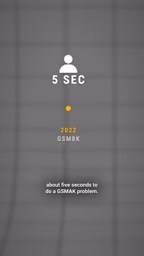
With each step, the "human time required" for the tasks AI can handle increases by roughly 10x — from 5 seconds to 1 minute to 10 minutes, with remarkable regularity.

GSM8K (Grade School Math) is a benchmark released by OpenAI in 2021 containing roughly 8,500 multi-step arithmetic word problems. It was long considered the standard test for evaluating basic mathematical reasoning in language models. The MATH benchmark, published by Hendrycks et al., covers 12,500 competition math problems across seven difficulty levels spanning algebra, geometry, probability, number theory, and more — with the hardest problems touching the boundaries of high school math competitions. The key difference between the two isn't the volume of knowledge required, but the length and complexity of the reasoning chain. Top-tier MATH problems often require multiple layers of nested reasoning — exactly what Brown means by "depth of reasoning." Notably, almost as soon as models approached perfect scores on GSM8K, researchers immediately needed to introduce harder benchmarks. This "benchmark saturation" phenomenon itself confirms that capability gains outpaced what the testing infrastructure was designed to measure.
From IMO Gold to the Millennium Prize Problems
Following this 10x-per-year curve, the next natural milestone is IMO (International Mathematical Olympiad) Gold Medal level. A typical IMO problem takes a human mathematician around 100 minutes — about an hour and a half. Brown said it was "very reasonable" to expect models to reach IMO Gold in 2025, squarely within the trend line's predictions.

What's truly thought-provoking is his subsequent extrapolation: if the pace continues at 10 to 15x per year, starting from IMO Gold (roughly 1.5-hour scale), models a year later should be able to handle tasks in the ~15-hour range. But tackling top-tier mathematical conjectures like the Millennium Prize Problems clearly requires far more than 15 hours.

The Millennium Prize Problems were established by the Clay Mathematics Institute in 2000 — seven problems, each carrying a $1 million prize, including the Riemann Hypothesis, P vs NP, and the Navier–Stokes existence and smoothness problem. To date, only the Poincaré Conjecture has been solved, by Grigori Perelman in 2003. These problems serve as the endpoint coordinates for extrapolating AI capabilities because they represent the current frontier of human mathematical knowledge — requiring not just sustained reasoning over extremely long periods, but creative reconstruction of mathematical frameworks, typically demanding years or even decades of focused research. Placing them alongside IMO problems highlights a critical tension: competition math tests the ability to quickly solve problems within an established framework, while Millennium Prize Problems demand pioneering entirely new conceptual frameworks. The difference is qualitative, not merely quantitative.
"A Lot Faster Than I Expected"
Based on this framework, Brown's original timeline was quite conservative: no model capable of solving Millennium Prize–level problems by 2026, probably not 2027 either, maybe 2028.
But he openly admitted that actual progress had "happened a lot faster than I expected." The timing of IMO Gold validated the exponential curve's existence — and forced him to recalibrate his predictions for what comes next. The fact that a frontline researcher openly acknowledges being outpaced by his own field's progress is itself a telling footnote to the current state of AI development.
What This Curve Actually Means
Brown's framework offers a few things worth chewing on.
First, it transforms "AI getting stronger" from a vague feeling into a quantifiable trend. Using human task completion time as a proxy for difficulty captures the leap in reasoning depth better than raw accuracy rates.
Second, the danger of exponential curves is that they look gradual early on and then shoot up steeply. Going from 5 seconds to 10 minutes might still feel intuitively manageable — but once you enter the "hours" or "tens of hours" range, each successive step represents an absolutely enormous jump in capability.
Third — and this deserves a clear-eyed view — progress on math benchmarks doesn't necessarily map linearly onto every domain. Problems like the Millennium Prize Problems require not just extended reasoning but creative insight, and the single dimension of "human time required" may not fully capture that qualitative shift. Brown himself acknowledged he doesn't have "a great handle" on the time scales for such problems, making this extrapolation more of a trend warning than a precise prediction.
Regardless, when a core OpenAI researcher is genuinely surprised by the pace of progress, the conventional imagination about AI capability ceilings probably needs to be revised upward.
The property of exponential growth — appearing gradual early and steep late — is well-documented throughout the history of technology, often called the "intuition trap": human intuition naturally favors linear extrapolation, leading to systematic underestimation of the back half of exponential trends. Applied to AI reasoning, the jump from "5-second tasks" to "10-minute tasks" involves an absolute time difference of barely 10 minutes, still feeling incremental. But from "10 minutes" to "100 minutes" and then "15 hours," each step corresponds to a leap in task complexity that far exceeds any familiar reference point. Brown's framework provides an anchor for visualizing this acceleration — but it carries a methodological caveat: it assumes a monotonic mapping between "human time to complete a task" and "cognitive complexity of the task." In reality, many mathematical breakthroughs hinge not on hours logged, but on a flash of insight that no clock can measure. This makes the framework highly persuasive for explaining progress on competition math, but calls for extra caution when extrapolating to open-ended research problems.
Related articles

WebMCP: Every Website as Its Own MCP Server, So AI Agents No Longer Rely on Screenshots
WebMCP lets websites expose tools via the document.modelcontext API, becoming directly callable MCP servers. This article explains its architecture, the Claude Code remote-debugging demo, Chrome's current support stage, and its impact on the agent ecosystem.
MCP Protocol-Driven AI Testing Agent: …
MCP Protocol-Driven AI Testing Agent: Automated Execution, Diagnosis, and Reporting
Introduces an MCP protocol-based AI testing Agent: using FastMCP to expose PyTest execution tools, running Llama 3.2 3B locally with Ollama for failure diagnosis, automatically generating timestamped reports and comparing them with historical results to create a closed loop of test execution, root cause analysis, and fix tracking.

AI Agent Draws an Architectural Elevation in 15 Seconds — Open-Source Drawing Software Rewritten by AI
An AI Agent controls open-source drawing tool VectorCraft via MCP Server, executing 1,077 commands with zero errors to draw an architectural elevation in 15 seconds and export editable SVG/PDF.