AI Agent Draws an Architectural Elevation in 15 Seconds — Open-Source Drawing Software Rewritten by AI

A developer rewrote open-source drawing software with AI in two weeks, and an AI Agent remotely completed 1,077 commands with zero errors.
The article introduces VectorCraft, an open-source drawing software whose Adobe Illustrator-alternative features were rewritten in Rust with AI assistance in about two weeks, currently in Alpha at roughly 65% complete. A creator's AI Agent remotely controlled it via an MCP Server, issuing 1,077 commands to operate about 240 objects and complete an architectural elevation with zero errors, exporting SVG and PDF. AI produces editable vector files rather than unmodifiable images, which matters for precise-editing fields like architecture. The information comes from a single YouTube source and has not been independently verified.
Title
AI Agent Draws an Architectural Elevation in 15 Seconds — Open-Source Drawing Software Rewritten by AI
Meta Description
An AI Agent remotely controls the open-source drawing tool VectorCraft via an MCP Server, executing 1,077 commands with zero errors, drawing an architectural elevation in 15 seconds and exporting editable SVG/PDF. The software is written by AI and used by AI — this article examines the trend and the real-world limitations of the Alpha stage.
Article Content
A developer, with AI assistance, rewrote an entire Adobe-alternative drawing tool in Rust in about two weeks — open-source and free. More notably, another creator had an AI Agent remotely operate this software, issuing 1,077 commands to complete an architectural elevation containing roughly 240 objects, with zero errors throughout. This points to an emerging trend: software is written by AI, and software is also used by AI.
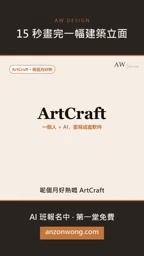
Open-Source Drawing Software VectorCraft: An AI-Rewritten Adobe Alternative
According to a share from the YouTube channel Anson, this open-source drawing software called VectorCraft was rewritten from scratch in Rust by a single developer with AI assistance over about two weeks, covering an entire suite of Adobe-alternative features. It is positioned as an Illustrator replacement — open-source and free.
VectorCraft is currently in Alpha, roughly 65% complete, and can only be downloaded from its official GitHub. Anson specifically noted that he did not operate the Illustrator alternative himself — it was his AI Agent that actually completed the drawing.

1,077 Commands, 240 Objects: Agent-Controlled Drawing with Zero Errors
In the test, Anson's AI Agent remotely controlled VectorCraft through an MCP Server, issuing 1,077 commands and operating roughly 240 objects, without a single command error. After the drawing was complete, the Agent also exported the result as SVG and PDF.
This means AI can not only generate images, but also directly manipulate vector objects in professional drawing software, producing engineering files that can be edited line by line. In the video, Anson summarized two changes he observed: first, software is written by AI; second, software is used by AI.

MCP (Model Context Protocol) is an open protocol proposed by Anthropic in late 2024, designed to let AI models connect to external tools and data sources in a standardized way. Its core idea is to encapsulate software functions as "tools," which an AI Agent invokes through a JSON-RPC-style interface, rather than simulating mouse clicks or screen coordinates. An MCP Server is the server side that implements this protocol, responsible for exposing a capability list (such as creating rectangles, setting colors, exporting files, etc.) to the Agent. Compared with the UI-simulation approach of traditional RPA (robotic process automation), MCP calls act directly on an application's internal API, offering higher reliability, reproducibility, and auditability — particularly suited to vector drawing scenarios that require precise batch operations.
From "Photos You Can't Edit" to "Files You Can Edit Line by Line"
Anson emphasized that what AI hands you is no longer a photo you can't edit, but a vector file where every line can be modified. This is especially critical for fields like architecture and design that require precise editing — what AI generates is no longer a black-box image, but a structured design file that can be further worked on.
This also explains why the involvement of an MCP Server is noteworthy: it lets an AI Agent invoke software functions through a standardized interface rather than simulating mouse clicks. For drawing tasks that require batch, precise operations, this approach offers greater reliability and reproducibility.

The essential difference between vector graphics and bitmaps is that vector graphics describe shapes using mathematical objects (points, lines, curves, polygons), with each object retaining independent geometric parameters and style attributes — infinitely scalable and editable line by line; bitmaps, by contrast, are composed of a pixel grid, where editing can only change pixel colors, making it difficult to precisely adjust individual shapes. Both SVG (Scalable Vector Graphics) and PDF (Portable Document Format) can carry vector data, with SVG based on an XML text format that is easy for programs to parse and for AI to generate, while PDF is more commonly used for printing and delivery. What an AI Agent produces by operating vector software is precisely this kind of structured file, making subsequent human review and secondary processing possible, rather than facing a flat image that cannot be taken apart.
The Reality of the Alpha Stage and Unresolved Issues
VectorCraft is currently about 65% complete and in Alpha, with feature completeness and stability still to be verified. At the end of the video, Anson asked viewers: if AI could directly use your software, what kind of files would you want it to produce? This question points to a more practical issue — when Agents take over software operation, how should workflows, file formats, and human review steps be redesigned?
It should be noted that the above information comes mainly from a single YouTube creator's share; details such as 1,077 commands with zero errors and rewriting an Adobe alternative in two weeks have not been independently verified, and readers should exercise caution when referring to them.
One-line Summary
A developer rewrote open-source drawing software with AI in two weeks, and an AI Agent remotely completed 1,077 commands with zero errors.
Paragraph Summary
The article introduces VectorCraft, an open-source drawing software whose entire suite of Adobe Illustrator-alternative features was rewritten in Rust by a developer with AI assistance in about two weeks. It is currently in Alpha, about 65% complete. More strikingly, a creator's AI Agent remotely controlled the software via an MCP Server, issuing 1,077 commands to operate about 240 objects and complete an architectural elevation with zero errors, then exporting SVG and PDF. The article stresses that AI produces an editable vector file rather than an unmodifiable image, which is highly significant for precise-editing scenarios like architectural design. It also notes that the information comes from a single YouTube source and that key data has not been independently verified, so it should be viewed with caution.
Related articles

Uber Deploys ChatGPT Work Company-Wide: AI in the Workplace Enters the Scaled Implementation Phase
Uber deploys ChatGPT Work to 30,000+ employees, extending it from engineering to all roles. We analyze its expert-engineer pairing, end-to-end automation, and questions of AI control and power concentration—insights for scaling AI in the workplace.

Shift at Midnight Hands-On: When "ID Verification" Becomes Alien Hunting
Shift at Midnight blends ID verification with horror survival in a four-player co-op game. We break down its inspection mechanics and chaotic humor.

Zelensky Recounts the Outbreak of War: I Need Ammunition, Not a Ride
Zelensky recalls the first day of war in a YouTube interview: farewell to family, rejecting Biden's evacuation offer with "I need ammunition, not a ride," and how Bucha shaped his stance on compromise and peace talks.