Noble Carbon Smart Circuit Breaker: Install EV Chargers Without Upgrading Your Electrical Panel

Noble Carbon's smart circuit breaker enables EV charger installation without upgrading your home's main electrical panel.
Many U.S. homes face the costly, time-consuming challenge of upgrading their main electrical panel to support EV chargers and other high-power devices. Startup Noble Carbon is tackling this problem with a smart circuit breaker that uses real-time load monitoring and dynamic scheduling — automatically throttling EV charging when other appliances are running — to keep total consumption within the existing panel's safe limits. The approach replaces hardware expansion with software intelligence, potentially saving homeowners thousands of dollars. Noble Carbon is making its public debut at TechCrunch Disrupt; pricing and technical specs have yet to be announced.
The Hidden Barrier to Home Electrification
As more households look to install EV chargers, heat pumps, or other high-power appliances, they often run into an unexpected obstacle: insufficient capacity in their main electrical panel. The traditional fix is to upgrade the entire main service panel — a process that's not only expensive but typically involves power outages, permit applications, and lengthy wait times. For many homeowners eager to embrace electrification, this hidden barrier is enough to stop them in their tracks.
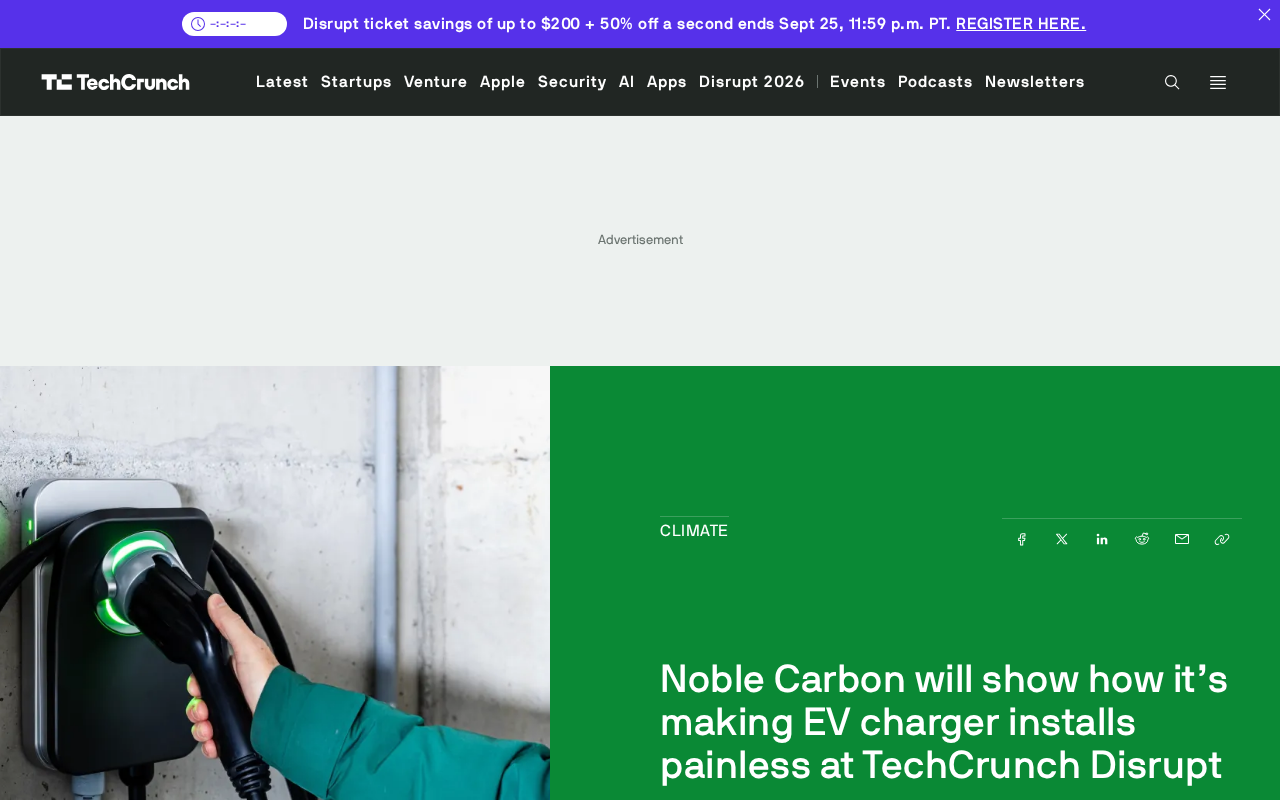
Startup Noble Carbon is taking the stage at TechCrunch Disrupt to showcase a solution designed to make EV charger installation essentially painless.
The main service panel is the central hub of a home's electrical system, distributing incoming power from the utility across individual circuits. A large share of existing U.S. homes are equipped with older panels rated at just 100A or even 60A. A Level 2 home EV charger typically requires a dedicated 40–50A circuit on its own, while heat pump water heaters and induction ranges each demand another 20–30A. Stack multiple high-draw appliances together, and older panels quickly run out of headroom.
Upgrading to a 200A or 400A panel can cost anywhere from $2,000 to $8,000 in the U.S., depending on location and complexity — and coordinating with the utility for service line upgrades can stretch the entire process from weeks into months. This combination of cost and timeline frequently stalls electrification projects that would otherwise make economic sense.
The Core Idea Behind a Smart Circuit Breaker
Noble Carbon's flagship product is a smart circuit breaker with a clear mission: enable home electrification upgrades without requiring a main panel replacement.
The reason traditional panels need upgrading is straightforward — when multiple high-power loads run simultaneously, total current draw can exceed the panel's rated capacity, triggering breaker trips or creating safety hazards. Noble Carbon's smart circuit breaker addresses this by continuously monitoring and dynamically managing individual circuit loads. When total consumption approaches the panel's limit, the device intelligently schedules power usage — for example, throttling or pausing EV charging while other high-draw appliances are running — keeping the overall load within safe bounds.
The value of this load management approach lies in reframing the problem: what previously required hardware expansion can now be addressed through software and intelligent control, dramatically reducing both cost and complexity.
Load management itself isn't a new concept, but integrating it directly into a single circuit breaker represents a recent innovation. Earlier load management solutions typically required a standalone energy management system (EMS) that coordinated with chargers and appliances via communication protocols like OCPP or Modbus — an approach that was costly and complicated to install. Noble Carbon's strategy is to push sensing and control intelligence down to the breaker itself, eliminating the need for a separate EMS altogether.
Worth noting: the U.S. electrical industry operates under a rigorous certification framework. Products must obtain safety certification from organizations like UL (Underwriters Laboratories) and comply with the NEC (National Electrical Code) before they can be legally installed. This is one of the primary reasons hardware startups in this space often face a long road from development to large-scale deployment.
Why This Matters
As EV adoption accelerates and home electrification gains momentum, the last mile of the grid — the distribution systems inside individual homes — is becoming a new bottleneck. Upgrading a main panel involves not just the homeowner, but also the utility, contractors, and regulatory approvals, creating a long and cumbersome chain.
Noble Carbon is squarely targeting this pain point. If smart circuit breakers can reliably replace or defer main panel upgrades, the benefits extend beyond individual households — potentially easing regional grid expansion pressures and enabling a smoother path to widespread electrification.
For everyday consumers, this translates to a lower barrier to entry: skip the multi-thousand-dollar panel upgrade, shorten installation timelines, and avoid the disruption of major electrical work.
Debut at TechCrunch Disrupt
Noble Carbon's choice to debut at TechCrunch Disrupt signals that the company is actively seeking market visibility and investor validation. For a hardware product targeting home energy infrastructure, the ability to scale, achieve safety certification, and maintain compatibility with existing electrical standards will be the decisive factors in its success.
Based on what's publicly available so far, Noble Carbon is telling a clear and concrete story: use a smarter circuit breaker to solve one of the most frustrating bottlenecks on the road to home electrification.
Note: This article is based on limited information from Noble Carbon's official announcements. Specific technical specifications, pricing, and availability have not yet been disclosed; further details are expected as the company shares more.
Related articles

Amphibious Transforming Drone: Beyond 100x Power Savings, What Are the Real Needs?
Is the amphibious transforming drone just a gimmick? Starting from the 100x power difference of the M4 Morphobot, explore real application scenarios and thesis topic ideas, analyzing boundary conditions where pure drones and pure ground robots both fail.

Warhound Raises $200 Million: Genetically Engineered "War Dogs" Paired with Anduril Gear
Warhound raises $200M, backed by Ben Lamm and Palmer Luckey, to genetically engineer dogs for military and law enforcement use and equip them with Anduril gear. This article analyzes its technology direction, funding logic, and ethical controversy.

Claude API Comes to Google Cloud: IAM Integration and SDK Access Guide
Anthropic hosts the full Claude API on Google Cloud with IAM-controlled permissions and unified billing. This guide covers the Vertex AI and Anthropic-hosted entry points, IAM role configuration, and SDK access.