Norwest Bets on AI with New $4B Fund
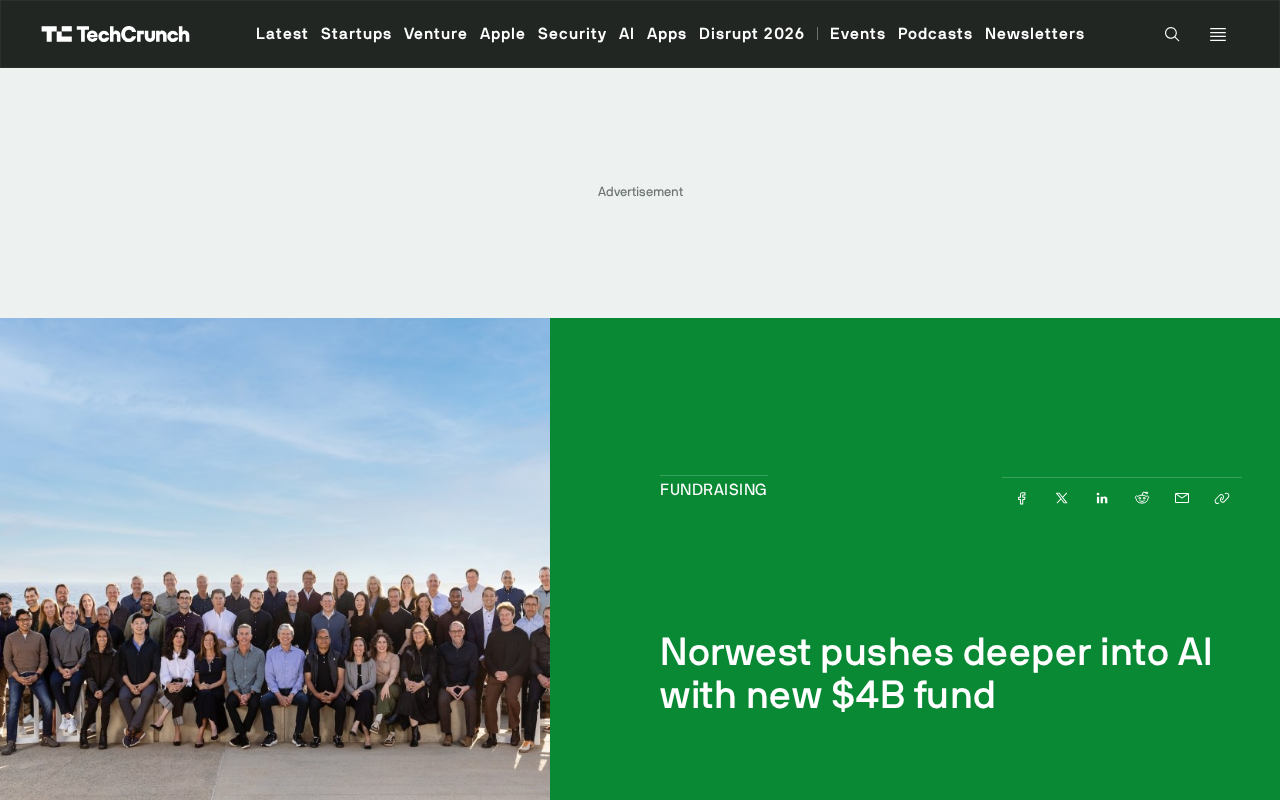
Norwest launches its largest-ever $4 billion fund to deepen its AI investment strategy.
Venture capital firm Norwest has announced a $4 billion fund, its largest ever, focused on deepening its AI positioning. The move reflects intensifying AI financing competition and strong LP interest in AI opportunities. The fund may cover AI infrastructure, enterprise applications, and vertical solutions, while Norwest's post-investment resources in SaaS, fintech, and healthcare could be a differentiator. For entrepreneurs, the capital is a positive signal but may intensify the head effect, testing the firm's balance between big bets and accurate investing.
Venture capital firm Norwest has announced the launch of a new $4 billion fund—its largest to date. The capital will be used to deepen its positioning in artificial intelligence, marking the established investment firm's continued push into the AI sector.
Fund Size Hits an All-Time High
The $4 billion fund Norwest has raised this time sets a new fundraising record for the firm itself. For an institution known for early- and growth-stage investing, this scale means a significant increase in deployable capital, and it also reflects strong LP (limited partner) interest in AI-related investment opportunities.
Against the industry backdrop, financing competition in the AI space has continued to heat up in recent years, with the capital requirements of leading projects rising markedly in magnitude. Norwest's decision to expand its fund size at this moment is both a response to market trends and a necessary move to stay competitive in the fierce contest for talent and deals.
LP (Limited Partner) refers to the primary providers of capital in private equity and venture capital funds, typically including institutional investors such as pension funds, university endowments, insurance companies, and family offices. In a VC fund structure, the GP (General Partner—the investment management firm such as Norwest) is responsible for fundraising, investing, and post-investment management, while LPs provide the vast majority of the capital but do not participate in day-to-day decisions. After LPs commit capital, funds are drawn down gradually in line with the investment pace rather than paid in a single lump sum. Therefore, the establishment of a $4 billion fund represents a collective endorsement by numerous LPs of Norwest's investment strategy and the outlook for the AI sector. LP allocation preferences often lead public market discussion, and their increased commitments to AI-dedicated funds are typically seen as an important leading indicator of medium- to long-term capital flows.
AI Becomes a Core Investment Theme
Although the original article did not disclose specific portfolio details, the phrasing "pushes deeper into AI" suggests that AI has risen from a peripheral area of focus for Norwest to one of its core themes. The new fund is likely to cover multiple layers, including AI infrastructure, enterprise-grade AI applications, and vertical industry solutions.
Interestingly, Norwest's accumulated post-investment resources in areas such as SaaS, fintech, and healthcare may become a differentiating advantage that sets it apart from pure AI funds—helping AI startups find real enterprise customer scenarios rather than remaining at the stage of technology demos.
AI infrastructure, enterprise-grade AI applications, and vertical industry solutions constitute three typical layers of the current AI investment landscape. AI infrastructure refers to the underlying capabilities that support model training and inference, including compute chips, cloud platforms, data pipelines, model development frameworks, and MLOps toolchains—characterized by high capital expenditure and high technical barriers. Enterprise-grade AI applications target general scenarios such as internal process automation, customer service, data analytics, and code generation, emphasizing integrability and quantifiable ROI. Vertical industry solutions embed AI into specific domains such as healthcare, finance, legal, and manufacturing, relying on industry data and compliance understanding. The three differ significantly in capital requirements, exit cycles, and post-investment capabilities, and a fund's layered allocation ratio often reflects its judgment on the stage of AI commercialization.
Impact on the Startup Ecosystem
For AI entrepreneurs, the entry of a fund at the $4 billion level is a clear positive signal. Against a backdrop of generally cautious financing conditions, the availability of large-scale dedicated capital means a higher likelihood that high-quality AI projects will secure long-cycle capital support.
On the other hand, capital concentration may also intensify the head effect: teams with clear commercialization paths are more likely to attract favor, while projects lacking real-world deployment scenarios will face stricter scrutiny. Whether Norwest can strike a balance between "making big bets" and "investing accurately" will determine the fund's actual return performance.
The head effect refers to the phenomenon in which capital, talent, and customer resources concentrate among a small number of leading companies. In the AI field, this effect is particularly pronounced: the cost of training foundation models is high, and data and compute converge toward leading companies, making teams with first-mover advantages and clear commercialization paths more likely to secure large financing, while early-stage projects face more severe screening. For VCs, the head effect means larger individual investment amounts and narrower margins for error, requiring funds to make strategic trade-offs between "concentrating bets on a few winners" and "broad diversification to capture uncertainty." Large funds, under pressure from management fees and return expectations, tend to follow already-validated leading projects, which in turn reinforces the Matthew effect and exerts some squeeze on ecosystem diversity and early-stage innovation.
Reading the Market Signals
Norwest's fundraising move is a microcosm of the current AI investment boom. More and more traditional VCs are adjusting their strategies and placing AI at the center of their investment logic. This structural shift brings both an abundance of capital supply and higher demands on investment firms' depth of industry understanding.
For readers following AI entrepreneurship and investment trends, the subsequent deployment of Norwest's new fund is worth continued tracking—it may reveal mainstream capital's true judgment on the pace of AI application adoption.
One-line Summary
Norwest launches its largest-ever $4 billion fund to deepen its AI investment positioning.
Paragraph Summary
Venture capital firm Norwest has announced a new $4 billion fund, a fundraising record for the firm, with capital focused on deepening its positioning in artificial intelligence. The move responds to intensifying AI financing competition and rising capital needs among leading projects, and reflects strong LP interest in AI opportunities. The fund may cover AI infrastructure, enterprise applications, and vertical solutions, while Norwest's post-investment resources in SaaS, fintech, and healthcare could serve as a differentiator. For entrepreneurs, the large capital inflow is positive but may intensify the head effect, testing the firm's ability to balance big bets with accurate investing.
Related articles

VP ≠ VNP: A Major Breakthrough in Computational Complexity Theory
A study claiming to prove VP ≠ VNP over every field sparks heated discussion on Hacker News. This article analyzes the algebraic complexity background of VP and VNP, the proof approach, community controversy, and its potential impact on computational complexity theory.

Developer Naming Woes: The Technical Names That Drive Us Crazy
Why is technical naming so maddening? From Nginx and Vite to Qt and Sudo, a YouTube creator rants about the chaos of developer naming and pronunciation, revealing the tug-of-war between creators' intentions and community habits, and the cultural roots behind spelling traps like PyPI and GNOME.

Figma Workplace Scandal: Employee Sues CEO for Forcing Confrontation with Harasser
Figma and its CEO are sued by a current employee alleging sexual harassment and discrimination, and forcing the victim to confront her harasser. This article outlines the background, potential impact, and industry reflection.