Notra: The GEO Tool That Helps Your Brand Stand Out in AI Search
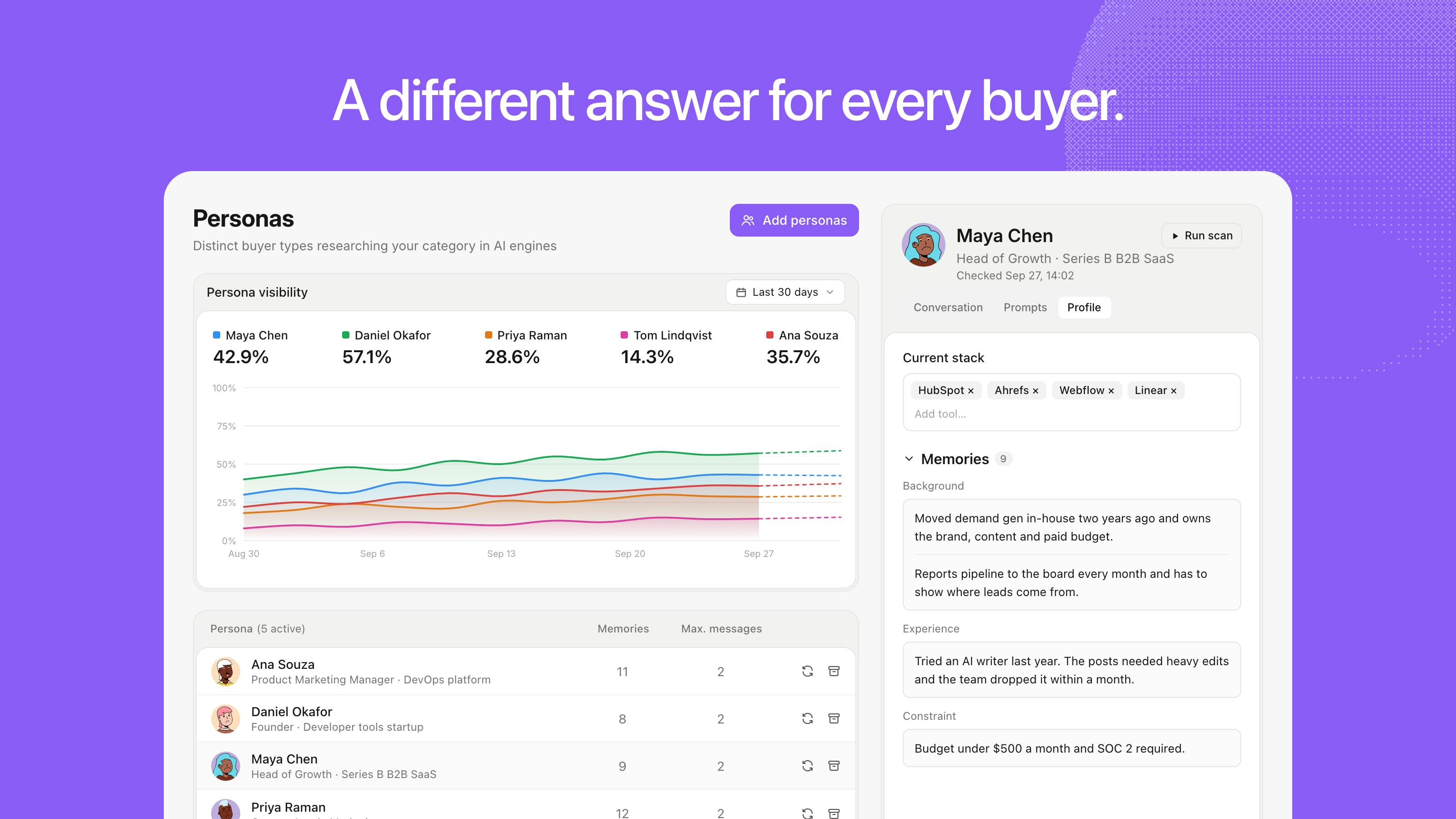
Notra is a GEO tool that helps brands monitor and improve visibility in AI search answers.
The article introduces Notra, a new Product Hunt product—a GEO (Generative Engine Optimization) tool for generative AI search. Its core logic: as users increasingly get information through conversational AI like ChatGPT, Claude, and Gemini, brands absent from AI answers lose potential customers. Notra simulates buyer questions, tests across three mainstream models, analyzes brand mention frequency and competitor presence, and offers optimization suggestions, targeting marketers, SEO specialists, and growth hackers. The article notes GEO is still early-stage, constrained by dynamic model updates, black-box decision mechanisms, and rising competition. Notra received 98 votes and ranked 6th on Product Hunt, showing initial interest, but product details and pricing remain under-disclosed.
AI search is changing how users find information. When users ask ChatGPT, Claude, or Gemini a question, does your brand appear in the answer? Notra, a GEO (Generative Engine Optimization) tool, is trying to answer that question.
Why do you need a GEO tool?
Traditional SEO focuses on rankings in search engine results pages, while GEO focuses on answers from generative AI. As more and more users get information through AI conversations, brand visibility in AI answers becomes critical. Notra's core philosophy is: if your brand isn't mentioned by AI, you're losing potential customers.
According to its Product Hunt page, Notra asks ChatGPT, Claude, and Gemini the questions buyers might ask, then shows whether your brand appears, who the alternatives are, and how to improve. It's essentially a monitoring and optimization solution for the AI search era.
GEO (Generative Engine Optimization) is a concept introduced in contrast to traditional SEO, first systematically proposed by researchers from Princeton University and other institutions in late 2023. Its core research subject is AI answers under the Retrieval-Augmented Generation (RAG) architecture: the model first retrieves web pages and then organizes language to answer, so the citability, factual density, structural clarity, and authority signals of content directly affect whether a brand is written into the answer. Unlike traditional SEO, which values keyword rankings and click-through rates, GEO focuses on being "mentioned," "cited," and "recommended," with metrics including mention rate, citation share, answer position, and sentiment. Because AI answers typically integrate only a few sources, the top-tier effect is more pronounced than in search rankings—this is the direct motivation behind GEO tools.
How does Notra work?
Notra's workflow can be summarized in three steps:
- Simulate buyer questions: Based on your business domain, the tool generates a series of questions potential customers might ask AI.
- Cross-model detection: These questions are fed separately into ChatGPT, Claude, and Gemini, and each model's answer is recorded.
- Visibility analysis and recommendations: It analyzes how often and where your brand appears in the answers, along with competitor appearances, and provides optimization suggestions.
The advantage of this approach is that it covers mainstream AI models, avoiding the bias of a single model. At the same time, it targets buyers' real questions rather than generic keywords.
The feasibility of cross-model detection rests on the APIs provided by each vendor: ChatGPT corresponds to OpenAI's interface, Claude to Anthropic, and Gemini to Google. However, note that the same prompt may yield different answers at different times and with different temperature parameters, and each model's knowledge cutoff and web retrieval strategies are not consistent. Therefore, a single query's conclusion has limited representativeness; repeated sampling and statistical mention frequency are usually needed to obtain relatively stable visibility metrics. In addition, some models retrieve web pages in real time when in web-enabled mode, in which case whether a brand is mentioned also depends on how easily the site can be crawled and indexed—an overlap with SEO.
Who should use Notra?
Notra is primarily aimed at marketers, SEO specialists, and growth hackers. According to Product Hunt's categorization, it falls under Marketing, SEO, and Growth Hacks. For companies that have invested in SEO but haven't yet paid attention to AI search, Notra offers a low-barrier entry point.
Interestingly, GEO is still an emerging field, and the effectiveness of tools depends on whether AI models update their knowledge bases and on the coverage of questions asked. Notra currently has 98 votes and 8 comments, ranking 6th on Product Hunt for the day, indicating some early attention.
Limitations and challenges
Although Notra's concept is appealing, GEO tools face several inherent challenges:
- Dynamic nature of AI models: Model answers may change over time, so monitoring needs to be continuous.
- Black-box nature: We cannot fully understand why AI chooses to mention certain brands; optimization suggestions may be based on experience rather than deterministic rules.
- Intense competition: As AI search becomes more widespread, more similar tools are expected to appear.
Notra's founding team includes Jan Burzinski and others, but public information is limited. The tool's pricing and specific feature details have not been fully disclosed on its Product Hunt page, and potential users may need to try it further.
The so-called "black-box nature" refers to the fact that large models generate text based on massive parameters and probability distributions, and internally there is no set of ranking rules that can be externally audited. Researchers can currently only induce correlations through large-scale prompt experiments—for example, finding that content with statistics, cited sources, clear structure, and an expert tone is more likely to be adopted by AI, but these are statistical patterns rather than deterministic rules, and may fail with a different model or a different phrasing. This means GEO recommendations are closer to "best practices for increasing the probability of being cited" and cannot offer the kind of definitive promises that traditional SEO keyword placement can. Marketing teams need to have reasonable expectations when evaluating ROI.
Conclusion
Notra captures the early demand for AI search optimization, helping brands compete for exposure in generative AI answers through cross-model questioning and visibility analysis. Although the GEO field is still immature, Notra is worth watching for marketing teams hoping to seize the early advantage. In the future, as AI search's share grows, such tools may become standard equipment in digital marketing.
One-line Summary
Notra is a GEO tool that helps brands monitor and improve their visibility in AI search answers.
Paragraph Summary
The article introduces Notra, a new product on Product Hunt—a GEO (Generative Engine Optimization) tool for generative AI search. Its core logic: as users increasingly get information through conversational AI like ChatGPT, Claude, and Gemini, brands that don't appear in AI answers lose potential customers. Notra works by simulating buyer questions, testing across three mainstream models, analyzing brand mention frequency and competitor presence, and providing optimization suggestions; its target users are marketers, SEO specialists, and growth hackers. The article also notes that GEO is still early-stage, constrained by the dynamic updates of AI models, black-box decision mechanisms, and increasingly fierce competition. Notra received 98 votes and ranked 6th on Product Hunt, showing initial attention, but product details and pricing remain insufficiently disclosed.
Related articles

Asana AI Product Lead Shares AI Agent Best Practices
Asana's AI product lead shares AI Agent best practices, covering responsibility boundaries, human-in-the-loop design, data model anchoring, and evaluation iteration methods for product teams deploying Agents.

Japanese Internet Giant GMO Hit by Hacker Leak: Cloud Service Vulnerability Exposes Customer Data
GMO Internet confirms cloud service hack, customer data possibly exposed. The company is verifying the leaked data, highlighting cloud security and supply chain attack risks.
Apple Adds AI Assistant to Pages, Keynote, Numbers
Apple introduces an AI assistant to Keynote, Pages, and Numbers, powered by Apple and OpenAI models, capable of understanding document context, designing animated slides in Keynote, and drafting and restructuring documents in Pages, escalating AI competition in productivity suites.