Nov 18 AI Roundup: GPT-6.2 Dual Versions, Free Gemini Tasks, and Microsoft's New MAI Models
Within 24 hours, OpenAI, Google, Microsoft, and three others made dense releases as agents move toward free access and controllability.
The article reviews six dense AI updates from November 17–18: OpenAI released GPT-6.2 Astra and Sol with tiered pricing, claiming Astra is the first external model to meet the high threshold for AI self-improvement; Google made Gemini task features free in six countries; Microsoft launched MAI Code 2 and repositioned Copilot as a "work operating system"; Replit introduced Missions with budget caps, human approval, and an AI judge; and Suno launched Visuals for lip-synced music videos. The author notes most performance and price comparisons come from vendor self-reported benchmarks and distills three threads: self-reported data becoming the norm, task-oriented agents entering a phase of free access and scale, and boundary design for autonomous agents taking shape.
Three Giants Move at Once in a Single Day
On November 18, the AI world saw a dense wave of product updates within 24 hours: OpenAI released the dual-version GPT-6.2 series, Google made Gemini's task automation features free for users in multiple countries, and Microsoft unveiled new MAI models at Ignite while redefining Copilot. In addition, Replit and Suno each introduced noteworthy new capabilities. This article is based on the daily roundup by Bilibili creator "Whale Girl" (鲸鱼娘) and offers a review and analysis of these six developments.
A caveat up front: most of the performance comparisons and price ratios mentioned in this article come from each vendor's own published benchmarks and have not been independently verified by third parties.
OpenAI Releases GPT-6.2 Astra and Sol: Tiered Pricing and the Self-Improvement Threshold
OpenAI launched the GPT-6.2 series on November 17, comprising two versions: Astra, positioned for stronger performance, and Sol, aimed at everyday use. Both are integrated into ChatGPT Work, Codex, and the API.
On pricing, Astra costs $8 per million input tokens and $40 per million output tokens, roughly 20% cheaper than GPT-6 Astra; Sol retains the GPT-6.1 Sol pricing of $2 input and $10 output. OpenAI claims Astra sets new records on work and science benchmarks at less than one-third the cost of GPT-6 Astra.
Data disclosed in the system card shows Astra scoring 97% on GPQA-Diamond and Sol 96%. More notably, the system card states that Astra is "the first externally released model to meet the high threshold for AI self-improvement." If true, this suggests the pace of model capability iteration could accelerate further—though this remains the vendor's own claim. On cybersecurity, both models reach the critical threshold, with high-risk cyber assistance restricted by default.
For developers, the tiered pricing of Astra and Sol offers a clear choice space, but the creator also cautions: these records and cost ratios are all published by OpenAI itself, so it's best to test them against your own tasks before selecting a model.
AI self-improvement threshold in the context of a system card typically refers to a model's ability to significantly boost its own R&D efficiency—for example, autonomously proposing algorithmic improvements, writing and validating training code, or completing a model iteration loop without human intervention. The industry often uses "whether it can substantially accelerate development of the next-generation model" as the criterion, rather than benchmark scores alone. Once this threshold is crossed, the pace of capability iteration could shift from "human-led, AI-assisted" to "AI-led, human-reviewed," which is why regulators and safety evaluators pay close attention. It should be emphasized that such claims are currently mostly vendor self-assessments lacking a unified third-party evaluation framework; readers should treat them as directional signals rather than established fact.
Google Makes Gemini Tasks Free: It Can Call for You and Pay for You
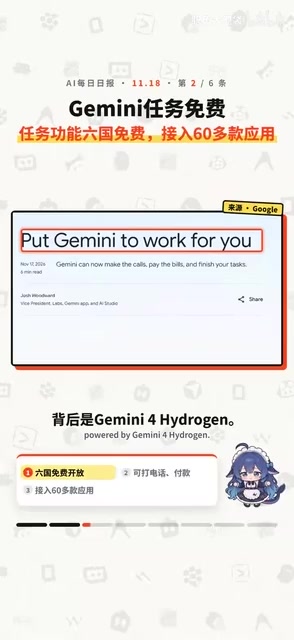
On November 17, Google made Gemini's task features free, covering users in the US, Japan, South Korea, Canada, Australia, and India, powered by Gemini Hydrogen.
The core of this capability is "executing on your behalf": it can simultaneously call two car dealerships to schedule appointments, connect to over 60 apps, check utility bills, buy groceries via Instacart, and manage schedules. The payment layer is supported by the Agent Payments Protocol, supporting MasterCard and Visa, with American Express marked as coming soon; users can also set spending limits.
Several security design details are worth noting: each task runs in a hardware-isolated virtual machine under a dedicated account; before critical steps like clicking to purchase, Gemini pauses to seek confirmation. Limitations also exist—the calling feature is unavailable in five states (Indiana, Louisiana, Minnesota, Montana, and Nebraska), and contacting Gemini via SMS requires a US phone number and a supported carrier.
Free availability means task-oriented agents are moving from demos to mass availability, but regional and carrier restrictions also show that deployment of such capabilities remains constrained by infrastructure and compliance conditions.
Agent Payments Protocol is a protocol-layer design for AI agents to complete transactions on behalf of users. Its core is enabling agents to securely initiate payments, verify amounts, and retain auditable records within the scope of user authorization. It typically involves identity verification, spending limit controls, tokenized credential exchange between merchants and card networks, and dispute resolution mechanisms. Unlike traditional "card number autofill," such protocols emphasize user-preset limits and per-transaction traceability to reduce financial risk from agent errors or misuse. Google's integration with MasterCard and Visa—with American Express marked as coming soon—indicates that agent payments are moving from proof of concept to card network coordination, though actual coverage and liability allocation in disputes remain to be seen.
Microsoft Ignite Launches: MAI Code 2 Competes with Rivals, Copilot Repositioned as a "Work Operating System"
At Ignite, Microsoft announced a batch of new MAI models, all released on November 17.
MAI Code 2 is positioned as an everyday enterprise coding model and is now live in GitHub Copilot. Microsoft claims its coding performance reaches 98% of GPT-6.1 Sol at about 40% of the price; against Claude Sonnet 5.5, it delivers 96% of the performance at 5% of the price. The lightweight MAI Code 2 Flash targets GPT-6 Luna at 65% of its price. There is also a voice model, MAI Real Time E, starting at $0.01 per audio minute; and an image model, MAI Image 2.7, which Microsoft claims ranks first on the Artificial Analysis image editing leaderboard at one-fifth the price of GPT Image 2.6 Sunburst.

It should be noted that the above comparison figures are all published by Microsoft itself, with evaluation setups not detailed, and actual performance still requires independent verification.
At the same event, CEO Nadella articulated Copilot's new positioning: Copilot is the new work operating system, integrating Chat, Copilot, Code, and Autopilot, where Autopilot is an autonomous agent capable of advancing work around the clock. Supporting capabilities include Copilot Workspaces for human-agent collaboration, the Microsoft IQ enterprise data platform integrating Fabric and Foundry, the Agent 365 governance platform already hosting over 50 million agents, and business analytics features that map AI spending to business outcomes. Copilot's 200 virtual machines are also now generally available. However, the keynote did not specify launch dates for these new features.
From "assistant" to "operating system," Microsoft is trying to position Copilot as the entry layer for enterprise AI work, and Agent 365's scale figures indirectly confirm that agent governance is becoming an enterprise necessity.
Replit Missions: Autonomous Development with Budget Caps and an AI Judge
Replit launched Missions on November 17. After users set a goal, the system completes planning, building, testing, and iteration in the cloud, with the protocol specifying budget caps and actions requiring human approval—such as contacting potential customers, with an example cap of $1,000. Acceptance is determined by an independent AI judge against agreed criteria; if the criteria are not met, the task is not considered complete.

Replit used Missions to build a monitoring platform called DataCat in two days with a $3,000 budget. In controlled tests, a database failure triggered an alert in 38 seconds against a 60-second target; a three-hour stress test processed the first 6 million activity records and 4.4 million logs with zero loss. Compared with a version built by Claude Code, DataCat passed 51 of 56 API compatibility checks versus 45 for the other.
But Replit itself states these are controlled tests and do not represent production performance. DataCat's self-hosted version has been open-sourced, and Missions itself has not yet announced pricing. This "budget + approval + judge" mechanism essentially adds controllable cost and acceptance boundaries to autonomous agents—an approach worth referencing for other agent products.
AI-as-a-judge refers to using a model independent of the executor to adjudicate outputs against pre-agreed acceptance criteria. A common practice is to write acceptance conditions as verifiable items, which the judge model compares one by one and concludes as pass or fail. Its value lies in shifting "whether it's done" from the executor's self-report to third-party judgment, reducing the risk of autonomous agents overstating progress. Limitations are also obvious: the judge model itself may have biases, interpret ambiguous criteria inconsistently, and the judgment process may not be fully reproducible. In engineering practice, therefore, AI judges are usually combined with manual spot checks and automated testing rather than used alone as the final acceptance basis.
Suno Visuals: Turn Songs into Lip-Synced Videos Up to 15 Seconds
Suno launched Visuals on November 17, available on web, iOS, and Android. It generates videos and images up to 15 seconds long from songs in the user's library, can create lyric videos that move to the beat, album covers that match the song, and can turn photos into videos that follow the song's structure with lip-syncing. After completion, users can extend, edit, or re-prompt with text. Visuals credits are purchased separately from song credits; the page does not specify pricing.

On copyright compliance, Suno uses text and image filters to block prompts targeting specific artists, public figures, and copyrighted works, and partners with Audible Magic, ASEA Cloud, and Music Smash to block copyrighted audio; content is embedded with a watermark before being shared off-platform. This also means prompts that work well on other video platforms may fail in Visuals.
Observations: Self-Reported Data, Free Access, and Agent Governance
Looking at the six developments together, three threads stand out.
First, vendor self-reported performance is becoming the norm. The records and price ratios from OpenAI and Microsoft all come from their own benchmarks, and Bilibili creator "Whale Girl" repeatedly flags this. For users, treating vendor data as a starting point for selection rather than a conclusion—and validating with your own tasks—is the more prudent approach.
Second, task-oriented agents are entering a phase of free access and scale. Gemini's task features going free and Agent 365 hosting over 50 million agents show that agents are moving from novelty to everyday tools, bringing with them deployment details such as regional restrictions, payment protocols, and human confirmation.
Third, boundary design for autonomous agents is taking shape. Replit's budget caps, approval actions, and AI judge represent an engineering attempt to constrain autonomy; Microsoft's agent governance platform approaches from the enterprise governance angle. Both paths point to the same question: how to let agents run—and keep them under control.
One-line Summary
Within 24 hours, OpenAI, Google, Microsoft, and three others made dense releases as agents move toward free access and controllability.
Paragraph Summary
The article reviews six dense AI updates from November 17–18: OpenAI released GPT-6.2 Astra and Sol with tiered pricing, with the system card claiming Astra is the first external model to meet the high threshold for AI self-improvement; Google made Gemini task features free in six countries, capable of making calls, connecting to over 60 apps, and supporting spending limits; Microsoft launched MAI Code 2 and other models at Ignite and repositioned Copilot as a "work operating system"; Replit introduced Missions with budget caps, human approval, and an AI judge; and Suno launched Visuals, a lip-synced music video tool of up to 15 seconds. The author notes that most performance and price comparisons come from vendor self-reported benchmarks and distills three threads: self-reported data becoming the norm, task-oriented agents entering a phase of free access and scale, and boundary design for autonomous agents taking shape.
Related articles

Daybreak Red Deployment Guide: A Reference Architecture for Supervised Security Investigation
A breakdown of the Daybreak Red reference architecture: security control design, deployment configuration process, and runtime monitoring for supervised security investigation.

Gemini 4 Neon Tops the Models Engineering Index
Gemini 4 Neon tops the Models Engineering Index, sparking Hacker News debate over ranking credibility and evaluation methods. Here's what it means for developers.

Apple's Self-Developed AI Agent: An Agent That Can Operate Your Mac Is Coming
Apple is reportedly developing an AI agent that can operate a Mac, targeting Meta Muse, Claude, OpenAI Dots, and others. This article analyzes Apple's system-level advantages, the competitive landscape, and likely rollout paths in the agent race.