Nushell: A New Rust Shell Redefining the Command-Line Experience
Nushell uses Rust to refactor the shell pipeline into structured tables, balancing type safety and cross-platform consistency.
The article introduces Nushell, a modern shell written in Rust. Its core innovation is unifying every segment of data in the pipeline into a structured table with column names and row concepts, replacing awk and sed text cutting with commands like where, select, and sort-by, and shifting the parsing burden from the user into the shell. Rust brings memory safety, zero-cost abstractions, and cross-platform consistency while reducing implementation hazards like null pointers. The built-in type system improves command discoverability and pipeline composability, surfacing errors earlier. The project has 40,797 stars and 2,331 forks on GitHub. The author considers Nushell a supplementary tool for data-analysis tasks and cross-platform scripting rather than a wholesale replacement, with its value lying in a shell abstraction better suited to modern data.
From "Text Streams" to "Structured Data": A Paradigm Shift
Traditional shells (such as Bash and Zsh) are built on a philosophy of plain text streams: command output is a series of strings, and users must repeatedly cut, filter, and stitch them together with tools like awk, sed, and grep. This model is flexible but has a steep learning curve, and all type information about the data in the pipeline is completely lost.
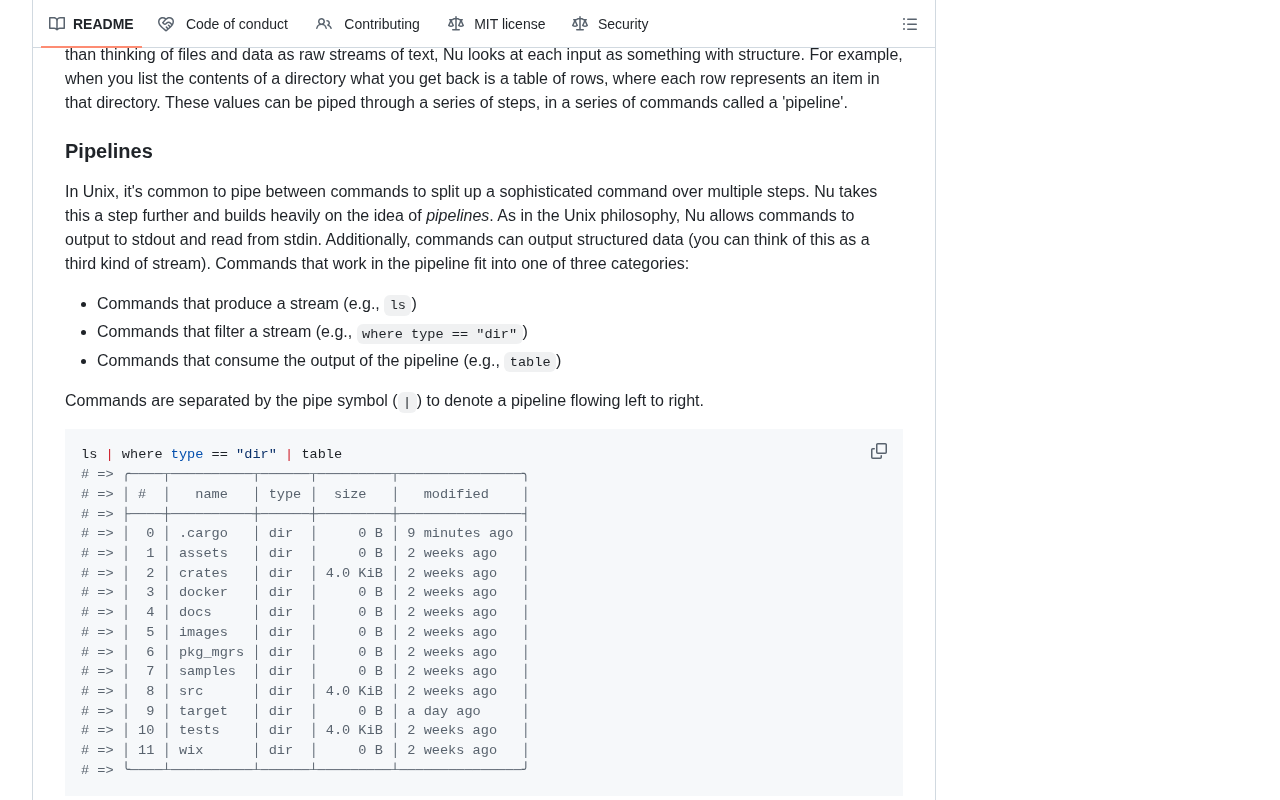
Nushell (nushell/nushell) proposes a fundamentally different approach — treating every segment of data in the pipeline as a structured table. Whether it's a file listing, JSON, YAML, CSV, or system processes, once it enters Nushell it becomes a unified table structure with column names and row concepts. This means you can manipulate command output the way you would a database, using commands like where, select, sort-by, and group-by to work directly with fields, without worrying about text delimiters and formatting details.
This design is not mere syntactic sugar. It shifts the implicit burden of "parsing output" from the user into the shell itself, giving the pipeline genuine type awareness and surfacing errors earlier.
Structured Data is a concept opposed to plain text streams, referring to data with an explicit schema: fields have names and types, and records have clear boundaries. Common formats include JSON (JavaScript Object Notation, a text format nesting key-value pairs and arrays), YAML (an indentation-sensitive configuration format), and CSV (comma-separated values, a tabular plain-text format). In traditional shells, these formats degrade into strings once they enter the pipeline, and field information must be reconstructed by the user with regexes or delimiters; Nushell, by contrast, preserves column names, column types, and row structure during parsing, making field-based filtering like where status == 200 a native operation instead of fragile text matching like grep '"status": 200'. This difference is precisely the fundamental divide between the two abstractions: "structured" and "text stream" shells.
Modern Engineering Practices Built with Rust
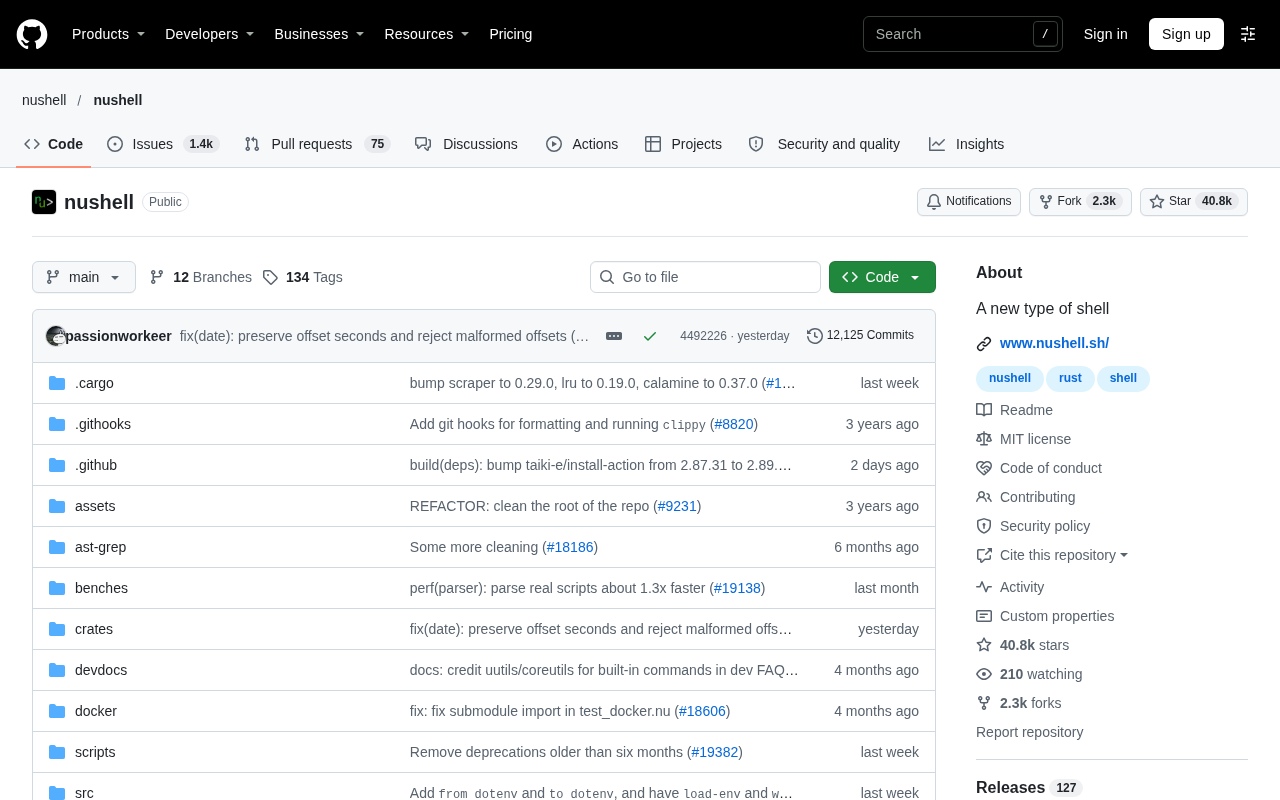
Nushell is written in Rust, which brings memory safety, zero-cost abstractions, and excellent cross-platform capabilities. According to project data, it has 40,797 stars and 2,331 forks on GitHub, with 88 new stars in a single day, indicating that community interest continues to rise.
Choosing Rust is not just about performance. Command-line tools have long suffered from "poor script portability" — the same script often requires different approaches on macOS, Linux, and Windows. Leveraging Rust's cross-platform ecosystem, Nushell provides a consistent command set and data types across the three major operating systems, which is especially practical for developers who frequently switch environments. Meanwhile, Rust's strict compile-time checks also reduce the likelihood of null pointers, buffer overflows, and other hazards in the shell's internal implementation.
It is worth noting that Nushell does not aim to completely replace Bash. It retains the ability to call external commands; you can run native tools like git, docker, and cargo at any time, except their output is automatically captured and structured where possible. This "progressive adoption" strategy lowers the cost of migration.
Understanding Rust's value here requires distinguishing several terms that are often conflated. Memory safety means the language rules out undefined behavior such as dangling pointers, buffer overflows, and data races at compile time or runtime; Rust guarantees this statically at compile time through ownership and the borrow checker, without garbage collection. Zero-cost abstraction means that high-level language features (iterators, generics, pattern matching) incur no extra runtime overhead after compilation, enabling Rust to write expressive code while maintaining near-C performance — crucial for command-line tools that launch frequently and pursue low latency. In addition, Rust's cargo build system and conditional compilation allow the same source to be cross-compiled to Linux, macOS, and Windows, which is exactly the technical foundation of Nushell's consistent cross-platform command set.
Discoverability and Composability Brought by the Type System
A major highlight of Nushell is its built-in type system. Every value has an explicit type (integer, string, list, record, table, etc.), and command signatures declare input and output types. This brings two direct benefits:
- Discoverability: The
helpcommand lets you view the parameter types and usage of any command; the shell itself can tell you "what this command needs and what it returns," rather than relying on memory and search engines. - Composability: Pipelines with matching types can be partially validated before execution, reducing the frustration of "a pipeline fails halfway through."
For data-intensive tasks — such as batch-processing logs, converting configuration files, or analyzing JSON returned by an API — these typed pipelines are more reliable and more readable than traditional text concatenation.
A type system is a set of rules that assigns a type to every value in a program and constrains its legal operations. In a shell context, the significance of a type system is often underestimated: in Bash everything is a string, and there is no way to distinguish whether the output of ls is a list of filenames or a piece of text; errors can only appear at runtime in hard-to-locate ways. Nushell's types include int, string, list, record, table, etc., and command signatures declare type contracts of the form input -> output. Composability here means: if the upstream output type matches the downstream input type, the pipeline can be safely joined; if not, the mismatch can be caught before execution or at an early stage. This aligns with the functional-programming idea that "types are documentation, types are validation," and it is also the precondition for Nushell's bold self-describing commands (help outputs parameter types).
Community Ecosystem and Applicable Boundaries
As an open-source project, Nushell's plugin mechanism allows developers to write custom commands in Rust and load them dynamically, leaving room for ecosystem expansion. However, it is still not a "ready out of the box" default shell replacement: some traditional script syntax is incompatible, complex interactive configurations require relearning, and certain toolchains that depend on POSIX behavior may need adaptation.
In terms of positioning, Nushell is better suited as a supplementary tool for data-analysis tasks and cross-platform scripting rather than a wholesale replacement for existing shells. For everyday simple commands, traditional shells remain handy; but when tasks involve structured data processing, Nushell's advantages become markedly amplified.
Conclusion
Nushell's value lies in proposing a shell abstraction that better fits the shape of modern data: command-line input and output are no longer fuzzy strings but data with shape and type. The engineering quality and cross-platform consistency brought by Rust give this idea the reliability to be put into practice. For developers willing to invest the learning cost, it offers a shortcut from "text processing" to "data manipulation."
One-line Summary
Nushell uses Rust to refactor the shell pipeline into structured tables, balancing type safety and cross-platform consistency.
Paragraph Summary
The article introduces Nushell, a modern shell written in Rust. Its core innovation is unifying every segment of data in the pipeline into a structured table with column names and row concepts, replacing awk and sed text cutting with commands like where, select, and sort-by, and shifting the parsing burden from the user into the shell. The choice of Rust brings memory safety, zero-cost abstractions, and cross-platform consistency, and reduces implementation hazards such as null pointers. The built-in type system improves command discoverability and pipeline composability, surfacing errors earlier. The project has earned 40,797 stars and 2,331 forks on GitHub. The author considers Nushell positioned as a supplementary tool for data-analysis tasks and cross-platform scripting rather than a wholesale replacement for traditional shells; its value lies in proposing a shell abstraction that better fits the shape of modern data.
Related articles
 Tech Frontiers
Stylome Bot Slammed as Useless Junk: Why Do AI Detection Tools Keep Failing?
Reddit users test the Stylome AI detection bot: Gemini-rewritten text judged human-written, consistently low confidence. An analysis of AI text detection's technical dilemmas, privacy concerns, and credibility crisis in community governance.
 Tech Frontiers
When AI Becomes a Productivity Divide: Clarity or "AI Psychosis"?
A civil engineer's deep use of agentic AI boosted efficiency but bred contempt for peers who refuse to learn. Is this clarity or AI psychosis? An analysis of the cognitive and psychological challenges behind the AI productivity divide.
 Tech Frontiers
Opus 5.5 Benchmark Scores Climb, Community Says Its "Weights Are Blessed"
Reddit community discusses Opus 5.5's rising scores on the Benchmaxxing Bench, with users describing its performance as "weights are blessed." This article interprets the community reaction and cautions against conflating benchmark scores with real capability.