NVIDIA Cosmos: Building Physical AI Training Datasets with Two Prompts

NVIDIA Cosmos uses two prompts to generate training-ready long-tail physical AI datasets on demand.
The article covers the Cosmos world model approach from NVIDIA's developer blog, noting that the real bottleneck for physical AI datasets is hard-to-collect long-tail scenarios such as rare defects, nighttime accidents, and extreme weather. Cosmos compresses data production into two prompt steps—one defining scene conditions, the other constraining quality and diversity—turning prompts into a new data engineering interface and enabling targeted data supplementation for model weak spots.
NVIDIA Cosmos: Building Physical AI Training Datasets with Two Prompts
The accuracy of world models for physical AI depends heavily on the quality and diversity of their training datasets. But rare defects, nighttime accidents, extreme weather, and other scenarios in the real world are costly to collect and difficult to reproduce, often becoming the weakest link in the data loop. A post on NVIDIA's official developer blog presents an approach: using the Cosmos world model, just two prompts can generate physical AI datasets that are ready for training.
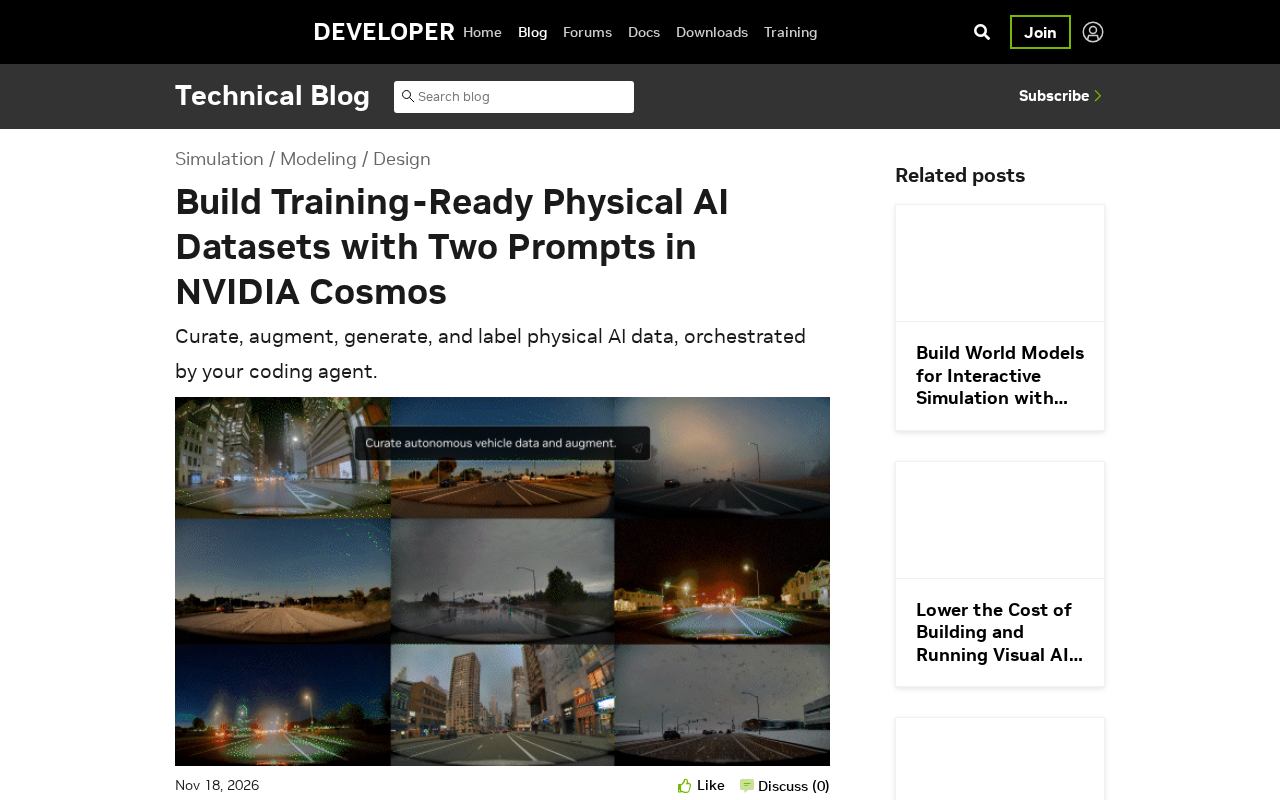
Why Physical AI Datasets Are So Hard to Build
Physical AI must understand motion, lighting, materials, and interactions in the real world, so models have to learn from large volumes of realistic video sequences. The problem is that the truly valuable training samples often hide in long-tail scenarios: rare product defects, road accidents in low light, and harsh weather such as rain, snow, and fog. These scenarios appear infrequently in natural collection, and building up volume through real vehicles and on-location shooting is both uneconomical and hard to control for variables.
NVIDIA states explicitly in the blog that world model accuracy starts with high-quality, diverse training datasets, and that capturing challenging scenarios such as rare defects and nighttime events is the current bottleneck. This explains why generative world models have been brought into the data production pipeline—it turns "waiting for a scenario to happen" into "constructing the scenario on demand."
World Model refers to a class of generative models that learn the dynamic laws of an environment. They attempt to internally represent state transitions and causal relationships in the physical world, so they can predict "what happens next" or "how the scene changes given an action." Unlike image generation models that merely fit pixel distributions, world models emphasize spatiotemporal consistency and physical plausibility—for example, objects do not vanish into thin air, lighting changes with the light source, and collisions obey conservation laws. NVIDIA Cosmos is a family of world foundation models designed for physical AI (autonomous driving, robotics, etc.), and its training corpus covers videos from driving, robotic manipulation, natural scenes, and other domains, giving it the ability to synthesize physically intuitive video sequences under given conditions. Understanding this is key to seeing why it can be used as a "data generator."
The Data Production Logic Behind Two Prompts
The "two prompts" in the title are not marketing rhetoric; they compress the data generation process into two reusable input steps.
The First Prompt: Defining the Scene and Conditions
The first prompt describes the physical conditions of the target scene, including the environment, lighting, object states, and event type. It amounts to giving the world model a "shooting script," so the model generates video clips under controlled conditions that meet training needs. Rather than waiting for rare events in the real world, this approach can directly hit the sample types missing from the dataset.
Long-tail Scenarios refer to sample types that appear extremely infrequently in the real data distribution but are critical to model safety, such as rare combinations of traffic participants, extreme weather, and special industrial defects. They may account for less than one-thousandth of collected data, yet they are often where model failures cluster. The traditional approach relies on large-scale road testing or on-location shooting to "get lucky" and hit these scenarios, which is costly and slow. The value of generative world models is that they turn long-tail scenarios from "passive waiting" into "active construction": developers can explicitly specify conditions such as snowfall, backlighting, and occlusion to synthesize these scarce samples on demand, thereby filling gaps in the training distribution in a targeted way. When supplementing long-tail samples, care should be taken to balance their proportion against the real distribution, so that synthetic samples do not dominate training excessively.
The Second Prompt: Constraining Data Quality and Diversity
The second prompt imposes quality and diversity constraints on the generated results. The value of a dataset lies not only in "having" samples, but in being "diverse enough with reliable annotations." Through prompt-level control, variants with different angles, conditions, and parameters can be produced in bulk under the same scene template, allowing the training set to cover a broader distribution.
The significance of combining these two steps is that it lowers the barrier to data production: there is no need to build a complex simulation pipeline or write large numbers of scene scripts; the prompts themselves become the interface for data engineering.
Training-ready is a phrase with a clear engineering meaning in this context: generated data must not only look visually realistic but also meet the requirements of downstream training pipelines for format, annotation, temporal length, resolution, and physical consistency. This usually includes several layers: the data format is compatible with existing training pipelines (e.g., frame rate, encoding, metadata); annotations or masks for key objects in the scene are available; and the generated physical interactions (such as vehicle trajectories or robotic arm grasping) are kinematically plausible, without clipping, drift, or artifacts that violate conservation laws. Without these checks, synthetic samples may introduce erroneous supervisory signals into the model even if they "look right." In practice, therefore, generation is often followed by a combination of automated physical consistency checks and manual spot checks.
Practical Impact on the Physical AI Development Workflow
The relationship between world models and data generation is bidirectional. High-quality data trains more accurate world models, and more accurate world models can generate more realistic training data, forming a positive cycle. Cosmos is positioned precisely as the "data amplifier" in this cycle.
From an engineering perspective, this approach changes the cost structure of the data preparation phase. In traditional workflows, data collection, cleaning, and annotation consume a large amount of time early in a project; prompt-driven generation moves part of that work forward into scene design, allowing teams to validate model performance in specific long-tail scenarios more quickly. For fields that depend on physical-world perception—autonomous driving, robotics, industrial inspection—this means data can be added in a targeted way for known weak spots rather than blindly scaling up collection.
It is important to note that generated data cannot fully replace real data. The blog still emphasizes "training-ready," meaning the generated results must meet the format and quality requirements needed for training, rather than simply piling up synthetic samples. The ratio of synthetic to real data and the physical consistency validation of generated samples remain questions that must be answered before deployment.
What Developers Can Expect
For teams already using the NVIDIA ecosystem, the appeal of this capability lies in its low integration cost: using prompts as the entry point and calling the world model as a data generation service. It is suitable for quickly building prototype datasets early in a project, and also for targeted enhancement against failure cases before a model goes live.
The real barrier will shift from "can we collect the data" to "can we design good scene prompts." This requires teams to have a clear understanding of the long-tail distribution of their own tasks—only by knowing where the model is likely to fail can they write valuable prompts. From this perspective, Cosmos turns part of data engineering into an understanding of the problem itself.
The data bottleneck for physical AI will not disappear because of a single tool, but putting the power to construct rare scenarios into developers' hands is indeed a step in the right direction.
One-line Summary
NVIDIA Cosmos uses two prompts to generate training-ready long-tail datasets for physical AI on demand.
Paragraph Summary
The article centers on the Cosmos world model approach introduced in NVIDIA's official developer blog, noting that the real bottleneck for physical AI datasets lies in long-tail scenarios such as rare defects, nighttime accidents, and extreme weather that are difficult to collect and reproduce. Cosmos compresses data production into two prompt steps: the first defines the physical conditions and environmental script of a scene, and the second constrains the quality and diversity of the generated data, enabling bulk production of multi-angle, multi-condition variants under the same scene template. Prompts thus become a new interface for data engineering, lowering the barrier to scene construction and creating a positive cycle between world models and training data, so that data can be added in a targeted way for model weak spots. The article also cautions that generated data must meet "training-ready" requirements, and that the ratio to real data and physical consistency validation remain key to deployment, with the core challenge for developers shifting from "can we collect data" to "can we design good scene prompts."
Related articles

Prompt Engineering for Beginners: From Writing Prompts to Engineering Thinking
Starting from the essence and four functions of prompts, this article systematically explains the six-step process, four success criteria, learning value, and practical limitations of prompt engineering to help you build a complete understanding.

Anthropic Launches Nasdaq IPO: AI Giant's Listing and Risk Disclosures
Anthropic officially launches its Nasdaq IPO under ticker ANT, with market valuation expected to potentially exceed SpaceX's record. The prospectus devotes nearly 100 pages to AI risks, while first-half revenue grew over 14x but net losses widened sharply, reigniting the AI bubble debate.

Rust cURL Clone Uses 4,832 unsafe Blocks—Is the Memory Safety Myth Broken?
A Rust cURL clone uses 4,832 unsafe keywords, challenging Rust's memory safety narrative. We analyze what unsafe really means, compare Fil-C, and examine rewrite motives.