NVIDIA cuML Accelerates Spectral Clustering: 100x+ Speedup Over Scikit-Learn Benchmarked
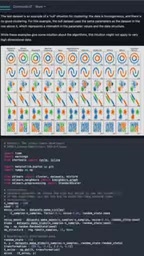
cuML enables 200x+ GPU-accelerated spectral clustering in Scikit-Learn with zero code changes.
Spectral clustering is valued for capturing complex non-convex structures that k-means misses, but its O(n³) eigendecomposition makes it prohibitively slow on large datasets. NVIDIA's open-source cuML library solves this with a "transparent acceleration" mechanism: load the GPU accelerator before Scikit-Learn imports, and all computation shifts to the GPU automatically — no code rewrites needed. Pre-installed on Google Colab and Kaggle, cuML delivers 200x+ speedups over CPU on large-scale datasets like equity options data, compressing runtimes from minutes to seconds, with public benchmark notebooks for independent verification.
Spectral Clustering is a machine learning technique capable of capturing complex data structures, but it has long been bottlenecked by slow CPU performance. NVIDIA's cuML library offers a compelling solution: without rewriting a single line of code, simply load the GPU accelerator before importing Scikit-Learn, and computations that previously took minutes can complete in seconds — delivering over 100x, and in some cases more than 200x, speedups on large-scale datasets.
Why Spectral Clustering Matters
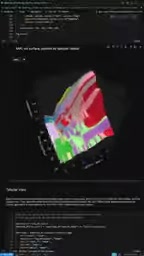
Spectral Clustering excels at discovering data structures that traditional methods like k-means tend to miss. In the original demo, the author used Scikit-Learn's spectral clustering to segment 50,000 options contracts by their volatility surface into distinct risk regimes, producing clearly separated groupings.
This kind of non-convex, non-spherical data distribution is exactly where spectral clustering shines. By contrast, k-means assumes clusters are roughly spherical and similarly sized, which often leads to poor results on complex geometries. Scikit-Learn's official clustering comparison page visually illustrates how different algorithms perform across various dataset types.
The core idea behind spectral clustering is to represent pairwise similarity between data points as a graph — where nodes are data points and edge weights reflect their similarity. By computing the eigenvectors of the graph's Laplacian Matrix, the algorithm maps high-dimensional data into a low-dimensional "spectral space," where standard k-means is applied for the final clustering step. The key insight is that the spectral transformation "unrolls" curved or ring-shaped data manifolds, making clusters that are inseparable in the original space linearly separable in the spectral space. This is why spectral clustering can identify concentric circles, spirals, crescent shapes, and other non-spherical structures — precisely the kinds of patterns that appear in financial data such as volatility surfaces and correlation networks.
Speed: The Biggest Barrier to GPU Acceleration
Spectral clustering is powerful, but computationally expensive. It involves constructing a similarity matrix and performing eigendecomposition, with computational cost growing rapidly as dataset size increases. On a CPU, a single run on a large dataset can take several minutes — practically unacceptable in workflows that require repeated hyperparameter tuning or iterative experimentation.
For large-scale financial datasets like equity options data, the speed bottleneck is especially pronounced. This is precisely why GPU acceleration is the key step toward making spectral clustering genuinely practical.
The computational bottleneck in spectral clustering lies in two steps: first, constructing the n×n similarity matrix (also called the affinity matrix), which has O(n²) space complexity — at tens of thousands of data points, the matrix alone can consume several gigabytes of memory. Second, performing eigendecomposition on the Laplacian Matrix, with a time complexity of O(n³), which is the most time-consuming step in the entire pipeline. For 50,000 data points, this means operating on a 50,000×50,000 matrix — a task that overwhelms single-core CPU processing of dense linear algebra. GPUs, with thousands of parallel compute cores, are naturally suited to large-scale matrix operations like these, and their advantage over CPUs grows more pronounced as dataset size increases.
The cuML Accelerator: Zero-Rewrite Integration
The most notable feature of cuML's GPU acceleration is that it requires no changes to existing code. Developers simply load the cuML GPU accelerator before Scikit-Learn's import statements, and Scikit-Learn will automatically run on the GPU. This "transparent acceleration" design means existing projects can migrate at virtually zero cost.
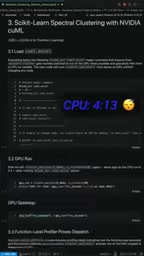
Even more conveniently, the accelerator comes pre-installed on both Google Colab and Kaggle — two of the most popular free cloud notebook platforms. This means users without a local GPU can immediately experience the speedup in the cloud, lowering the barrier to entry significantly.
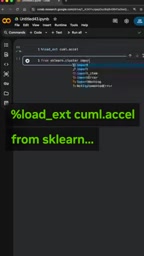
cuML (CUDA Machine Learning Library) is part of the NVIDIA RAPIDS ecosystem and implements GPU-accelerated versions of many common machine learning algorithms on top of CUDA. Its "transparent acceleration" mechanism works via Python's monkey-patching system, which at runtime replaces the relevant Scikit-Learn classes with GPU-optimized versions — while keeping the same calling conventions, parameter interfaces, and return value formats. Developers experience no visible change in how they interact with the API. Note that this transparent substitution requires a compatible NVIDIA GPU and CUDA drivers in the local or cloud environment. In a CPU-only environment, the accelerator loading step will either be automatically skipped or raise an error; code logic remains correct, but no speedup is achieved.
Benchmark Results: 200x+ Speedup on Large-Scale Data
According to the demo, spectral clustering on GPU runs more than 200x faster than on CPU for large-scale datasets like equity options data. What previously took minutes is compressed to seconds — a qualitative improvement for workflows that require frequent experimentation and real-time analysis.
This magnitude of speedup is no coincidence. The heavy matrix operations in spectral clustering are a natural fit for GPU parallel architecture, and the larger the dataset, the more pronounced the GPU's advantage over the CPU. The author also provides a notebook with benchmark code for readers to reproduce and verify the results.
Open Source and Reproducibility
It's worth noting that cuML is an open-source project hosted on GitHub, where anyone can view, use, and contribute to the codebase. Combined with the publicly available benchmark notebook, users don't just have to take the claimed speedup numbers at face value — they can verify actual performance on their own data.
For data science practitioners, the combination of a familiar Scikit-Learn API, free cloud environments, and open-source reproducibility transforms GPU acceleration from a specialized skill requiring dedicated learning into a convenience accessible with just a few lines of code. If you're working with large-scale clustering tasks and frustrated by CPU speed, cuML's transparent acceleration approach is well worth trying.
Related articles

Prompt → MCP → Agent → Skill: The AI Terminology Evolution Chain Explained in 5 Minutes
A clear guide to five core AI concepts — Prompt, MCP, Agent, Skill, and Cowork — and how they connect in a layered evolution chain from simple instructions to multi-agent teamwork.

OpenAI Discloses Model Anomalies, DeepMind Launches AGI Forum, NVIDIA Partners on Grid Power Management
Sept 17 AI roundup: OpenAI publishes model anomaly disclosure framework with 6 reports, Google DeepMind launches AGI public forum, NVIDIA leads AI energy management alliance with 18 partners.
Build a Local AI Agent with Python in 10 Minutes: Ollama + PydanticAI in Action
A hands-on guide to building a fully local AI agent with Python, Ollama, and PydanticAI in 10 minutes — covering model selection, tool functions, and conversation loops.