Nvidia: Decoding Its Role as the 'Central Bank' of AI

Nvidia controls AI-era compute and the CUDA ecosystem, making it the industry's de facto central bank.
Using the viral Hacker News analogy of Nvidia as the "central bank of AI" as a starting point, this article examines Nvidia's structural dominance in the AI industry. GPU compute has become the hard currency of the AI era, and Nvidia regulates industry "liquidity" through chip supply and product cadence. The CUDA ecosystem's decade-plus of path dependency means hardware rivals can't easily displace it. The article also flags the systemic risks of this power concentration in a single commercial entity, surveys challengers like Google TPU, AMD, and custom silicon, and calls for a more diverse, resilient compute supply landscape.
An Intriguing Analogy
"Nvidia is the central bank of AI" — this idea, born from a heated Hacker News discussion, uses a financial metaphor to precisely capture the core power structure of today's AI industry. The thread, which garnered 197 upvotes and 158 comments, draws a parallel between Nvidia's position in the AI ecosystem and a central bank's role in the monetary system. It's worth unpacking in depth.
What does a central bank actually do? It controls the money supply, sets the cost of capital, and shapes liquidity across the entire economy. Nvidia plays a strikingly similar role in the AI world: it controls the supply of compute — the "hard currency" of the AI era — determines the "cost of capital" for training a large model, and profoundly influences the pace of development across the entire AI industry.
Compute as Currency: Why the Analogy Holds
In traditional finance, money serves as the medium for exchanging value. In the AI era, GPU compute has become the "hard currency" that measures a company's technical capability and competitive edge. Whether it's OpenAI, Anthropic, Meta, or Google — the very first barrier to training a frontier model is whether you can secure enough Nvidia GPUs.
This scarcity of supply gives Nvidia pricing power analogous to a central bank. When compute is in short supply, who gets H100s, how many, and at what price is largely determined by Nvidia and its allocation strategy. Just as a central bank influences the economy by adjusting interest rates and money supply, Nvidia effectively regulates the "liquidity" of the entire AI industry through its chip production allocation and product release cadence.
The CUDA Ecosystem: A Near-Unassailable Moat
Nvidia's "central bank" status stems not only from its hardware, but from the lock-in effect built by the CUDA software ecosystem. After years of accumulation, virtually every mainstream deep learning framework and toolchain is deeply tied to CUDA. This means that even if a competitor releases a chip with comparable performance, the migration cost for developers is extremely high.
This mirrors the logic of a central bank's fiat currency — it's not that paper money has intrinsic value, but that the entire economic system is built upon it, creating powerful network effects and path dependency.
CUDA (Compute Unified Device Architecture) is a parallel computing platform and programming model introduced by Nvidia in 2006, allowing developers to use languages like C/C++ to directly schedule thousands of parallel compute cores on a GPU. Before the deep learning boom, CUDA had already built a large user base in scientific computing, physics simulation, and similar fields. The breakthrough victory of AlexNet at the ImageNet competition in 2012 was built on CUDA acceleration, and mainstream frameworks like PyTorch and TensorFlow subsequently adopted CUDA as their default GPU backend. Today, the ecosystem built around CUDA includes: the cuDNN library for fundamental deep learning operations, NCCL for distributed communication, and tens of thousands of pre-compiled operators and third-party tools. Migrating to another platform means not only rewriting low-level call code and re-adapting the entire toolchain, but also abandoning years of accumulated tuning expertise — a switching cost that is often decisive in engineering practice.
The Risks of Concentrated Power
Comparing a commercial company to a central bank implicitly raises concerns about excessive concentration of power. The lively Hacker News discussion largely reflects the industry's complex feelings about this kind of single-point dependency.
Real central banks are at least subject to government regulation and public accountability, with decisions theoretically guided by the public interest. Nvidia, by contrast, is a publicly traded company maximizing shareholder returns. Its "monetary policy" over compute supply and pricing serves commercial objectives — not the overall health of the industry. When the lifeblood of an emerging industry rests in the hands of a single supplier, systemic risk follows.
Industry Responses and Challengers
Precisely because of this, we're seeing a growing number of forces attempting to break this monopoly. Cloud providers like Google (with TPUs), Amazon (with Trainium/Inferentia), and AMD (with its MI-series accelerators) are all vying for a share of the market. Companies like OpenAI are also exploring the possibility of developing their own chips.
In the near term, however, the biggest obstacle these challengers face isn't hardware performance — it's the software ecosystem and developer habits that Nvidia has built up over more than a decade. Dislodging the "AI central bank" requires not just better chips, but an entire software stack and developer community capable of rivaling CUDA.
It's worth noting that the various challengers take fundamentally different technical approaches. Google's TPU uses a systolic array architecture optimized to the extreme for matrix multiplication, but is offered primarily as a cloud service with no option for self-deployment. Amazon's Trainium is designed specifically for training workloads while Inferentia focuses on inference, with both deeply tied to the AWS ecosystem. AMD's MI300X actually surpasses the H100 in memory bandwidth, and offers a degree of CUDA compatibility through the ROCm platform. It has recently earned procurement backing from cloud providers like Microsoft Azure, making it currently the most market-recognized hardware alternative. Beyond these, startups such as Groq with its LPU and Cerebras with its wafer-scale chip have chosen to start from scratch at the architectural level, demonstrating throughput several times that of GPUs in specific inference scenarios. These differentiated approaches signal that the strategy for challenging Nvidia has shifted from head-on competition to seeking asymmetric breakthroughs in niche use cases.
What This Analogy Tells Us
The reason "Nvidia is the central bank of AI" resonates so widely is that it cuts straight to the structural reality of the current AI industry: compute has become the core factor of production in the new era, and the supply of that factor is highly concentrated.
For entrepreneurs and business decision-makers, this analogy is a reminder that when formulating an AI strategy, the stability and cost of compute supply must be treated as a core variable. For the industry as a whole, the key question over the coming years will be how to gradually build a more diverse and resilient compute supply landscape — even while benefiting from Nvidia's technological dividends.
A healthy "monetary system" requires competition and checks and balances. Whether the AI industry can move beyond excessive dependence on a single "central bank" is not merely a question of cost and efficiency — it goes to the heart of the long-term vitality of the entire technology ecosystem.
Related articles

Insufficient Source Material: A Tweet With No Substantive Content
A single tweet reading 'Available until the goblins notice.' with two unexpanded links provides no substantive content to write an article from.
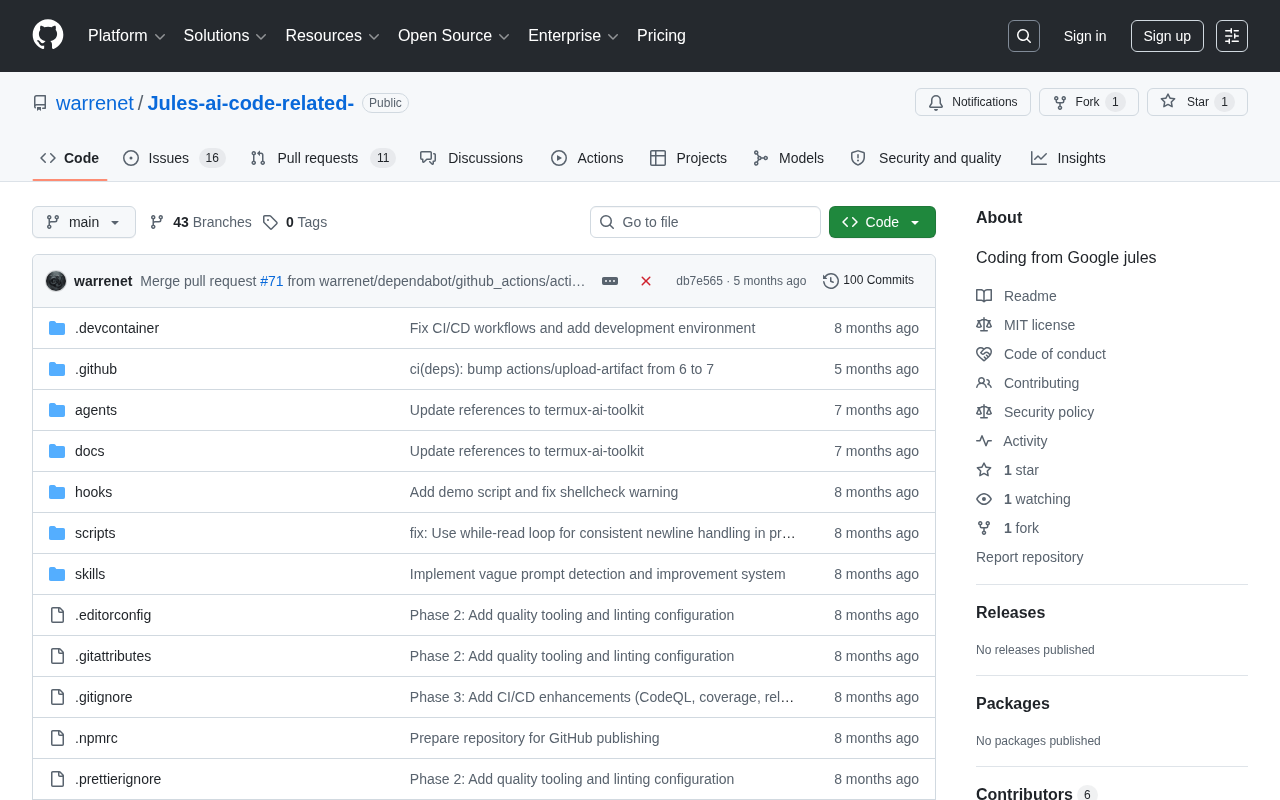
Google Jules AI Coding Assistant: A Quick Look at an Open-Source Practice Repo
A look at a small GitHub repo centered on Google Jules, an autonomous AI coding agent. Explores what Jules does, the repo's practical value, and how to evaluate early-stage AI tool projects.

GitHub Project Overview: prateek0221/jules — Critically Lacking Information
The GitHub repo prateek0221/jules has only 1 star, no code, and no README. We review available info and provide background on Google's Jules AI coding agent.