NVIDIA Earth-2: An AI Platform for Weather Decision-Making Powered by Real-Time Observations

NVIDIA Earth-2 uses GPU-accelerated AI to turn real-time observations into high-resolution weather decisions for industry.
Traditional NWP models are too slow and coarse for the localized, real-time weather needs of energy, logistics, and agricultural industries. While these sectors are accumulating their own sensor and field-level data, a significant technical gap — spanning data assimilation and high-resolution modeling — stands between raw observations and actionable decisions. NVIDIA Earth-2 bridges this gap by combining GPU acceleration with AI weather models, allowing enterprises to feed proprietary data into a platform that generates fast, region-specific forecasts to support energy dispatch, logistics routing, and agricultural management.
Weather-sensitive industries are gaining access to increasingly rich observational data that can detect weather changes earlier and at a more localized level. Energy companies, logistics firms, and agricultural operators are all accumulating their own real-time observation resources. The core challenge that NVIDIA Earth-2 aims to solve is how to rapidly convert these raw observations into actionable decisions.
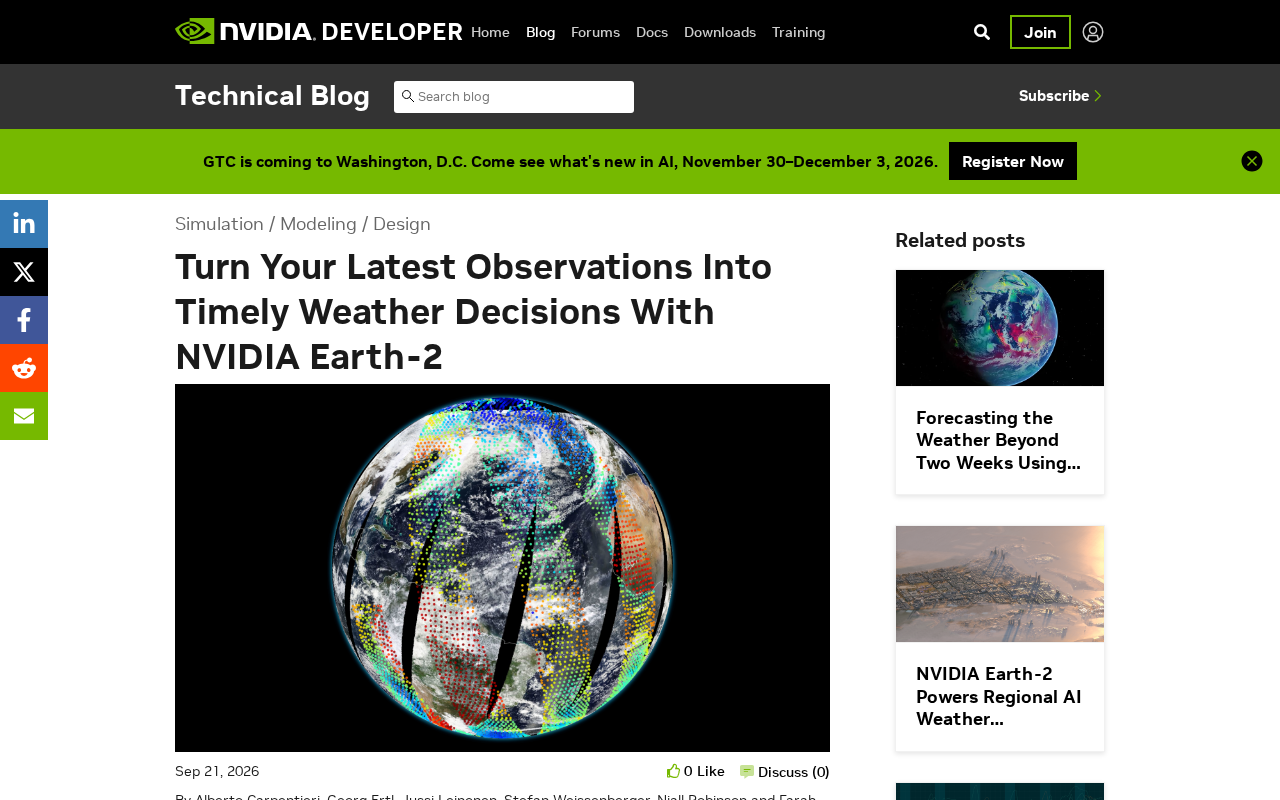
The Value and Challenge of Observational Data
Traditional weather forecasting relies primarily on large-scale numerical weather prediction (NWP) models published by government meteorological agencies. These models offer broad coverage and reliable accuracy, but their update frequency is limited and spatial resolution is coarse — making them insufficient for use cases that require local, real-time weather information.
Today, industries themselves are becoming important data sources. Energy companies deploy large numbers of sensors at wind farms and solar installations, logistics companies rely on real-time monitoring of road conditions and flight routes, and agricultural operators track field-level temperature, humidity, and precipitation. These observational datasets are more timely and geographically targeted, and in theory can deliver earlier, more granular warnings than public forecasts.
The challenge is that raw observations don't automatically translate into decisions. There is a significant technical gap between data collection, assimilation, modeling, and inference. Turning the latest observations into timely, trustworthy weather assessments requires a technology stack capable of fusing multi-source data, running computations quickly, and outputting high-resolution results.
NWP models typically operate at spatial resolutions of several to tens of kilometers, with update intervals of six hours or longer. This falls far short of what's needed for sub-kilometer-level accuracy in wind farm power forecasting or micro-weather assessment along flight routes. Data assimilation is the key technique for bridging this gap — it uses statistical methods to "incorporate" newly arriving observations into the model's initial state, bringing the forecast's starting point closer to the true state of the atmosphere. However, traditional assimilation pipelines (such as four-dimensional variational assimilation, 4D-Var) are extremely computationally expensive, with each run potentially taking hours. This is the fundamental barrier preventing proprietary enterprise observations from being fed into public forecast systems in real time. AI-driven assimilation approaches aim to approximate this process using neural networks, compressing computation time to minutes or even seconds.
Earth-2's Positioning
NVIDIA Earth-2 is a platform-level solution for climate and weather simulation, with the goal of delivering higher-resolution, faster inference for weather forecasting using GPU acceleration and AI models. Its core approach is to combine machine learning-driven weather models with traditional numerical methods, enabling enterprises to feed their own observational data into the modeling pipeline and generate forecasts tailored to specific regions and scenarios.
For weather-sensitive industries, this capability means being able to build decision-support systems beyond public forecasts — ones more closely aligned with their own operational needs. For example, energy companies can use this to optimize dispatch scheduling for wind and solar generation, while logistics companies can proactively route around severe weather.
Key Steps in Converting Observations into Decisions
Transforming real-time observations into decisions involves several interconnected technical steps: data ingestion and preprocessing, fusion and assimilation with existing forecast models, high-resolution inference computation, and finally presenting results in a business-ready format. Earth-2's value lies in using AI acceleration to reduce the overall latency across this chain, so that "the latest observations" can genuinely influence "current decisions" rather than lagging behind events as they unfold.
This closed loop from data to decision is one of the primary directions for AI deployment in the meteorological domain today. Compared to traditional methods that often require hours-long model runs, the fast inference characteristics of AI models make high-frequency, localized weather updates feasible.
The AI weather model approach used in Earth-2 follows the lineage of influential recent models such as FourCastNet, Pangu-Weather, and GraphCast. These models learn the statistical patterns of atmospheric dynamics by training on long-term reanalysis datasets like ERA5, and at inference time require no solving of partial differential equations — making them orders of magnitude faster than traditional NWP. NVIDIA combines its own FourCastNet with downstream downscaling models (such as the CorrDiff diffusion model) within Earth-2, enabling global-scale forecasts to be "zoomed in" to finer regional resolutions. This two-stage architecture of "coarse global model forecast + local AI downscaling" represents the current industry consensus for balancing accuracy and speed.
Implications for Industry
AI weather models have developed rapidly in recent years, progressing from early experimental research toward industrial applications. NVIDIA's integration of these models into the Earth-2 platform reflects a broader trend of engineering and productizing cutting-edge research. For enterprises, this means they don't need to build meteorological models from scratch — instead, they can connect their own data to an existing platform and quickly obtain customized weather insights.
A note: the source material for this article is limited in scope, covering only Earth-2's overall positioning for weather-sensitive industries and the applied value of observational data. It does not address specific model architectures, performance benchmarks, or deployment details. Readers looking for a deeper technical understanding are encouraged to consult the official NVIDIA developer documentation for complete information.
Overall, as observational data becomes increasingly abundant and AI inference capabilities continue to improve, the barrier to converting real-time data into timely weather decisions is falling. This opens up new operational optimization opportunities for weather-sensitive industries such as energy, logistics, and agriculture.
Related articles

macOS Is No Longer UNIX: Apple Didn't Renew Certification, But the Technology Is Unchanged
Apple did not renew macOS's UNIX certification, and the Open Group has removed Apple's entry. This article analyzes the technical reality behind the expiration, Apple's possible intentions, and the practical impact on developers.

Building Stateful Multi-Agent Systems with Azure Cosmos DB
Based on the official Azure Cosmos DB tutorial, this article explains how to use the Agent Memory Toolkit to add shared persistent memory to a multi-agent travel planner, covering short-term, long-term, episodic, and semantic memory plus cross-session state continuity.

Production AI Agent Operations: A Three-Step Framework for Observing, Evaluating, and Optimizing
Azure Cosmos DB team proposes a three-step framework for production AI Agent operations: observe trace tracking, evaluate with LLM as a judge and regression testing, optimize cost across RU, retrieval, memory, and LLM layers.