Nvidia Launches NVKE: A New Kubernetes-Native AI Compute Management Engine

Nvidia may launch NVKE, extending GPU compute management from the chip layer to the Kubernetes orchestration layer.
Based on a Hacker News entry about the Nvidia Kubernetes Engine (NVKE) project with very little information, the article infers from the naming paradigm that Nvidia may launch a Kubernetes distribution or managed control plane for GPU infrastructure. The author analyzes that the motivation lies in general-purpose schedulers being unable to handle GPU topology awareness, NVLink interconnect, MIG partitioning, and multi-tenant isolation, while the existing GPU Operator only solves node-level problems. The article argues that NVKE is more likely positioned as a portable reference control plane rather than directly competing with GKE/EKS. AI platform teams could thereby offload driver maintenance, but they need to be wary of vendor lock-in risks caused by deep control plane binding. The full text emphasizes that the current analysis is all inference based on the name and requires official documentation and code for verification.
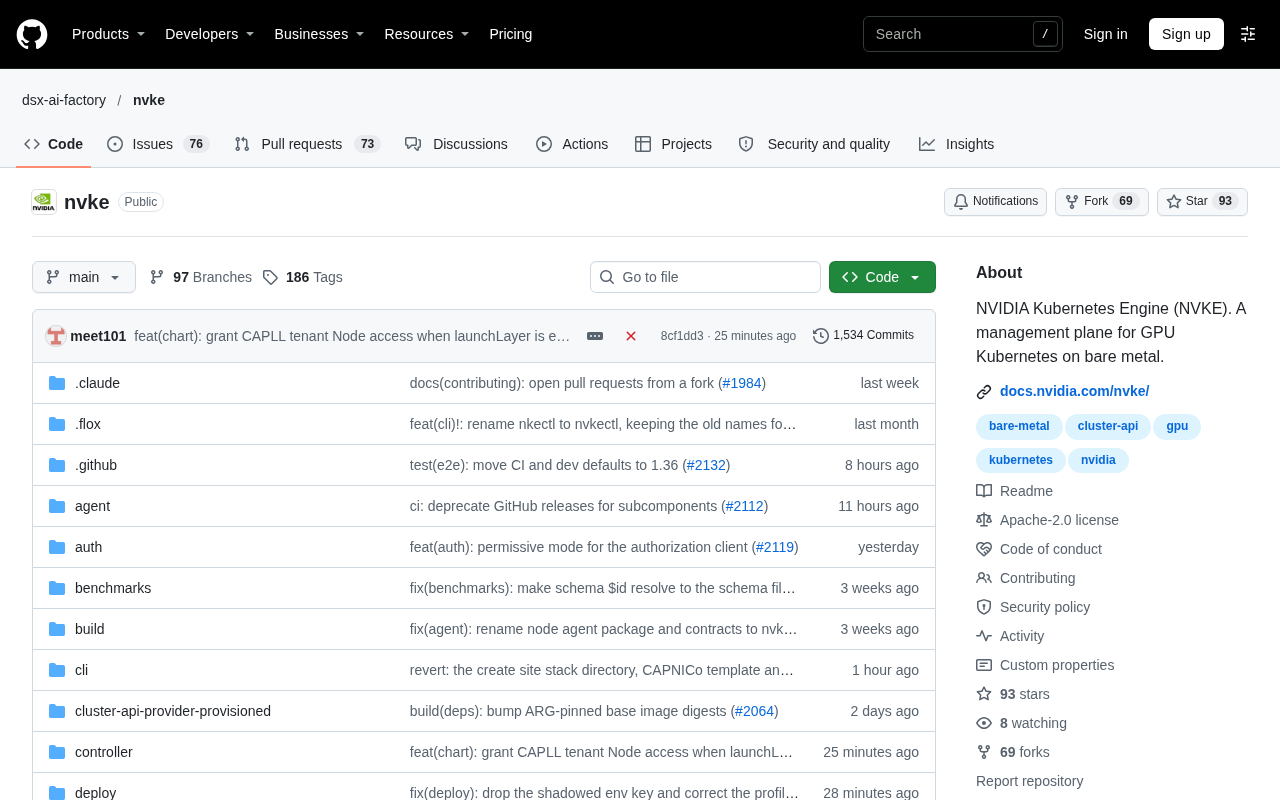
Nvidia is extending its influence in the AI compute space from the chip layer to the orchestration layer. A new project entry named Nvidia Kubernetes Engine (NVKE) has appeared on Hacker News. Although the disclosed information is very limited, the naming itself sends a clear signal: Nvidia wants to manage its GPU compute clusters in a Kubernetes-native way.
What NVKE Is: Product Positioning Inferred from the Name
From the naming structure, NVKE belongs to the same naming paradigm as the well-known GKE (Google Kubernetes Engine), EKS (Amazon Elastic Kubernetes Engine), and AKS (Azure Kubernetes Service). This means NVKE is most likely not just another GPU monitoring plugin, but a Kubernetes distribution or managed control plane for Nvidia GPU infrastructure.
This positioning is worth pondering. Over the past few years, Nvidia's software investments have focused on toolchains such as CUDA, cuDNN, TensorRT, Triton Inference Server, and GPU Operator, but these components are more about "running in Kubernetes" rather than "managing Kubernetes itself." If NVKE lives up to its name, it means Nvidia intends to bring the control plane into its own product portfolio.
Why Nvidia Would Build Its Own Kubernetes Engine
The infrastructure requirements of AI training and inference workloads differ greatly from those of general web services: GPUs are scarce resources, and capabilities such as topology awareness, NVLink interconnect, MIG partitioning, and memory scheduling cannot be handled out of the box by general-purpose Kubernetes schedulers.
Nvidia previously alleviated some of these problems through GPU Operator and Device Plugin, but capabilities such as multi-tenant isolation, GPU utilization optimization, and training job queuing and preemption still require users to assemble schedulers and queue systems themselves. An officially maintained Kubernetes engine could codify these best practices and lower the barrier for enterprises to deploy AI infrastructure.
Another background factor that cannot be ignored is the change on the inference side. As large-model inference becomes a常态化 workload, enterprises need platform capabilities that can elastically scale and schedule by GPU model tier, rather than manually installing drivers on every machine.
NVLink and MIG: NVLink is Nvidia's high-bandwidth interconnect technology between GPUs. During multi-GPU training, it handles data exchange between GPUs, and its topology (such as which cards are directly connected and the distance across NUMA nodes) directly affects distributed training efficiency. MIG (Multi-Instance GPU), on the other hand, allows a single GPU such as A100/H100 to be physically partitioned into multiple independent instances, each with isolated memory and compute units. The Kubernetes-native scheduler only sees whole-card resources and cannot perceive NVLink topology affinity or fine-grained allocation of MIG instances. This is precisely the underlying reason Nvidia needs to extend at the control plane layer.
GPU Operator and Device Plugin: GPU Operator is a Kubernetes Operator provided by Nvidia to automate the deployment of components such as drivers, container runtimes, Device Plugin, and DCGM monitoring; Device Plugin is an implementation of the Kubernetes device plugin framework, responsible for reporting GPU resources to kubelet and completing device mounting within containers. The two solve the problem of "GPUs being usable by Pods," but do not involve scheduling policies, queue management, or multi-tenant quotas. They are node-level capabilities rather than control plane capabilities.
Coopetition with the Existing Ecosystem
NVKE will inevitably form a delicate relationship with cloud providers' managed Kubernetes services. On the one hand, cloud providers are Nvidia's largest GPU buyers, and if NVKE only makes sense in its own data centers, its value would be greatly diminished; on the other hand, cloud providers also have strong incentives to maintain the differentiation of their own control planes.
The expected path is that NVKE is more likely positioned as a reference architecture and portable control plane, allowing enterprises to maintain a consistent experience across their own clusters, edge nodes, and hybrid clouds, rather than directly competing with GKE/EKS for managed business. This judgment is currently only speculation based on the name. The discussion heat on Hacker News (17 points, 1 comment) also shows that the community is still watching.
Managed Control Plane and Reference Architecture: A managed control plane means the cloud provider is responsible for operating control plane components such as the Kubernetes API Server, etcd, and scheduler, while users only manage workloads; a reference architecture is a set of validated deployment topologies and configuration manifests that users build on their own infrastructure. GKE/EKS/AKS belong to the former, while if NVKE takes the latter route, it is closer to an "Nvidia-certified Kubernetes distribution"—providing scheduler configurations, CRDs, and Operator combinations tuned for GPU scenarios, while the control plane is still hosted by users or cloud providers, thereby avoiding direct conflict with cloud providers.
What It Means for AI Infrastructure Teams
If NVKE ultimately lands as an official Kubernetes engine, the focus of AI platform teams will shift: the "dirty work" of underlying drivers, device plugins, and topology scheduling can hopefully be handed over to Nvidia for maintenance, allowing teams to focus on model service orchestration, quota governance, and cost optimization.
But vendor lock-in also needs to be watched. Once the control plane is deeply bound to Nvidia's scheduling extensions and CRDs, the cost of migrating to other accelerator ecosystems will rise. For enterprises with multi-chip strategies, evaluating NVKE should focus on whether it adheres to upstream Kubernetes consistency and whether its extension points remain open.
Currently, public information about NVKE is extremely limited, and the above analysis is more of an inference based on naming conventions and Nvidia's existing product line. The real answer will only be revealed once official documentation and code are released. Developers interested in this project are advised to start with the evolution path of GPU Operator and observe whether Nvidia is gradually taking over the orchestration layer upward.
Vendor Lock-in and Upstream Consistency: Vendor lock-in here refers to the control plane depending on Nvidia's proprietary scheduling extensions, CRDs, or admission controllers, making workload definitions difficult to migrate to accelerator platforms such as AMD and Intel. Evaluation should focus on two points: first, whether NVKE exposes GPU capabilities through upstream standard APIs such as Kubernetes Device Plugin, RuntimeClass, and ResourceClaim rather than private interfaces; second, whether scheduling extensions are implemented as replaceable Scheduler Framework plugins. Adhering to upstream consistency means that enterprises with multi-chip strategies can reuse workload descriptions across different accelerator ecosystems, reducing migration costs.
One-line Summary
Nvidia may launch NVKE, extending GPU compute management from the chip layer to the Kubernetes orchestration layer.
Paragraph Summary
Based on a Hacker News entry about the Nvidia Kubernetes Engine (NVKE) project with very little information, the article infers from the naming paradigm that Nvidia may launch a Kubernetes distribution or managed control plane for GPU infrastructure. The author analyzes that the motivation lies in general-purpose schedulers being unable to handle GPU topology awareness, NVLink interconnect, MIG partitioning, and multi-tenant isolation, while the existing GPU Operator only solves node-level problems. The article argues that NVKE is more likely positioned as a portable reference control plane rather than directly competing with GKE/EKS. AI platform teams could thereby offload driver maintenance, but they need to be wary of vendor lock-in risks caused by deep control plane binding. The full text emphasizes that the current analysis is all inference based on the name and requires official documentation and code for verification.
Related articles
 Tech Frontiers
Stylome Bot Slammed as Useless Junk: Why Do AI Detection Tools Keep Failing?
Reddit users test the Stylome AI detection bot: Gemini-rewritten text judged human-written, consistently low confidence. An analysis of AI text detection's technical dilemmas, privacy concerns, and credibility crisis in community governance.
 Tech Frontiers
When AI Becomes a Productivity Divide: Clarity or "AI Psychosis"?
A civil engineer's deep use of agentic AI boosted efficiency but bred contempt for peers who refuse to learn. Is this clarity or AI psychosis? An analysis of the cognitive and psychological challenges behind the AI productivity divide.
 Tech Frontiers
Opus 5.5 Benchmark Scores Climb, Community Says Its "Weights Are Blessed"
Reddit community discusses Opus 5.5's rising scores on the Benchmaxxing Bench, with users describing its performance as "weights are blessed." This article interprets the community reaction and cautions against conflating benchmark scores with real capability.