NVIDIA NemoClaw: Full-Stack Control for Building Secure, Specialized AI Agents

NVIDIA NemoClaw advocates building secure, reliable specialized agents with a controllable stack and runtime constraints.
NVIDIA released NemoClaw in its developer blog, a construction solution for specialized agents. The article notes that building autonomous agents requires the coordination of model, harness, and domain tools, but what truly determines deployment is not capability but control. NemoClaw's core proposition is to push security constraints from the prompt level down to the runtime, enforcing tool whitelists, path restrictions, and action boundaries so they do not depend on model obedience and cannot be bypassed by prompt injection. "Controllable stack" emphasizes developers' complete authority over model selection, tool integration, and data flows, suitable for private scenarios involving internal data; the specialization route trades reliability and security for a converged tool set. The article also notes that this launch did not disclose APIs, deployment flows, or compatibility details, and evaluation should focus on verifying whether constraints can truly be enforced.
Building an autonomous agent that can actually execute tasks requires three things: a sufficiently capable model, a runtime framework (harness) responsible for orchestration and scheduling, and domain tools that fit the business scenario. But once these are assembled, the real challenge developers face is not capability—it's control. Who can guarantee the agent acts as intended, and who can stop it in time when it crosses the line? NVIDIA's answer, presented in its developer blog, is NemoClaw: a specialized agent-building solution that emphasizes a secure runtime and full-stack controllability.
From "It Runs" to "We Dare Use It": What Agents Lack Is Runtime Constraints
NVIDIA opens the article by identifying the components of such systems: model, harness, and domain tools—all three are indispensable. This breakdown itself is nothing new; what carries real information is the judgment that follows—to deploy agents more safely, developers need a runtime capable of enforcing constraints.
That statement gets to the core pain point of current agent deployment. Most teams in the demo phase only care about whether the model can understand instructions and whether tool calls succeed; once in production, the questions immediately shift to permission boundaries, auditable behavior, and interruptible anomalies. An agent that can call the file system, a browser, or internal APIs—without hard limits at the runtime level—means any prompt injection or reasoning deviation could turn into real damage. NemoClaw's positioning is precisely to push such constraints from "gentlemen's agreements in prompts" down to the runtime execution layer.
Prompt Injection is a key risk category for understanding why runtime constraints are necessary. It refers to attackers hiding malicious instructions in content the model will read—web page text, documents, tool return results, even file names—inducing the agent to treat that content as user instructions. Unlike traditional code injection, prompt injection exploits the model's tendency to obey natural language instructions, so it cannot be completely eliminated through input filtering. When an agent has file read/write, browser operation, or internal API calling capabilities, a single successful injection can trigger data exfiltration or unauthorized operations. This also explains why "gentlemen's agreements" at the prompt level are insufficient: the model itself cannot reliably distinguish "data" from "instructions," and the runtime must set hard interceptors at tool calls, path access, and action triggers to keep the impact of injection within controllable bounds.
Why Stack Autonomy Has Become a Key Issue
The phrase "a Stack You Control" in the title deserves separate analysis. It expresses not just "it can run locally," but that developers have complete decision-making authority over model selection, tool integration, data flows, and execution policies.
This is especially important for enterprise scenarios. Specialized agents often need access to internal knowledge bases, business systems, and sensitive credentials; hosting these capabilities on an uncontrollable third-party orchestration layer means outsourcing the security boundary. NVIDIA's emphasis on a controllable stack is effectively arguing that the agent's model, harness, and tools should be deployed in an environment the developer can audit and adjust themselves, with security policies, tool whitelists, and human intervention points all defined by the developer.
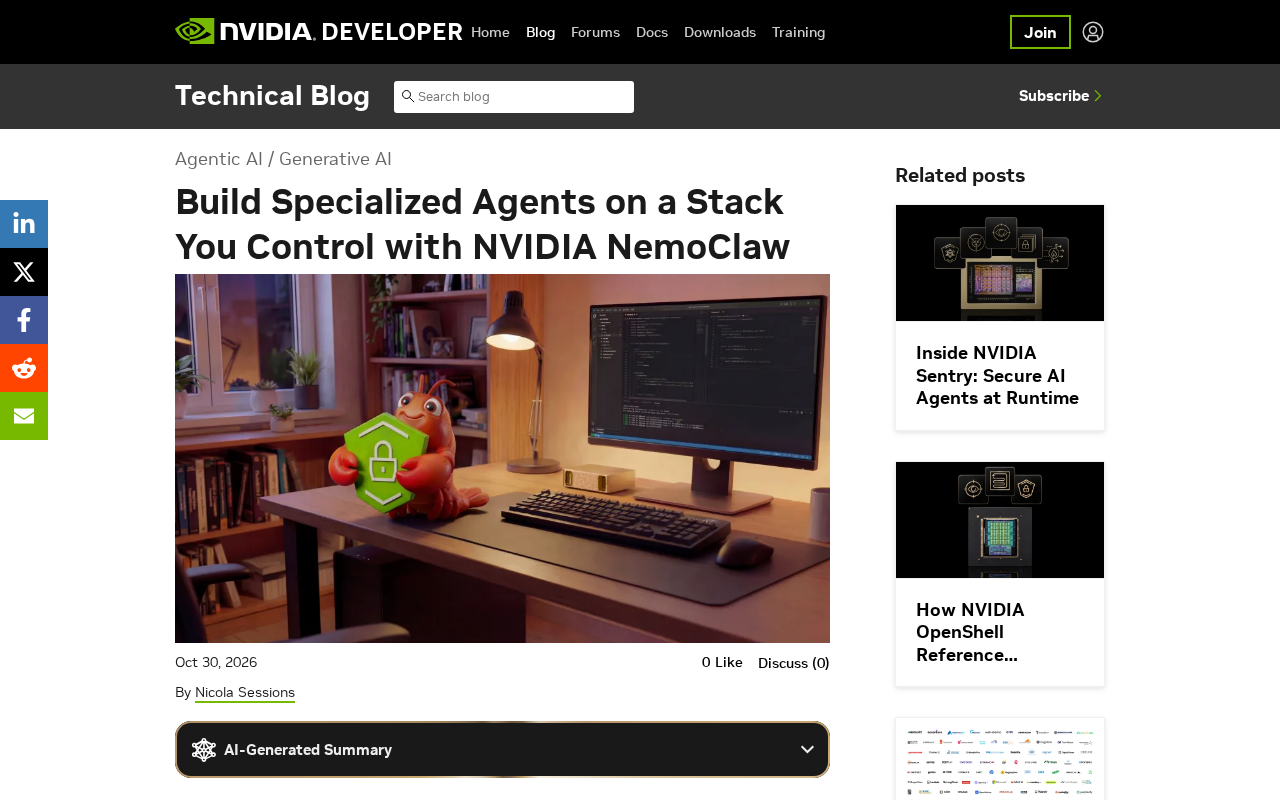
The original article's image shows a combination of a DGX Spark desktop device and a code interface, suggesting this solution targets development and deployment forms in local or private environments. For teams that want to complete agent development, debugging, and operation on their own hardware, this direction reduces dependence on external services.
Harness is the middle layer between the model and the external world, responsible for translating the model's intent into concrete actions and managing the entire execution process. It typically includes: task decomposition and planning, parsing and routing of tool calls, context and state maintenance, loop control for multi-turn execution, and error handling and retries. The model is only responsible for "thinking"; the harness is responsible for "doing" and "remembering how far it got." Precisely because the harness controls the choke point of tool calls and state transitions, constraints such as security policies, tool whitelists, and human confirmation points are most naturally enforced at this layer—and are hardest for the model itself to bypass. Different harnesses vary greatly in extensibility, observability, and security mechanisms, and the choice directly determines whether an agent can be audited and constrained.
Specialized Rather Than General: A Divide in Agent Design Philosophy
"Specialized Agents" in the title is likewise a clear product philosophy signal. General-purpose agents attempt to cover all tasks with one set of prompts and tools, often resulting in touching everything and mastering nothing, with the permission surface infinitely expanded. NemoClaw points to another path: specialized agents built for specific domains, with converged tool sets and clear behavioral boundaries.
Specialization brings two benefits. The first is reliability—narrow-domain tool call paths are shorter and have a smaller error surface; the second is security—because the resources they can access and the actions they can execute are confined to an explicit scope, runtime constraints are easier to implement as concrete rules rather than abstract principles.
Tool Surface Reduction is the concrete implementation method of the specialization route. General-purpose agents often mount a large number of tools, and the permission surface expands accordingly; misuse or abuse of any single tool widens the attack surface. Specialized agents retain only the minimal tool set necessary to accomplish their goals, with explicit limits on each tool's parameter range and accessible resources. This "least privilege" approach is consistent with operating system permission models: the fewer resources accessible, the smaller the room for errors and privilege escalation. Tool surface reduction also reduces the ambiguity the model faces when choosing among many tools, making call paths shorter and behavior more predictable—which is why specialized agents benefit in both reliability and security.
Several Practical Points Worth Noting During Implementation
Although NVIDIA's launch content focuses on solution positioning and does not elaborate on detailed APIs and deployment flows, several judgments with direct guidance for developers can be extracted.
Clearly distinguish the three layers of responsibility. The model handles reasoning and decision-making, the harness handles orchestration and state management, and tools handle interaction with the external world. The clearer the interfaces between the three layers, the easier it is to apply security policies at the harness layer without repeatedly modifying model prompts.
Make security constraints a runtime capability. Rather than repeatedly admonishing in prompts "do not perform dangerous operations," directly restrict the callable tools, accessible paths, and triggerable actions at runtime. Such constraints do not depend on the model's obedience and cannot be bypassed by prompt injection.
Prioritize a controllable deployment environment. For agents involving internal data, placing the model and orchestration layer on owned hardware or in a private environment can significantly reduce data leakage and supply chain risks.
Editorial View
The emergence of NemoClaw reflects a shift in the focus of agent competition: from "whose model is smarter" to "who can make agents run safely in real organizations." Model capability still matters, but what determines whether a project moves from PoC to production is runtime control and boundary design. By emphasizing full-stack controllability and specialization at this point in time, NVIDIA is effectively treating the secure runtime as a differentiator, consistent with its longstanding layout in developer toolchains.
What should be viewed soberly is that this launch content says limited about NemoClaw's specific capability boundaries, its compatibility with the existing harness ecosystem, and the concrete implementation mechanisms of runtime constraints. For teams preparing to evaluate this solution, it is advisable to first clarify what hard constraints are needed for their own scenarios, then verify against the documentation whether these constraints can truly be enforced at the runtime level rather than remaining in configuration descriptions.
The value of a specialized agent lies not in how much it can do, but in what it is explicitly limited from doing—and that limitation is observed by the system, not by the model.
One-line Summary
NVIDIA NemoClaw advocates building secure, reliable specialized agents with a controllable stack and runtime constraints.
Paragraph Summary
In its developer blog, NVIDIA introduced NemoClaw, a construction solution for specialized agents. The article notes that building autonomous agents requires the coordination of three layers—model, harness, and domain tools—but what truly determines deployment is not capability but control. NemoClaw's core proposition is to push security constraints from the prompt level down to the runtime, enforcing tool whitelists, path restrictions, and action boundaries so that they do not depend on model obedience and cannot be bypassed by prompt injection. "Controllable stack" in the title emphasizes developers' complete decision-making authority over model selection, tool integration, and data flows, suitable for private scenarios involving internal data; the specialization route trades reliability and security for a converged tool set. The article also notes that this launch did not disclose APIs, deployment flows, or compatibility details, and evaluation should focus on verifying whether constraints can truly be enforced.
Related articles
DeepSeek Open-Sources DeepInfer: What Is an Inference Framework Actually For?
DeepSeek open-sources its inference framework DeepInfer under Apache 2.0, supporting DeepSeek V4.1 Flash offline inference. This article explains its request scheduling, FlashMLA/DeepGEMM compute optimization, DSPark speculative verification acceleration, and what it means for developers and ordinary users.
Open-Source AI Learning Agent: A Full Workflow Experience from Topology Graphs to Exam Generation
Explore an open-source AI learning agent: built on DeepSeek API, it constructs knowledge systems via topology graphs, with automatic document generation, notes, super documents, and exams. Learn about its Agent workflow and design highlights.

DeepSeek Whale Girl Open-Source MV Meme: AI Industry Coded Slang About Pivoting to Closed Source
Bilibili's DeepSeek Whale Girl rap MV uses fictional memes to tease the AI open-source vs. closed-source debate, with lyrics full of industry slang. This article explains the meme culture, the Whale Girl symbol, and the open/closed tension.