NVIDIA NemoClaw Vulnerability Deep Dive: AI Model Poisoning Attacks and Defense Guide
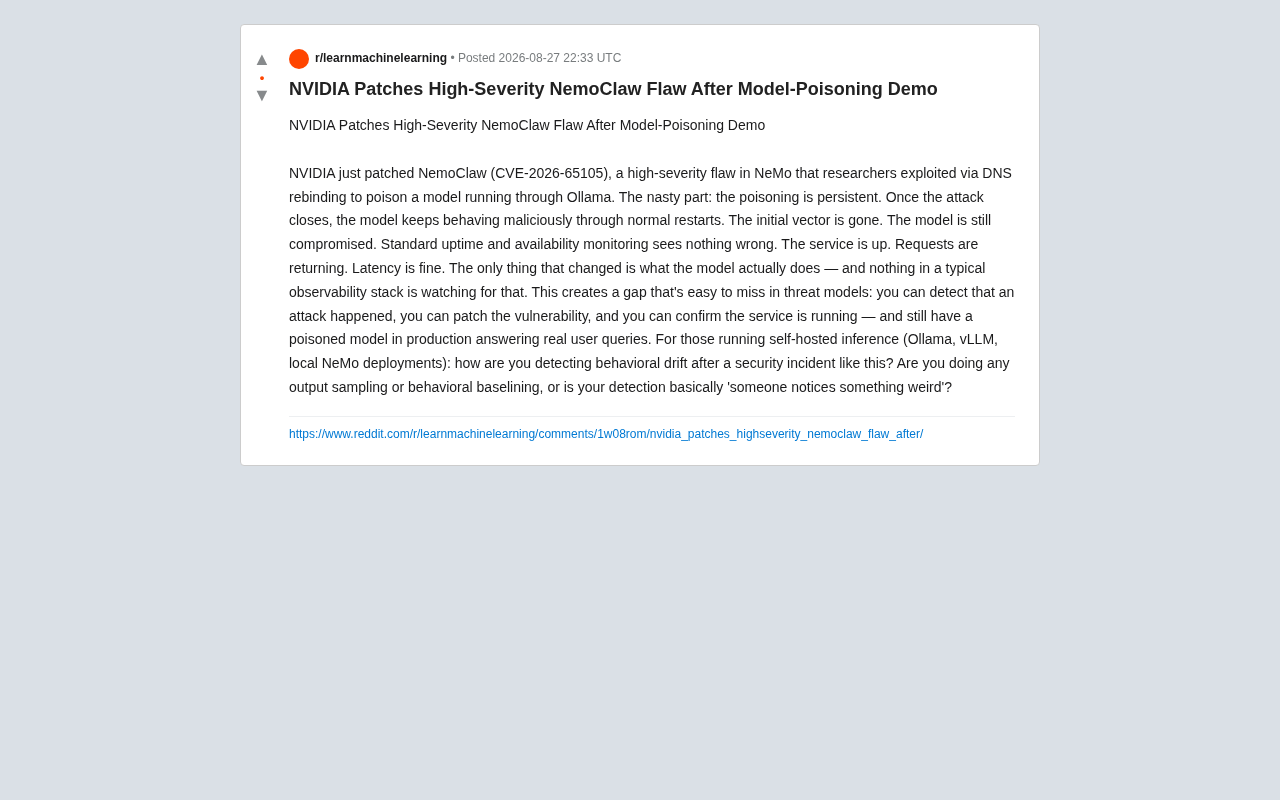
NemoClaw exploits DNS rebinding for persistent AI model poisoning, bypassing traditional monitoring
NVIDIA's NemoClaw vulnerability (CVE-2026-65105) exposed a critical gap in AI security: attackers used DNS rebinding to poison models running on frameworks like Ollama, with contamination persisting through restarts. Traditional monitoring failed to detect the attack because it only tracks service health, not model behavior. This incident reveals the need for model behavioral drift detection, weight verification, and treating model integrity as part of the security perimeter.
The Full Picture of NVIDIA NemoClaw Vulnerability Incident
NVIDIA recently patched a high-severity vulnerability designated CVE-2026-65105, codenamed NemoClaw, affecting its NeMo framework. Security researchers successfully exploited this vulnerability through DNS rebinding techniques, carrying out a "model poisoning" attack against a model running on Ollama.
NVIDIA NeMo is an open-source, end-to-end AI framework designed for building, training, and fine-tuning large-scale generative AI models (including large language models, automatic speech recognition, text-to-speech, and more). Deeply integrated with NVIDIA's GPU computing ecosystem, it supports advanced capabilities like distributed training, model parallelism, and mixed-precision training, making it a core toolchain for enterprise-grade AI application development. NeMo's widespread deployment across research institutions and enterprises means any security vulnerability in this framework could trigger large-scale cascading impacts.
This vulnerability has drawn significant industry attention, not only because it's a high-severity security flaw, but more importantly because it exposes a new attack surface that traditional security models struggle to cover—persistent contamination at the AI model layer. For teams extensively adopting self-hosted inference solutions (like Ollama, vLLM, or local NeMo deployments), this case serves as a wake-up call.
Attack Mechanism: How DNS Rebinding Enables Persistent Model Poisoning
DNS Rebinding Attack Mechanism Explained
DNS rebinding is a classic network attack technique. Attackers manipulate DNS resolution results to trick a victim's browser or application into believing it's accessing a trusted local service, thereby bypassing security protections like same-origin policy and indirectly accessing internal service interfaces that should be protected.
From a technical perspective, the core principle of DNS rebinding attacks exploits the flexibility of the TTL (Time To Live) mechanism in the DNS protocol. The attacker first registers a malicious domain that initially resolves to the attacker's own server, luring the victim's browser into making a request. The attacker then rapidly switches the domain's DNS resolution to a target internal network IP address (such as 127.0.0.1 or 192.168.x.x). Since browsers' same-origin policy is based on domain names rather than IPs, the browser considers subsequent requests as originating from the same source, allowing the attacker's malicious script to interact with internal services. This attack is especially dangerous because many locally deployed AI inference services lack authentication, relying solely on network isolation as their security barrier.
In the NemoClaw case, researchers leveraged precisely this technique to breach access isolation for NeMo/Ollama inference services, subsequently injecting malicious content into the model. Notably, Ollama is a rapidly emerging open-source local LLM inference tool that has gained traction in recent years, allowing users to deploy and run various open-source large language models (like Llama, Mistral, Gemma, etc.) on personal computers or servers with a single command. Its design philosophy emphasizes usability and lightweight deployment—through a simple command-line interface and REST API, developers can quickly set up local inference services. However, Ollama's default configuration typically lacks authentication and access controls, with its API interfaces directly exposed to the local network. This "convenience-first" design makes it naturally vulnerable to internal network penetration attacks like DNS rebinding.
The Most Dangerous Feature: Contamination Persists After Restart
The most concerning aspect of this attack is its persistence. As explicitly stated in the original text:
Once the attack concludes, the model continues to exhibit malicious behavior even after a normal restart. The initial attack vector has disappeared, but the model remains in a contaminated state.
This means that even if you detect the attack, patch the vulnerability, and confirm the service is running normally, a "poisoned" model may still exist in your production environment, responding to real user queries. The attack traces have been erased, but the malicious consequences are embedded within the model itself.
From an AI security perspective, model poisoning is one of the core threats in this field, categorized by attack phase into training-time poisoning and deployment-time poisoning. Training-time poisoning plants backdoors by contaminating training data (such as BadNets attacks), while NemoClaw demonstrates deployment-time poisoning—where attackers directly tamper with the weight parameters or configuration of already-deployed models. The danger of deployment-time poisoning lies in its ability to directly modify production model behavior without touching the training pipeline, and once the tampered weight files are persisted to disk, they continue to take effect after service restarts. Such attacks can cause models to output false information, leak sensitive content from training data, or execute attacker-preset malicious behaviors under specific trigger conditions.
Why Traditional Monitoring Systems Cannot Detect Model Poisoning
Fundamental Limitations of Service Health Checks
This incident exposes fundamental deficiencies in current AI infrastructure observability systems. As the original text pointedly notes:
Standard uptime and availability monitoring detects nothing. The service is online, requests return responses, and latency is normal. The only thing that has changed is what the model is actually doing—and there's nothing in a typical observability stack monitoring that.
Observability as a concept originates from control theory and typically encompasses three pillars in software engineering: Logs, Metrics, and Traces. Current mainstream AI inference service monitoring (such as Prometheus+Grafana, Datadog, etc.) primarily focuses on infrastructure-level metrics—GPU utilization, inference latency, throughput, error rates, queue depth, and so on. These metrics adequately reflect the service's "operational status" but are completely insensitive to the "semantic correctness" of model outputs. In recent years, model monitoring platforms have begun emerging in the MLOps space (such as Arize AI, WhyLabs, Evidently AI), capable of tracking data drift and prediction drift, but their ability to detect behavioral drift caused by malicious tampering remains in early stages.
Our familiar set of monitoring metrics—whether the service is alive, whether requests succeed, whether latency meets standards—completely fails when facing model poisoning. These metrics focus on "whether the system is running," not "whether the system's results are trustworthy."
Critical Gap Overlooked in Threat Models
This creates an easily overlooked gap in threat modeling. Threat modeling is a foundational methodology in security engineering, with classic frameworks including Microsoft's STRIDE model and OWASP threat modeling methods. STRIDE categorizes threats into six types: Spoofing, Tampering, Repudiation, Information Disclosure, Denial of Service, and Elevation of Privilege. However, traditional threat modeling typically defines trust boundaries around network, host, and application layers, with the model itself not considered an independent trust domain. The NemoClaw incident demonstrates that AI system threat modeling needs an additional dimension—the Model Integrity Boundary, meaning model weights, configurations, and behaviors themselves should be included in the definition and protection scope of trust boundaries. MITRE has released the ATLAS (Adversarial Threat Landscape for AI Systems) framework to address this need.
Defenders may have completed what appears to be a comprehensive response process:
- Detected that an attack has occurred
- Patched the exploited vulnerability
- Confirmed the service is running normally
Yet after all this is completed, a contaminated model may still be running in the production environment. Traditional intrusion detection and incident response processes focus on "attack paths" and "system state" but lack continuous validation of "model behavior" itself.
Model Behavioral Drift Detection: Four Viable Approaches
Facing this new type of threat, merely patching vulnerabilities is far from sufficient. The real challenge is: After a security incident, how do you effectively detect model behavioral drift?
Model behavioral drift detection faces a core engineering challenge: how to quantify the deviation degree of natural language outputs. Unlike traditional machine learning models that output numerical predictions, large language models output free-form text, making drift measurement far more complex. The following four approaches build a multi-layered defense system from different angles:
Approach 1: Establish Output Behavior Baselines
At model deployment, record the model's typical output characteristics for a fixed set of standard prompts, forming a quantifiable baseline for comparison. Once model outputs deviate from the baseline, trigger immediate alerts. In concrete implementation, this typically relies on cosine similarity comparisons of embedding vectors—converting the model's outputs for standard prompts into high-dimensional vectors, then detecting anomalies through changes in statistical distributions (such as KL divergence, JS divergence, or Kolmogorov-Smirnov tests). Baseline design needs to cover multiple scenarios, including general knowledge Q&A, safety-related questions (like the ability to refuse answering harmful requests), and domain-specific tasks.
Approach 2: Periodic Output Sampling and Comparison
Periodically probe the model with benchmark questions, comparing outputs against the baseline to detect deviations in semantics, bias, or safety. This resembles the regression testing approach in software testing. Probing frequency requires balancing computational cost against detection timeliness—overly sparse sampling may allow a poisoned model to serve many users between detection intervals, while excessively frequent probing consumes valuable GPU inference resources.
Approach 3: Model Weight Fingerprint Verification
Perform hash verification on model weight files to ensure the loaded model matches the trusted version, fundamentally preventing weight-level tampering. Conceptually, this resembles File Integrity Monitoring (FIM) in traditional security, as implemented by tools like Tripwire. Implementation requires computing cryptographic hashes (like SHA-256) of model files (in formats like .safetensors, .gguf, etc.) and verifying them at each model load. Note that certain quantization or optimization operations may legitimately alter weight files, so maintaining an audited whitelist of trusted hashes is necessary.
Approach 4: Red Team-Style Security Regression Testing
Incorporate security-related test cases into continuous integration workflows, treating "whether the model outputs malicious content" as an automatically testable metric, executing validation before each deployment. This borrows from penetration testing concepts in security, automating them and integrating them into CI/CD pipelines. Test cases should cover known adversarial attack patterns (such as jailbreak prompts, harmful content induction, etc.). OWASP has begun developing security testing standards specifically for LLM applications (OWASP Top 10 for LLM Applications), which can serve as a reference framework for test case design.
Mental Upgrade from System Security to Model Security
The deeper insight from this incident is: The security boundary of AI applications has extended from traditional infrastructure layers to the model behavior layer. When models themselves can be persistently contaminated, when this contamination cannot be eliminated by restarts or detected through conventional monitoring, dedicated observation and validation mechanisms for model output trustworthiness must be established. This marks a paradigm shift in security engineering from "protecting systems from intrusion" to "ensuring AI behavior remains continuously trustworthy."
Self-Hosted Inference Environment Security Hardening Checklist
With the proliferation of local deployment solutions like Ollama and vLLM, more teams are placing large model inference in environments they control. This stems from reasonable concerns about data privacy and costs, but the NemoClaw vulnerability reminds us: self-hosting does not equal absolute security. In fact, self-hosted environments may face greater risk exposure in some respects due to lacking default security protections provided by cloud service providers (such as WAF, DDoS protection, automatic security updates, etc.).
For teams running self-hosted inference services, immediately taking the following measures is recommended:
- Tighten network access controls for inference services: Be vigilant against indirect access attacks like DNS rebinding, strictly limit access sources to inference interfaces, and avoid exposure to untrusted networks. Specific measures include: binding inference services to specific internal IPs rather than 0.0.0.0, configuring reverse proxies with authentication enabled, setting Host header checks to defend against DNS rebinding, and restricting inbound rules at the firewall level.
- Promptly upgrade NeMo framework versions: NVIDIA has released patches, and relevant users should upgrade to the patched version as soon as possible.
- Establish continuous validation mechanisms for model behavior: Don't rely solely on service health checks as the only security signal; deploy the behavioral drift detection approaches described above.
- Incorporate model integrity into incident response processes: When handling security incidents, beyond patching vulnerabilities, assess whether the model itself has been contaminated and reload the model from trusted sources when necessary. Recommend establishing model supply chain security mechanisms, maintaining hash manifests of trusted model versions, ensuring rapid rollback to known-safe model states during incident response.
Conclusion: Model Trustworthiness is the Next Frontier of AI Security
The value of the NemoClaw vulnerability far exceeds its technical details. Through a concrete attack demonstration, it poses a question to the entire AI industry that has not been sufficiently addressed: When models can be persistently contaminated while our monitoring systems remain oblivious, how can we be confident that production models are still trustworthy?
As AI capabilities increasingly penetrate critical business processes—from financial risk control and medical diagnosis to autonomous driving decisions—observability and verifiability of model behavior are becoming the next frontier of AI security. Patching vulnerabilities is only the first step; rebuilding trust in model behavior is the real challenge. This requires cross-disciplinary collaboration among security engineers, MLOps engineers, and AI researchers to jointly build a full-chain AI security assurance system covering "infrastructure security—model integrity—output trustworthiness."
Key Takeaways
Related articles
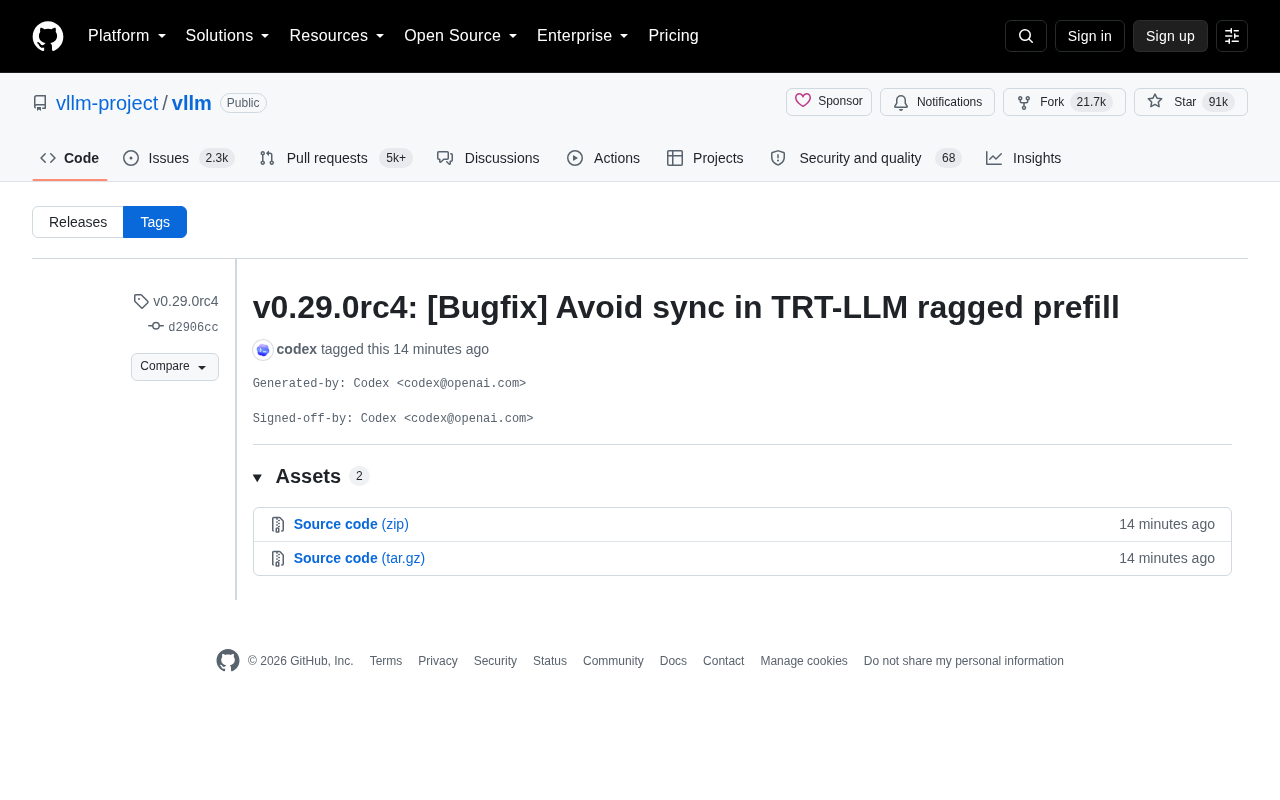
vLLM v0.29.0rc4 Released: Fixing the TRT-LLM Inference Synchronization Bottleneck Explained
Deep dive into vLLM v0.29.0rc4: fixing unnecessary GPU sync in TRT-LLM ragged prefill to eliminate CPU-GPU overhead and boost inference throughput.
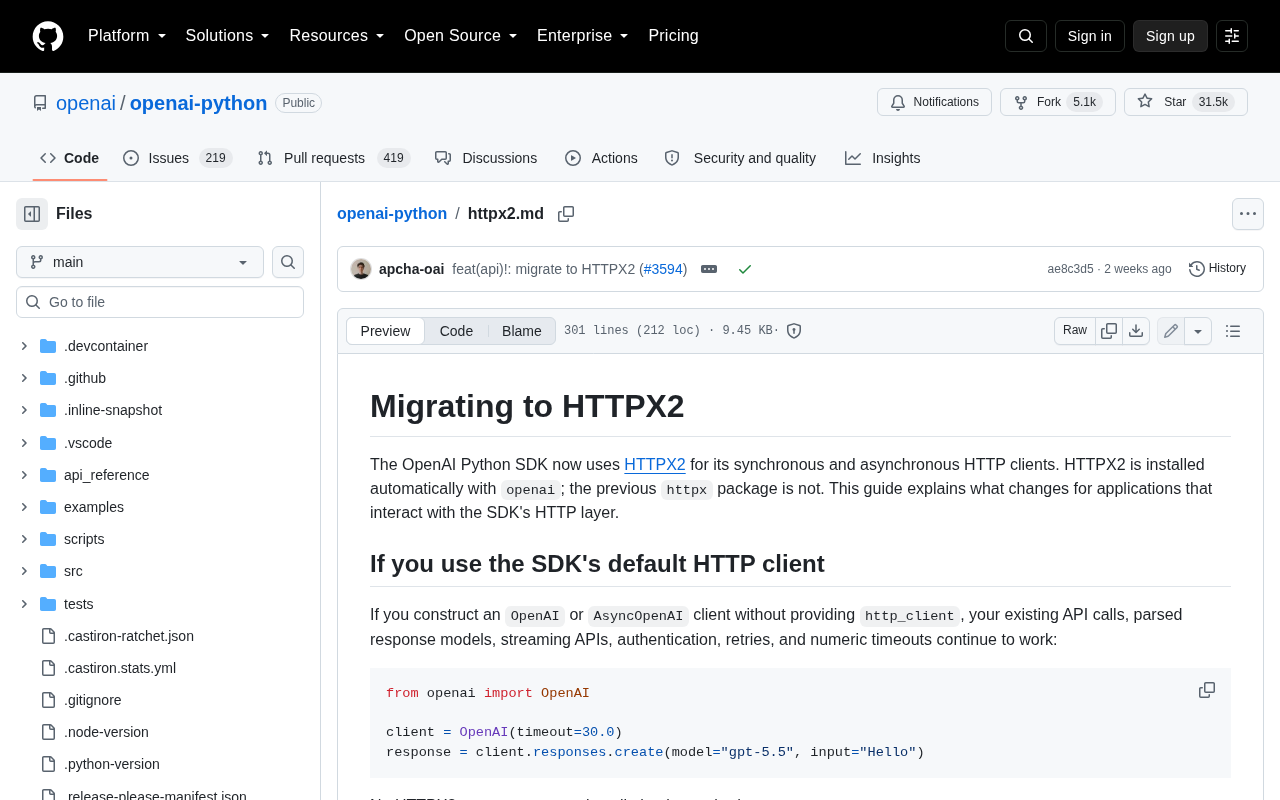
OpenAI's Migration to HTTPX: Why They Abandoned the requests Library
In-depth analysis of why OpenAI migrated its Python SDK from requests to HTTPX, covering async dual-mode support, HTTP/2 multiplexing, and the real impact on developers.

PyTorch Conference 2026: Hardware Acceleration and Compute Infrastructure Outlook
In-depth analysis of PyTorch Conference 2026 hardware acceleration core topics, covering heterogeneous chip adaptation, compilation stack evolution, torch.compile optimization, and distributed compute scheduling, examining future trends and industry impact of AI compute infrastructure.