#model poisoning
58 related articles

·3 min
Claude Package Hallucination Vulnerability: AI Generates Fake Dependency Packages That Steal Real API Keys
Anthropic's Claude generates nonexistent package names during coding assistance, which malicious actors register to steal real API keys. Analysis of the attack chain and developer defenses.
Read more →

·3 min
Symbio: Technical Analysis and Challenges of the AI Self Fine-Tuning Loop
In-depth analysis of Symbio's AI self fine-tuning loop mechanism, exploring the technical logic of self fine-tuning loops, personalization value, and challenges like catastrophic forgetting and model drift.
Read more →

·3 min
Scanning 7.6PB of HuggingFace Data: A Hidden Key Crisis in AI Training Sets
A security audit of 7.6PB of HuggingFace training data uncovered massive API key and credential leaks. Analysis of risks, scanning challenges, and data supply chain security governance.
Read more →

·4 min
AI Agent Memory Systems: Genuine Technical Progress or RAG in Disguise?
In-depth analysis of AI agent memory systems: examining whether current improvements represent real progress or just RAG repackaged, and what architectural changes are truly needed.
Read more →

·3 min
Deep Analysis and Hardening Practices for 16 Critical Vulnerabilities in an AI Security Platform
An AI security platform was found to have 16 critical vulnerabilities spanning prompt injection, privilege escalation, and auth bypass. A deep dive into hardening methodologies.
Read more →

·3 min
GitHub Supply Chain Security Upgrade: A Deep Dive into npm and Actions Defense Mechanisms
GitHub upgrades supply chain defenses for npm and Actions with provenance attestation, least privilege enforcement, and anomaly detection to combat attacks.
Read more →

·3 min
GitHub Supply Chain Security Upgrade: A Deep Dive into npm and Actions Defense Mechanisms
GitHub upgrades supply chain defenses for npm and Actions with provenance attestation, least privilege principles, and anomaly detection across multiple layers.
Read more →

·3 min
Fast Remediation Replaces Zero Vulnerabilities: A New Trust Model for Software Security in the AI Era
In the AI era, zero vulnerabilities is unrealistic. Explore why fast remediation is becoming the new security trust model and how MTTR metrics are reshaping software supply chain security.
Read more →
·4 min
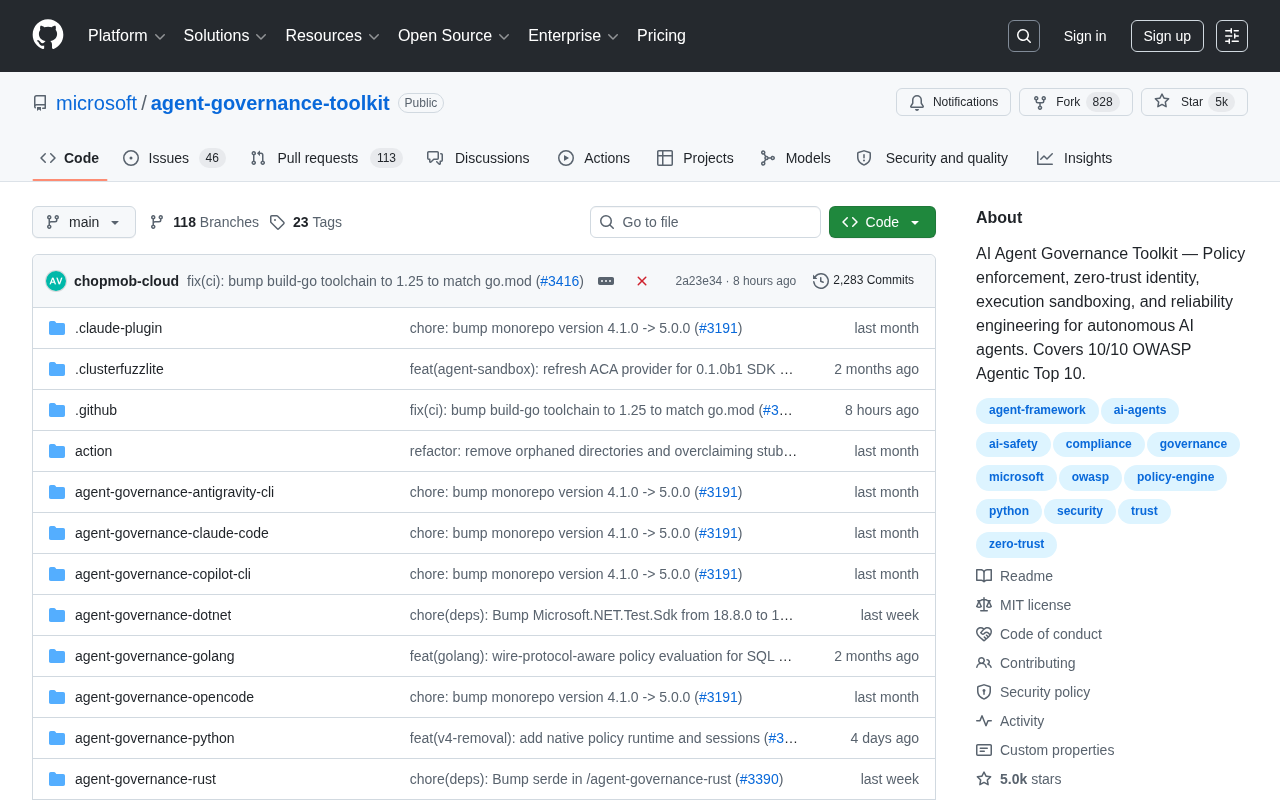
Microsoft Open-Sources AI Agent Governance Toolkit: Comprehensive Coverage of OWASP Top 10 Risks
Microsoft open-sources agent-governance-toolkit covering all OWASP Agentic Top 10 risks through policy enforcement, zero-trust identity, execution sandboxing, and reliability engineering for production AI Agent deployment.
Read more →

·2 min
Google's Beyond Zero: An Enterprise Security Framework That Goes Beyond Zero Trust for the AI Era
Deep dive into Google's Beyond Zero security concept, exploring how enterprises can move beyond traditional Zero Trust models in the AI era to address prompt injection, data poisoning, and other emerging threats.
Read more →

·3 min
DeepSeek Ignites Open Source vs. Closed Source Debate in Silicon Valley, Splitting Tech Giants into Rival Camps
DeepSeek's open source model shakes Silicon Valley. OpenAI defends closed source while Microsoft, NVIDIA, and Meta back open ecosystems. Analysis of the AI open/closed source debate, Apple-Micron chip tensions, and AI-driven historical disinformation.
Read more →

·2 min
LLM Agent Long-Term Memory Security: A Six-Stage Attack Surface and Defense Framework
Deep analysis of LLM agent long-term memory security threats, covering persistence, statefulness, and propagation of memory poisoning, with a six-stage lifecycle defense framework.
Read more →

·3 min
DeepSeek Ignites Open Source vs. Closed Source Debate in Silicon Valley, Splitting Tech Giant Alliances
DeepSeek's open source model shakes Silicon Valley. OpenAI defends closed source while Microsoft, NVIDIA, and Meta back open ecosystems. Analysis of the AI open/closed source debate, Apple-Micron chip tensions, and AI-driven historical disinformation.
Read more →
Human-Centered AI: Real-World Implemen…
·6 min
Human-Centered AI: Real-World Implementation in Healthcare and Design
An MSR workshop reveals the truth about AI deployment: from a $20 corneal diagnostic device to expert-in-the-loop chatbots, researchers share real-world experiences of AI in healthcare and design within resource-scarce environments.
Read more →

·6 min
The Boundaries of AI Coding: When Should You Show Yourself a Red Card?
As AI coding assistants like Codex become standard, the risks of overreliance grow too. Learn when developers should "show a red card," reclaim control, and safeguard code quality and responsibility.
Read more →

·2 min
Cursor 0-Day Vulnerability: Opening a Repository Silently Executes Malicious Code — Developers Beware
A critical 0-day in Cursor AI editor lets attackers execute code just by having you open a malicious Git repo. Learn how it works and how to protect yourself.
Read more →

·3 min
OWASP Agentic Security Top 10 Deep Dive: Understanding ASI01–ASI10 Risks and Mitigations
A comprehensive breakdown of the OWASP Agentic Security Top 10 framework, covering ASI01–ASI10 risks including goal hijacking, tool misuse, identity abuse, supply chain vulnerabilities, and cascading failures — with practical mitigations for AI agent systems.
Read more →
GODMODE Project Deep Dive: AI Jailbrea…
·2 min
GODMODE Project Deep Dive: AI Jailbreaking Techniques and the Security Arms Race in Large Language Models
GODMODE (G0DM0D3) has 9,300+ GitHub stars fueling debate on AI jailbreaking vs. safety alignment. A deep technical dive into LLM guardrails, prompt injection, and AI security governance.
Read more →
The Guardian Angels Framework: How LLM…
·3 min
The Guardian Angels Framework: How LLM Personalization Can Achieve Both Efficiency and Data Security
The Guardian Angels framework shows how LLM personalization can achieve both productivity and data security through local deployment, differential privacy, and tiered permissions.
Read more →

·2 min
LLM Red Teaming: One-Time Snapshot or Continuous Adversarial Testing? A Complete Guide
Every prompt or RAG change in an LLM app can reintroduce security flaws. This guide explains why traditional pentest logic fails on LLMs and how to build change-driven continuous adversarial testing.
Read more →