NVIDIA Nemotron 3 Speaker Diarization: Real-Time Identification of Up to 8 Speakers

NVIDIA releases a lightweight speaker diarization model that identifies up to 8 speakers in real time and runs fully on-device.
NVIDIA's Nemotron 3 Diarization is a lightweight speaker diarization model with around 100 million parameters that runs entirely locally. It addresses a key gap in traditional STT systems by labeling up to 8 speakers in real-time streaming audio — assigning IDs in order of appearance and maintaining identity consistency through voiceprint memory. Rather than replacing existing STT tools, it works alongside models like Parakeet, which handles transcription while Nemotron handles speaker attribution. Local processing keeps meeting audio off the cloud, making it especially valuable for privacy-sensitive use cases in enterprise, legal, and medical settings.
NVIDIA recently released the Nemotron 3 Diarization model, adding a critical capability to the speech transcription space: it doesn't just tell you what was said in a meeting — it tells you who said it. For anyone who relies heavily on voice recordings, this means upgrading from a wall of undifferentiated text to a structured transcript with speaker labels attached.
What Problem Does It Actually Solve?
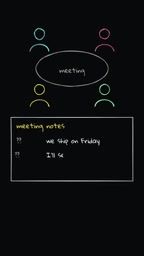
Traditional Speech-to-Text (STT) models are great at converting audio into words, but when it comes to multi-person meetings, the output is often a single undivided block of text with no indication of who said what. You can tell what was discussed, but tracking down which participant made a specific comment is a real challenge.
Nemotron 3 Diarization fills exactly that gap. It focuses specifically on Speaker Diarization — the ability to distinguish between up to 8 different speakers in real-time streaming audio. In other words, your notes no longer just capture what was said, but who said it.
How It Works: Frame-by-Frame Inference with Sequential Labels
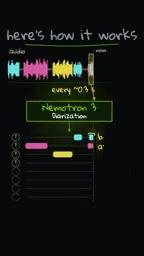
Based on the demo video, the mechanism is fairly intuitive. Audio is fed in as a continuous stream, and the model evaluates — at a fraction of a second interval — which of the 8 possible speakers is currently talking.
Speakers are labeled in order of first appearance: the first person to speak is tagged as speaker 0, the second as speaker 1, and so on. Even when two people talk over each other and voices overlap, the model still attempts to make a determination rather than lumping them together.
Voiceprint Memory: Keeping Identities Consistent
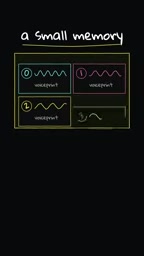
One easily overlooked but genuinely useful feature is the model's "memory" capability. It maintains a small acoustic profile for each voice it has heard. So when speaker 0 speaks again later in the meeting, the system still recognizes them as speaker 0 rather than assigning a new number.
This identity consistency is crucial for the usability of meeting transcripts — without it, the same person could end up with several different speaker IDs across an hour-long meeting, making it even harder to compile meaningful notes afterward.
Speaker Diarization is technically an audio segmentation and clustering problem. Traditional approaches typically involve two stages: first, Voice Activity Detection (VAD) to identify segments where someone is speaking, then Speaker Embedding to group acoustically similar segments under the same identity. Nemotron 3 uses streaming frame-level inference, meaning it doesn't need to wait for the entire recording to finish before outputting labels — making it technically more challenging than offline "record-then-segment" approaches. The model must make continuous judgments with only partial context available, while maintaining a low Diarization Error Rate (DER) through speaker transitions, varying speech rates, and background noise.
Works Alongside Existing STT Models
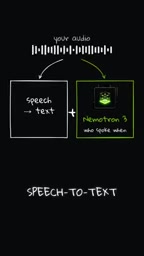
Nemotron 3 Diarization isn't designed to replace your existing speech-to-text pipeline — it runs as a complementary component alongside it. The demo video specifically mentions compatibility with NVIDIA's own Parakeet model family.
In this setup, the division of labor is clear: Parakeet handles transcribing spoken content into text, while Nemotron handles determining which speaker produced each segment. Together, they produce a fully labeled transcript.
Small Footprint and the Privacy Advantage of Local Deployment
The model's size is worth noting. Nemotron 3 Diarization has only around 100 million parameters, making it a lightweight model — one that can run entirely on-device.
Local execution has a direct privacy benefit. Meeting audio often contains sensitive information, and when transcription requires uploading audio to the cloud, you lose full control over where that data goes. Local processing means audio never has to leave your device, significantly reducing privacy risk. For use cases with strict data confidentiality requirements — enterprise meetings, legal consultations, medical settings — this is particularly important.
100 million parameters is an extremely small footprint in today's large-model landscape. For comparison, GPT-3 has 175 billion parameters, and even many "lightweight" language models routinely reach 7 billion. Speaker diarization doesn't require semantic understanding — it only needs to evaluate acoustic features like timbre, fundamental frequency, and formants. This makes the task inherently less complex than language understanding, which is why high accuracy is achievable at such a small parameter count. A smaller model also means lower VRAM usage and inference latency, running smoothly on a CPU or consumer-grade GPU — a meaningful advantage for developers looking to deploy on edge devices or personal computers.
Use Cases and Positioning
Putting these capabilities together, Nemotron 3 Diarization has a clear positioning: it's a key building block for high-quality meeting transcription tools.
- Real-time streaming — suited for live meeting scenarios, not just post-hoc transcription
- Up to 8 speakers — covers the scale of most small-to-medium meetings
- Lightweight and locally deployable — balances performance with privacy
- Plug-and-play with existing STT models — lowers the barrier to integration
For developers and product teams, small, specialized open-source components like this are becoming increasingly valuable — not because they try to do everything, but because they do one specific thing well, in a way that's usable, controllable, and deployable locally. If you want to try it out, check the links provided in the video description for more details.
Related articles

WorkBuddy Full Tutorial: Build an AI Office Automation Agent from Scratch
A complete WorkBuddy tutorial: installation, three working modes, multimodal picture book video practice, expert team agent building, and workflow configuration for low-cost AI office automation.

WorkBuddy Agent Complete Guide: From Beginner to Automation in 7 Days
Based on Bilibili's 256-episode WorkBuddy masterclass, this systematically breaks down Tencent's AI office workbench core capabilities: Agent principles, Skill encapsulation, cross-platform connectors, scheduled automation, knowledge bases, and zero-code development, with learning path recommendations.

8 AI Accounts, 7 Failed: An Honest Review of Using AI to Get Work Done
Only 1 of 8 AI-run Bilibili accounts succeeded. We break down the real difference between "performing AI" and "using AI to get work done."