Nvidia Open-Sources auto-ontology: An Automated Ontology Construction Tool
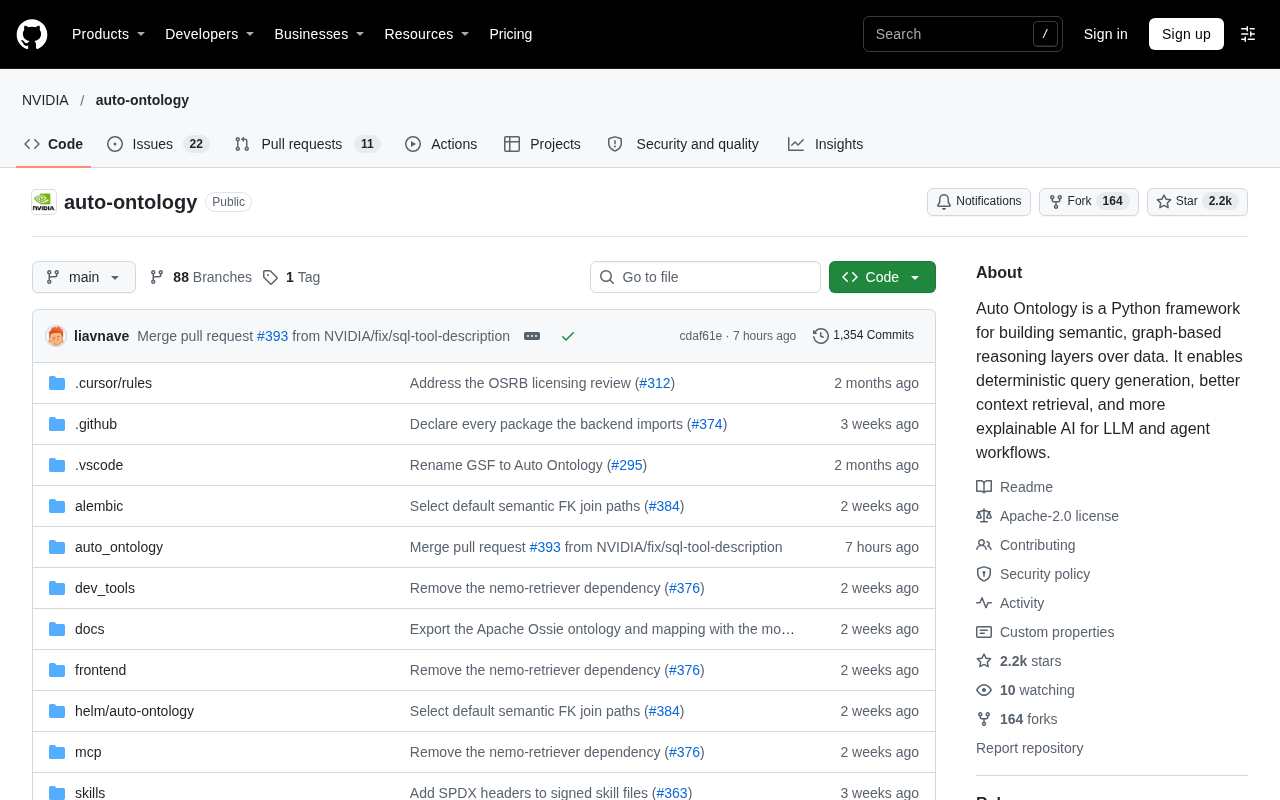
Nvidia open-sources auto-ontology, aiming to lower the barrier to ontology construction through automation.
Nvidia has open-sourced the auto-ontology project on GitHub, targeting automated ontology construction. The news received 223 upvotes and 81 comments on Hacker News. Ontology is a foundational concept in knowledge graphs and the semantic web; traditional construction is expert-dependent and costly, and automation could significantly shorten the knowledge engineering cycle. In the large model era, ontology technology remains important for RAG, intelligent Q&A, and enterprise knowledge management. Open-sourcing aligns with Nvidia's AI infrastructure strategy. Specific features, architecture, and licensing require visiting the repository.
Nvidia has open-sourced the auto-ontology project on GitHub, a tool designed to automate ontology construction. The news sparked extensive discussion on Hacker News, garnering 223 upvotes and 81 comments, demonstrating the developer community's strong interest in knowledge graph and semantic technology infrastructure.
Project Overview
auto-ontology is an open-source project introduced by Nvidia and hosted on GitHub. As the name suggests, its core goal is to automate ontology construction. Ontology is a foundational concept in the knowledge graph and semantic web domains, used to formally define the concepts, properties, and relationships within a given field. Traditionally, ontology construction has relied heavily on manual work by domain experts—a time-consuming and costly process. The emergence of auto-ontology signals that Nvidia is attempting to lower this barrier through automation.
The buzz on Hacker News indicates that the community has high expectations for this direction. The 223 upvotes and 81 comments suggest the topic resonates with pain points developers encounter in their actual work—how to efficiently transform unstructured information into machine-understandable structured knowledge.
Ontology originates from the philosophical concept of "the study of being" and in computer science specifically refers to a formal, explicit specification of knowledge in a given domain. A typical ontology consists of classes, properties, relations, individuals, and axioms, commonly described using standards such as OWL (Web Ontology Language) or RDF Schema. What distinguishes it from a database schema is its emphasis on semantic reasoning: using description logic, a system can derive implicit conclusions from existing facts. An ontology is the "skeleton" or schema layer of a knowledge graph, determining how the graph organizes entities and relationships. For this reason, ontology construction has long been regarded as the most expert-dependent and hardest-to-scale part of knowledge engineering—and it is precisely the core object that auto-ontology seeks to automate.
Technical Significance and Application Scenarios
The value of automated ontology construction lies in bridging the gap between data and semantics. In the era of large models, knowledge graphs and ontology technologies are far from obsolete—they are playing an increasingly important role in scenarios such as retrieval-augmented generation (RAG), intelligent question answering, and enterprise knowledge management. A tool capable of automatically generating or assisting in generating ontologies can significantly shorten the knowledge engineering cycle.
Nvidia's decision to open-source this project also aligns with its recent strategy of continuous investment in AI infrastructure. By open-sourcing tools that lower the integration cost for ecosystem partners, Nvidia can extend its influence across the AI full stack.
Retrieval-Augmented Generation (RAG) is a technical paradigm that combines external knowledge retrieval with large language model generation: when faced with a user query, the system first retrieves relevant fragments from an external knowledge base, then feeds them as context to the model for answer generation, thereby mitigating hallucination and knowledge staleness issues. Ontologies can play two roles in RAG: first, as a structured knowledge source, providing entities and relationships to the retriever in graph form; second, as a schema constraint, standardizing entity types and relationship types during extraction and indexing to improve retrieval precision and answer consistency. If auto-ontology can automatically generate domain ontologies, it could significantly reduce the upfront cost of building such "ontology-enhanced RAG" systems.
Community Reaction and Observations
The Hacker News comment section is an important window into developers' real attitudes. 81 comments mean there is multi-dimensional discussion around auto-ontology, potentially covering practical issues such as ontology quality assessment, the reliability of automated generation, and compatibility with existing knowledge graph tools.
Since the original information only provides a project link and a community discussion entry point, specific feature details, technical architecture, and license information require readers to visit the GitHub repository for further understanding. For developers interested in knowledge engineering, semantic technology, and the real-world deployment of large model applications, this project is worth following closely.
Evaluating the quality of automatically generated ontologies typically involves several dimensions: coverage (whether core domain concepts are included), consistency (whether description logic constraints are satisfied and no contradictory axioms exist), appropriate granularity (hierarchy and relationships neither too coarse nor too fine), and reusability (whether it can be aligned with existing standard ontologies such as Schema.org and FOAF). Common practices include manual comparison against gold-standard ontologies, using reasoners to detect logical conflicts, and end-to-end evaluation on downstream tasks (such as entity linking and question answering). Discussions around automated ontology generation often also touch on the necessity of human review—fully automated output typically still requires domain expert verification, and the tool's value is more about compressing repetitive labor to an acceptable level.
Conclusion
auto-ontology is an open-source exploration by Nvidia in the semantic technology direction. Whether it can become a practical tool in the knowledge automation field depends on subsequent feature refinement and community co-development.
One-line Summary
Nvidia open-sources auto-ontology, attempting to lower the barrier to ontology construction through automation.
Paragraph Summary
Nvidia has open-sourced the auto-ontology project on GitHub, aiming to automate ontology construction. The news garnered 223 upvotes and 81 comments on Hacker News. The article notes that ontology is a foundational concept in knowledge graphs and the semantic web; traditional construction relies heavily on domain experts and is costly, while automation could significantly shorten the knowledge engineering cycle. In the era of large models, ontology technology remains important in scenarios such as RAG, intelligent question answering, and enterprise knowledge management. Open-sourcing also aligns with Nvidia's strategy of investing in AI infrastructure and lowering ecosystem integration costs. Since the original source only provides a project link, specific features, architecture, and license details require visiting the repository.
Related articles

Deleted Reddit Post Sparks Debate Over AI Content Moderation
A Reddit post removed with only a 'Removed by Reddit' notice highlights AI content moderation's transparency gaps, misjudgment risks, and appeal challenges for platforms and creators.

DSH + Ollama Local LLM Deployment in Practice: Free Chat with Da Fei Yu
Bilibili creator tests DSH + Ollama local LLM deployment end to end: Ollama install, Xunlei-accelerated downloads, ModelScope GGUF model import, DSH custom API address setup, and a comparison of Qwen 3.5 4B, 8B, Gemma, and other models on 8GB VRAM, with advice on choosing local deployment vs. API calls.

Tested: A $899 Mac Mini vs. a $200/Month AI Subscription
Real-world test of whether an M4 Mac mini can replace a $200 AI subscription: 16GB can't fit large models, and both speed and quality fall short—but privacy, no caps, and near-zero running costs make it an ideal host for an always-on agent. Includes buying advice per configuration and money-saving strategies.