NVIDIA Open-Sources OpenShell: Putting a Safety Cage Around AI Agents
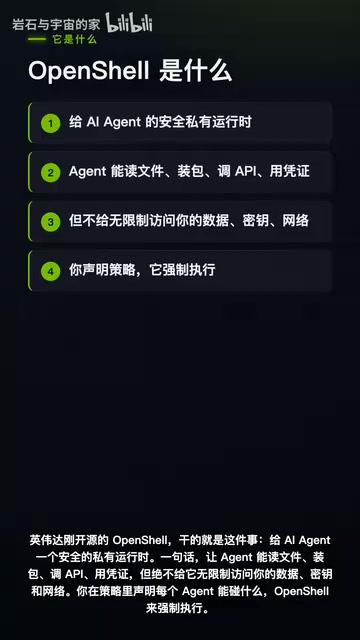
NVIDIA open-sources OpenShell, sandboxing AI agent permissions with formal verification.
NVIDIA open-sourced OpenShell on GitHub, a runtime security sandbox for autonomous AI agents. It restricts file access and syscalls at the kernel level, injects credentials only for approved endpoints so agents never see real keys, and formally verifies policy changes to block high-risk permission escalations pending human review. Built in Rust with zero trust and mTLS, it is Apache 2.0 with multi-language SDKs, but remains an early 0.1.x project with a steep setup curve.
Title
NVIDIA Open-Sources OpenShell: Putting a Safety Cage Around AI Agents
Meta Description
NVIDIA open-sources OpenShell, providing AI agents with a kernel-level sandbox and formally verified secure runtime to solve the problem of runaway permissions. This article breaks down its two core mechanisms, engineering pros and cons, and NVIDIA's strategic intent.
Article Content
NVIDIA has open-sourced OpenShell on GitHub, a runtime security sandbox designed specifically for autonomous AI agents. The news spread quickly across tech communities like Bilibili, and the core pain point is straightforward: when you let an agent help write code or run tasks, it can theoretically also delete your database, steal API keys, and quietly exfiltrate company files. What OpenShell aims to do is lock these capabilities inside a policy-controllable cage.
Why Agent Security Suddenly Became a Hard Requirement
By 2026, autonomous agents have been deployed at scale. The more widespread coding agents like Codex and Cursor become, the more unsettling the question "what exactly did it do on my machine" gets. Traditional permission models assume the operator is a human, whereas an agent is a program that runs by default and makes continuous decisions—it doesn't need to "do evil"; a single hallucination or a single unauthorized call is enough to cause an incident. The problem isn't the agent's intent, but that it by default has the same machine access as you.
This is exactly the question OpenShell tries to answer: can an agent read files, install packages, call APIs, and use credentials while the access boundaries for data, keys, and network are locked down tight?
Two Core Mechanisms: Kernel-Level Enforcement and Formal Verification
Sandboxing Down to the System Call Layer
OpenShell runs each agent in an isolated sandbox, restricting at the kernel level which files it can access and which system calls it can make. Every network connection must first pass a policy check, and the agent itself cannot bypass it. This foundation is written in Rust, follows a zero-trust approach, uses mTLS for end-to-end encryption, and its isolation drivers cover everything from Docker, Podman, and Kubernetes to virtual machines.
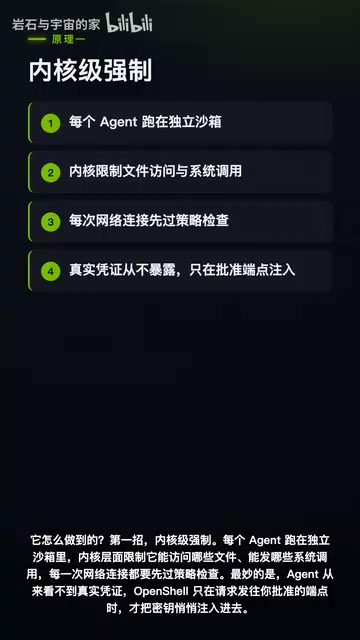
Credential handling is another highlight: the agent never sees the real key. Only when a request is sent to an endpoint you've approved does OpenShell quietly inject the key. This means that even if the agent is tricked into leaking credentials, it has nothing to leak.
System calls (syscalls) are the sole entry point for user-space programs to interact with the operating system kernel—file reads and writes, network send and receive, and process creation all go through them. If a sandbox only intercepts at the application layer, an agent can escape simply by bypassing the SDK or switching to a different calling method; only whitelisting and parameter validation of system calls at the kernel layer (via mechanisms such as seccomp, eBPF, and LSM) has enforcement power. This is also why OpenShell emphasizes "kernel-level enforcement": policies are executed by the kernel rather than voluntarily followed by the agent, so even if the agent is subjected to prompt injection or hallucinates, it cannot cross the declared system call boundary. The cost is that policies need fine-grained tuning for different workloads; being too strict will prevent the agent from properly installing dependencies or compiling code.
Policy Changes Require a Mathematical Proof First
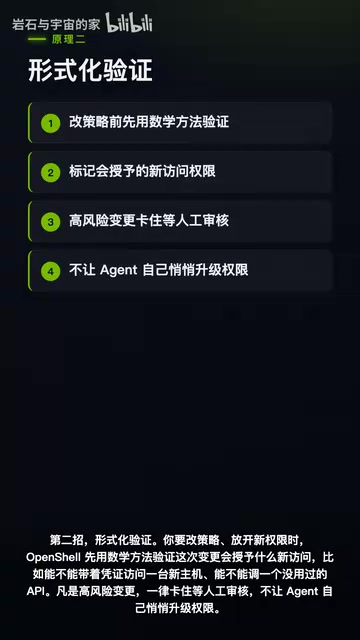
Granting new permissions is the highest-risk action, and OpenShell handles it with formal verification. When you modify a policy, it first uses mathematical methods to verify what new access this change would grant—for example, whether it could access a new host with credentials, or call an API that hasn't been used before. Any high-risk change is blocked pending human review, and the agent cannot quietly escalate its own permissions.
Formal verification means describing a system and its rules with a mathematical model, then using theorem proving or model checking to exhaustively enumerate or derive all possible behaviors, thereby determining whether a certain property always holds. In the access control context, it answers questions like "would this policy change introduce any access path that didn't exist before," rather than sampling a few test cases. Compared with manually reviewing ACLs or YAML rules, formal methods can catch implicit authorizations that emerge from combinations of multiple rules—for example, when a new rule stacks with an existing credential-injection rule to indirectly enable access to a new host. Its limitation is that it requires a sufficiently precise abstract model of the policy language and runtime behavior, and modeling deviations directly undermine the credibility of the conclusions.
Zero Trust's core tenet is "never trust, always verify": do not grant access by default just because a request comes from the internal network, from the local machine, or from some already-started process; every access must be re-authenticated and re-authorized. Traditional perimeter security assumes the internal network is trustworthy, but agents run precisely inside this trust boundary, so continuing to use the old model amounts to leaving them a back door. OpenShell uses mTLS (mutual TLS) so that both communicating parties present certificates and verify each other's identity, and combined with fine-grained policies, it transforms "is the agent trustworthy" into "is this specific request allowed by policy." This also explains why credential injection must be triggered per target endpoint: authorization is granted down to the level of a single call, rather than giving the agent a long-term pass all at once.
Engineering Strengths and Real Barriers
NVIDIA's personal involvement is OpenShell's biggest endorsement. A Rust security foundation, zero trust, mTLS, fully open source under Apache 2.0, a complete set of SDKs for Python, TypeScript, Go, and Rust, plus the ability to install Agent Skills directly so coding agents can call it themselves.
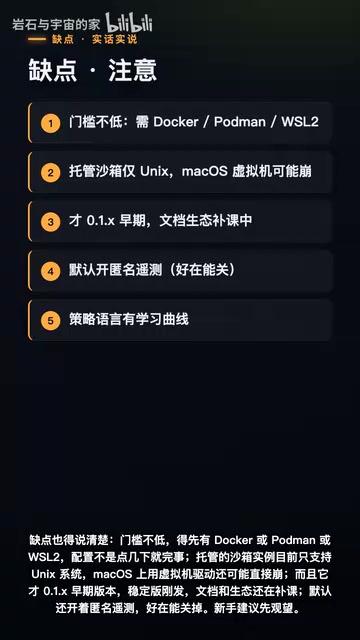
The drawbacks are equally obvious. The deployment barrier is not low: you first need a Docker, Podman, or WSL environment, and configuration isn't a one-click affair; managed sandboxes currently only support Unix-like systems; and on macOS the VM driver may crash outright. The project is at an early 0.1.x stage, the stable release has just come out, and the documentation and ecosystem are still catching up; anonymous telemetry is enabled by default (and can be turned off). For beginners, waiting and watching is a reasonable choice.
NVIDIA's Calculus: From Selling Compute to Controlling Boundaries
OpenShell shot to the top of trending lists overnight, and behind it is a broader positioning play. Agent security is the hottest topic right now, and this move by NVIDIA is a signal of extending from compute supplier to agent infrastructure. Whoever controls the security boundary of agents in the future will hold the gateway.
The project can be found on GitHub by searching for NVIDIA OpenShell, and it is open source under Apache 2.0. Teams that want to self-host agent security should evaluate it; individual developers who just want to try out coding agents can wait until the documentation and ecosystem mature a bit more.
Agent runtime refers to the infrastructure layer that hosts the autonomous agent execution loop, responsible for tool invocation, state management, permission control, and resource isolation. It is orthogonal to the model itself: the same model can run on different runtimes, and security and observability are mainly determined by the runtime. The industry is now treating the runtime as the third competitive layer after models and compute, because it determines which data and systems an agent can reach—and thus determines how critical the business tasks enterprises dare to hand over to it. OpenShell is open-sourced under Apache 2.0 and adapts to mainstream orchestration forms such as Kubernetes, essentially trying to make this layer the default option and thereby secure a position at the ecosystem gateway.
One-line Summary
NVIDIA open-sources OpenShell, reining in AI agent permissions with kernel-level sandboxing and formal verification.
Paragraph Summary
NVIDIA has open-sourced OpenShell on GitHub, a runtime security sandbox for autonomous AI agents that addresses the risk of agents defaulting to the same machine permissions as users and potentially mis-deleting data or leaking keys. It has two core mechanisms: first, it restricts file access and system calls at the kernel layer, routes every network connection through a policy check first, and injects credentials only when a request goes to an approved endpoint so the agent never sees real keys; second, before policy changes it uses formal verification to derive newly introduced access paths, with high-risk changes forced through human review. Written in Rust, it uses a zero-trust architecture and mTLS encryption, with isolation drivers covering Docker, Podman, Kubernetes, and VMs; it is Apache 2.0 open source and offers multi-language SDKs. But the deployment barrier is high, managed sandboxes only support Unix, the macOS VM driver is unstable, and it is still at an early 0.1.x stage.
Related articles

Asana AI Product Lead Shares AI Agent Best Practices
Asana's AI product lead shares AI Agent best practices, covering responsibility boundaries, human-in-the-loop design, data model anchoring, and evaluation iteration methods for product teams deploying Agents.

Japanese Internet Giant GMO Hit by Hacker Leak: Cloud Service Vulnerability Exposes Customer Data
GMO Internet confirms cloud service hack, customer data possibly exposed. The company is verifying the leaked data, highlighting cloud security and supply chain attack risks.
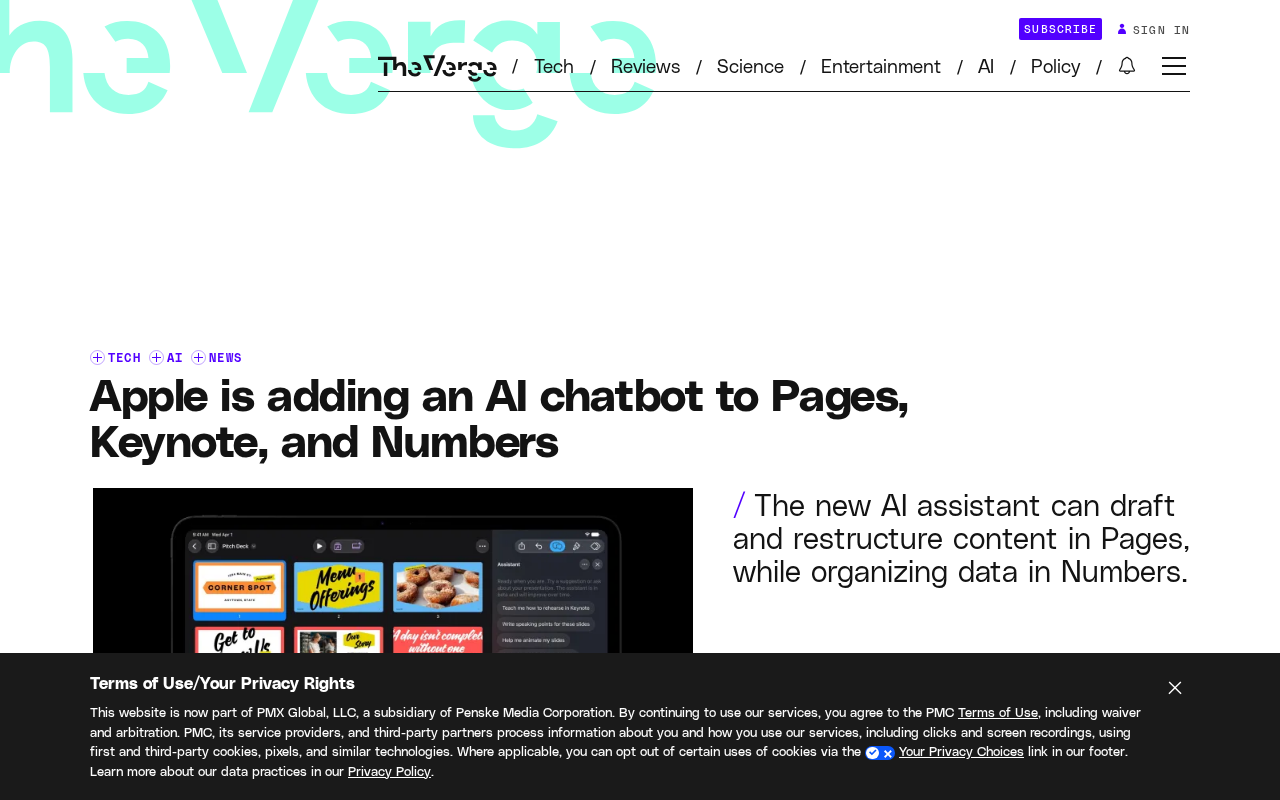
Apple Adds AI Assistant to Pages, Keynote, Numbers
Apple introduces an AI assistant to Keynote, Pages, and Numbers, powered by Apple and OpenAI models, capable of understanding document context, designing animated slides in Keynote, and drafting and restructuring documents in Pages, escalating AI competition in productivity suites.