NVIDIA Open-Sources SkillEvaluator: Adding Quality Gates to AI Agent Skills
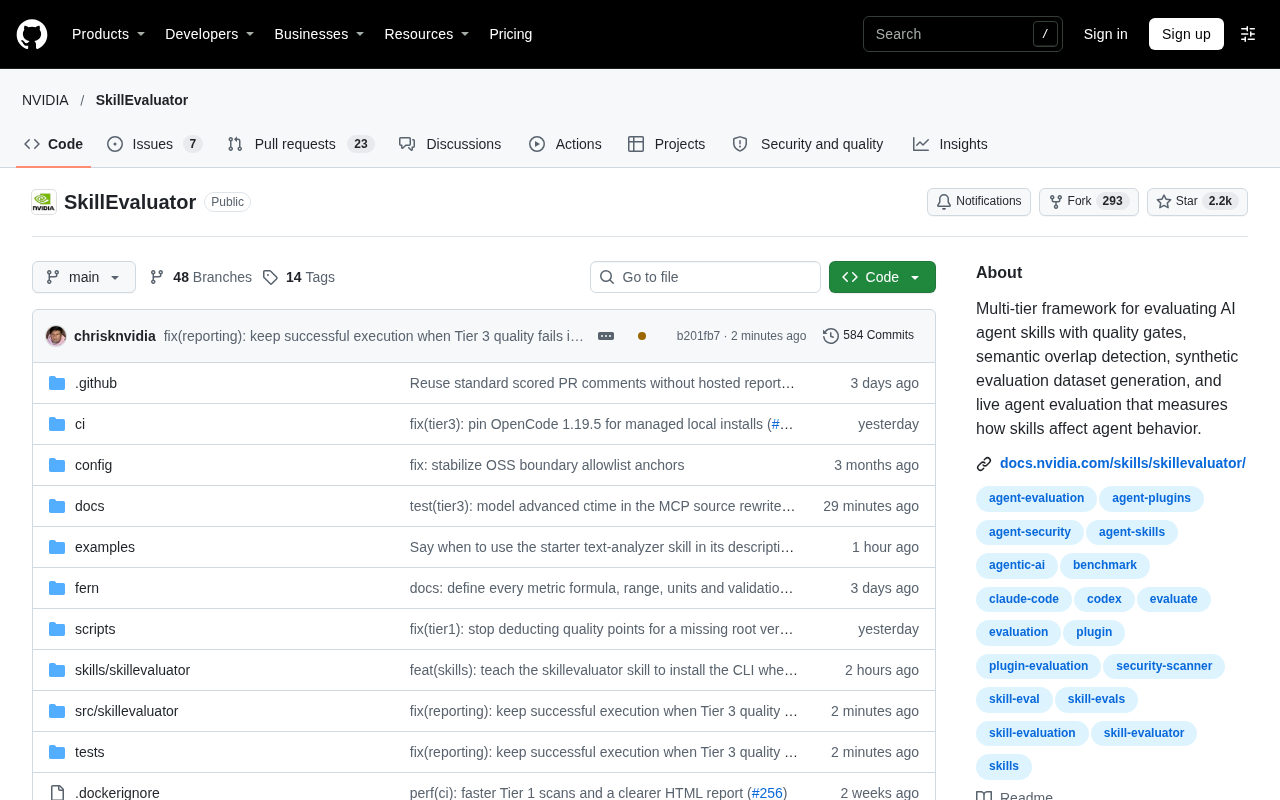
NVIDIA open-sources SkillEvaluator, using a four-tier framework to turn Agent skill quality into gate-able engineering metrics.
NVIDIA's open-source SkillEvaluator is a multi-tier AI Agent skill evaluation framework designed to solve the difficulty of systematically measuring skill quality. It offers four layers: quality gates for pre-ingestion static checks; semantic overlap detection to identify duplicate skills; synthetic evaluation dataset generation for scalable, repeatable testing; and live Agent evaluation to verify whether a skill truly changes Agent behavior. Implemented in Python with 2,181 GitHub Stars, its layered design lets teams adopt components as needed, reflecting a shift from model capability toward engineering management in Agent competition.
AI Agent capabilities increasingly depend on "skills"—a description, a tool definition, a set of operating procedures—each of which can determine how the Agent performs on real tasks. But whether a skill is well-written, whether it duplicates an existing skill, and whether it can actually change Agent behavior have long lacked systematic evaluation methods. NVIDIA's open-source SkillEvaluator targets exactly this gap: a multi-tier framework that uses quality gates, semantic overlap detection, synthetic evaluation datasets, and live Agent evaluation to turn "skill quality" into a measurable, gate-able engineering metric. The project has already gained 2,181 Stars and 292 Forks on GitHub, with 122 new Stars in a single day—a notably high level of interest.
Why Agent Skills Need a Dedicated Evaluation Framework
Agent skills sit between prompts and code, making them hard to cover with traditional software testing. A skill description may be syntactically correct and format-compliant yet highly semantically repetitive with existing skills, causing conflicts during Agent reasoning; or it may be well-written but have almost no impact on Agent behavior in practice—the skill exists in name only. SkillEvaluator's starting point is to break these hidden risks into checkable layers: from the quality of the skill text itself, to relationships between skills, to the skill's actual effect on Agent behavior.
This layered approach is closer to engineering practice than a single score. Teams can run static checks before a skill enters the repository, deduplicate as the skill collection expands, run regression tests with synthetic data before launch, and finally verify effectiveness with real Agent runs.
Breaking Down the Four-Tier Evaluation System
Quality Gates: The First Checkpoint Before a Skill Enters the Repository
Quality gates perform structured checks on individual skills. They do not depend on running the Agent; instead, they directly examine whether the skill content meets basic standards—whether the description is clear, whether boundaries are well-defined, and whether it contains actionable information. The value of gates is that they block clearly substandard skills from the pipeline, preventing low-quality skills from polluting the entire skill library. For teams whose skill counts are growing rapidly, this upfront interception is far cheaper than after-the-fact troubleshooting.
Semantic Overlap Detection: Solving the "Reinventing the Wheel" Problem in Skill Libraries
Semantic overlap detection targets relationships between skills. As a skill library grows from dozens to hundreds of entries, functionally similar skills with different wording appear in large numbers. Keyword matching alone struggles to find such duplication, but semantic comparison can identify skills that "say it differently but do the same thing." This is critical for maintaining skill-library consistency: duplicate skills not only waste maintenance effort but also create ambiguity when the Agent retrieves and selects skills.
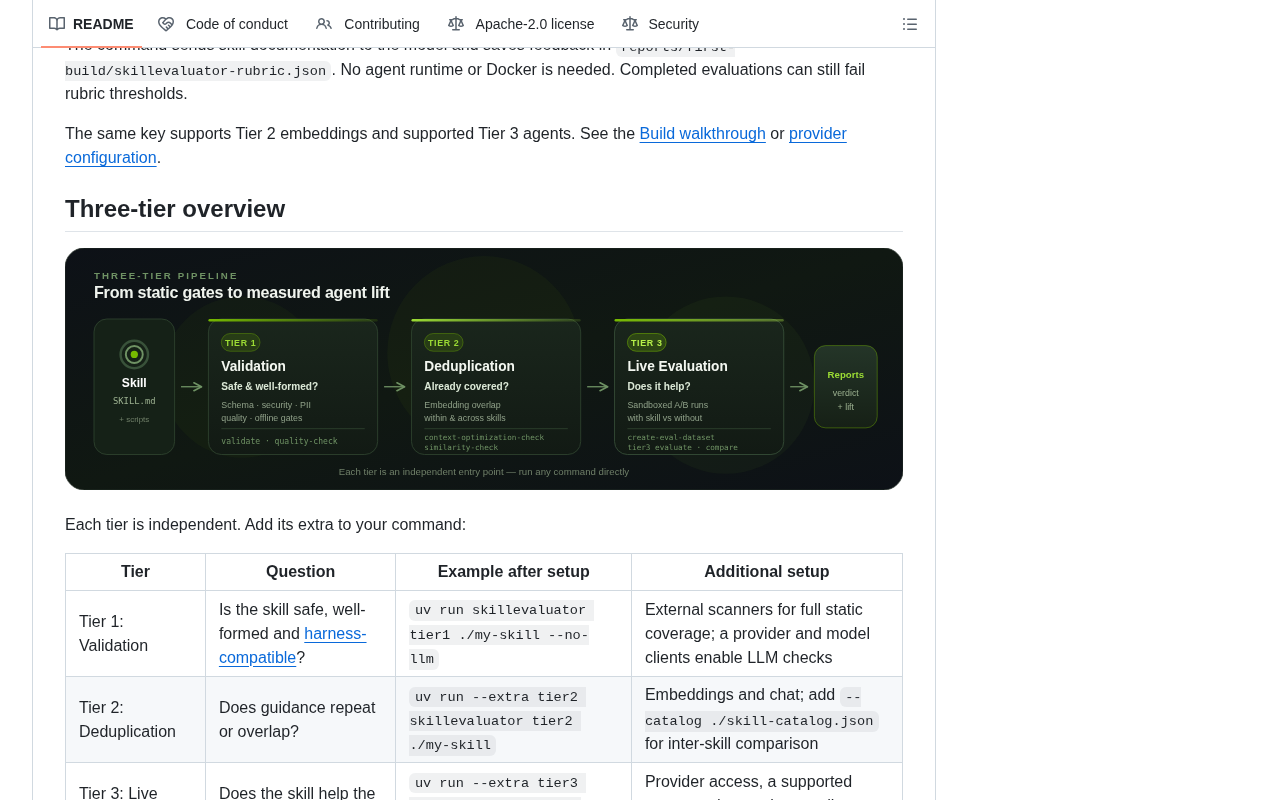
Semantic overlap detection typically relies on text embedding technology: each skill description is encoded into a high-dimensional vector, and semantic distance between skills is computed using metrics such as cosine similarity. Unlike keyword matching, embedding models capture synonymous phrasing and hyponym/hypernym relationships, so they can identify skill pairs that "describe the same operation in different words." In practice, lightweight sentence embedding models (such as the all-MiniLM series) are commonly used to perform encoding locally, combined with approximate nearest neighbor (ANN) indexes (such as FAISS) for fast comparison across large skill libraries. Setting a reasonable similarity threshold is key: too high a threshold misses variants, while too low a threshold may misclassify related but distinct skills.
Synthetic Evaluation Datasets: Scalable Testing Without Manual Annotation
Synthetic evaluation dataset generation addresses the problem of where evaluation samples come from. Real task data is often scarce, sensitive, or hard to cover edge cases, whereas synthetic data can automatically construct test cases based on skill content, enabling evaluation at scale. The significance of this layer is that skill evaluation is no longer "write a few examples and test them" but instead has a repeatable, extensible data foundation.
Synthetic evaluation dataset generation generally uses skill descriptions as seeds and leverages large language models to automatically expand into diverse task instructions, boundary conditions, and expected behaviors. Common approaches include: generating positive cases based on the skill's operating procedures, constructing adversarial cases targeting ambiguities in the description, and generating variants covering different phrasing styles through templates or rewriting. To ensure quality, filtering mechanisms are usually needed—for example, using rules or another model to remove samples that are semantically duplicate, logically contradictory, or unrelated to the skill. The advantage of synthetic data is that it can be generated repeatedly and iterated quickly as skills update, but it cannot fully replace real data; it serves more as a supplement for regression testing and stress testing.
Live Agent Evaluation: Testing Whether a Skill Actually Changes Behavior
The final layer is live Agent evaluation, and it is the most valuable part of the entire framework. It does not just inspect skill text; it lets the Agent actually run and measures the skill's impact on Agent behavior. Even if a skill passes the first three layers, if the Agent's performance does not change after adding it, then it has no reason to exist. This layer advances evaluation from "static review" to "behavior verification," answering whether the skill truly takes effect.
The core of live Agent evaluation is behavioral differencing: on the same task set, run the Agent with the skill loaded and without it, then compare differences in dimensions such as task success rate, tool-call sequences, and output content. If the difference is not significant, the skill has not materially affected Agent behavior. In implementation, this requires a reproducible Agent runtime environment, stable task inputs, and fine-grained behavior logs. Evaluation metrics should include not only final results but also process metrics, such as whether the skill was correctly retrieved and whether it was invoked at the right moment. This evaluation approach is relatively costly, but it directly answers the fundamental question of "whether the skill is worth keeping," making it suitable as the final verification before launch.
Implications for Agent Engineering Practice
SkillEvaluator reflects a trend: competition in Agent capabilities is shifting from "model capability" to "engineering capability." Skills, as reusable capability units for Agents, need to be managed like code—with standards, tests, deduplication, and regression. NVIDIA splits evaluation into multiple layers rather than building one all-encompassing scorer, and this design is better suited to real-world adoption: different teams can choose, based on their stage, whether to start with quality gates or go straight to live evaluation.
For teams building Agent platforms, this framework provides a reference checklist. The larger the skill library, the more obvious the value of semantic overlap detection and behavior verification. The project is implemented in Python, which also lowers the barrier to adoption.
Who Should Pay Attention to This Project
If you maintain an Agent skill library, design Agent evaluation workflows, or need to judge whether a given skill is worth launching, SkillEvaluator's multi-layer structure can be directly borrowed. It does not promise a "universal score"; instead, it breaks evaluation into actionable steps—precisely what Agent engineering needs most right now.
One-line Summary
NVIDIA open-sources SkillEvaluator, using a four-tier framework to turn Agent skill quality into gate-able engineering metrics.
Paragraph Summary
NVIDIA's open-source SkillEvaluator is a multi-tier AI Agent skill evaluation framework aimed at solving the difficulty of systematically measuring skill quality. The framework includes four layers: quality gates that perform pre-ingestion static checks on individual skills; semantic overlap detection that identifies functionally duplicate skills; synthetic evaluation dataset generation that supports scalable, repeatable testing; and live Agent evaluation that verifies through actual runs whether a skill truly changes Agent behavior. Implemented in Python and already at 2,181 GitHub Stars, its layered design allows teams to adopt components as needed, reflecting the shift in Agent competition from model capability toward engineering management.
Related articles

Two Cursors: A Hopeful Song About Writing Software with AI
YouTube music video *Two Cursors* uses lyrics to portray AI-assisted programming: from a single cursor to two-cursor collaboration to a three-party debugging scene, offering a hopeful view of conversational collaboration between developers and AI.

No API Key Needed: Manage Your WordPress Site Directly With Your AI
Anti-Manual releases MCP Connector, letting Claude, ChatGPT, Cursor and 14 AI tools manage WordPress without an API Key—draft writing, internal links, SEO audits, broken link checks, reusing existing subscriptions with no extra bills.

Cursor vs Claude Code: Terminal Agents Face Off Against Editor Completion
Cursor vs Claude Code compared: Cursor excels at editor tab completion; Claude Code is a full-repo autonomous terminal agent. Context windows, costs, and use cases.