NVIDIA OpenShell Architecture: Governing AI Agents at Scale

NVIDIA's OpenShell reference architecture moves agent security controls to the infrastructure layer, addressing governance gaps at scale with isolation, policy-as-code, and full-chain auditing.
NVIDIA proposes the OpenShell reference architecture to solve the security and governance challenges of autonomous agents at scale. The article notes that traditional security models based on deterministic code paths cannot cope with dynamically generated behavioral paths and blurred permissions from multi-agent spawning. OpenShell abstracts resource access into policy-constrained shells, moving control points from application code up to the infrastructure layer. The architecture includes three key layers: isolated execution sandboxes restricting file, network, and process access; declarative policies centrally managing permissions with versioned review; and full-chain structured logs correlating task context to support audit traceback. It lowers the barrier from pilot to production, but policy granularity, audit costs, and conflict resolution still require enterprise trade-offs. Agent governance is shifting from prompt constraints to enforced runtime boundaries.
Autonomous agents can execute complex tasks for hours on end, accessing files, tools, and the internet, and even spawning other agents to collaborate. This expansion of capability brings a thorny problem: as agent clusters grow from a handful to hundreds or thousands, how can enterprises ensure that every tool call, file access, and cross-agent collaboration stays within controllable, auditable boundaries? NVIDIA's answer is the OpenShell reference architecture, which attempts to provide a systematic security and governance framework for AI agent workloads.
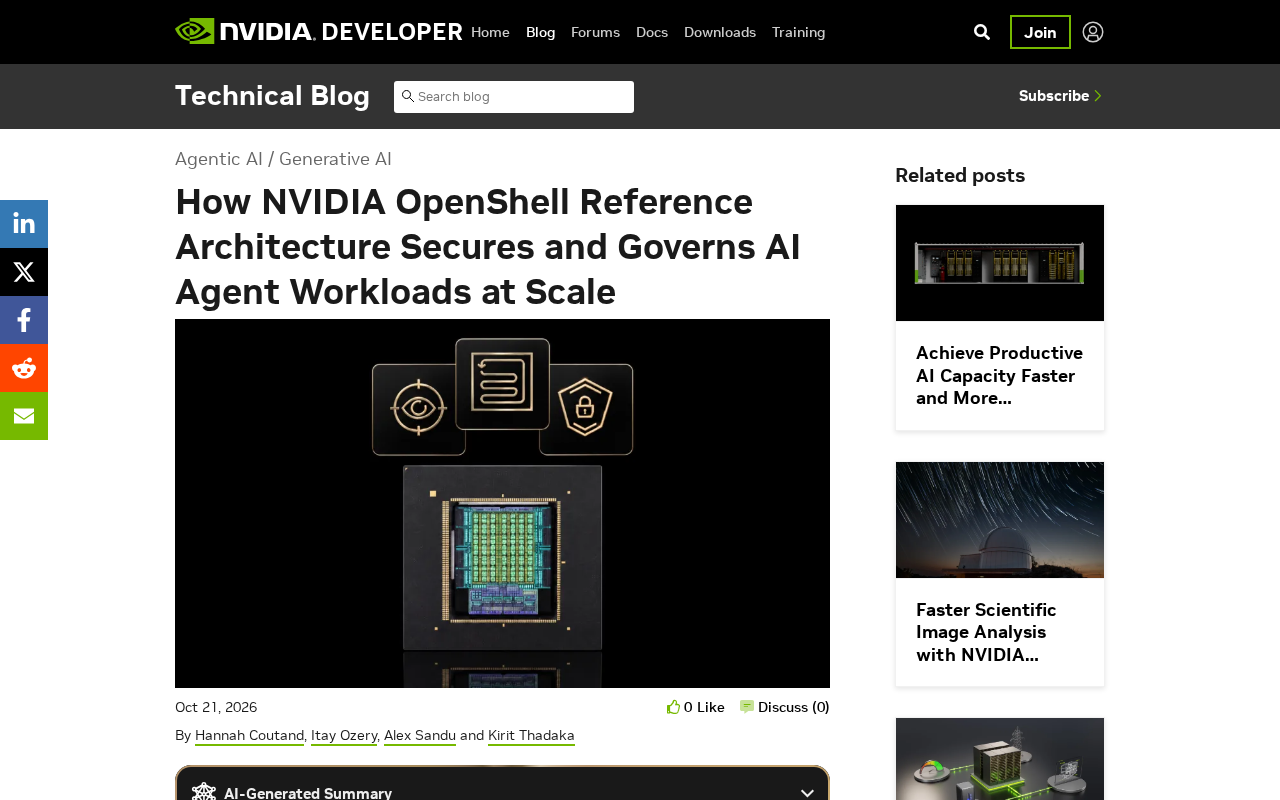
The Governance Gap Created by Agent Scaling
The security models of traditional applications are built on deterministic code paths: inputs, processing, and outputs can all be statically analyzed. But the behavioral paths of autonomous agents are dynamically generated—the same task may trigger completely different toolchains in different contexts. When multiple agents spawn each other and share context, permission boundaries become blurred, and a compromised sub-agent can become a springboard for lateral movement.
The core idea of the OpenShell reference architecture is to abstract the resource access of the agent runtime into policy-constrained "shells," moving security control points from inside the application code up to the infrastructure layer. This way, regardless of which framework an agent is written in or what task it performs, every touch of external resources must pass through a unified policy decision.
Three Key Layers of the Architecture
Isolated Execution Environments
OpenShell allocates an isolated execution sandbox to each agent session or task, restricting the scope of the file system, network egress, and local processes it can access. This isolation is not simple containerization; it is adapted to the agent characteristics of "long-running, dynamic spawning," so that sub-agents inherit their parent's policies without automatically gaining permissions beyond what the task requires.
Policy-as-Code Access Control
The architecture separates permission policies from agent prompts and business logic, managing them centrally as declarative configurations. Which agents can access which data sources, which external APIs they can call, and under what conditions they can spawn new agents—all become versionable, reviewable configuration items. This approach transforms governance from "relying on developers' self-discipline" to "enforced by the platform."
Policy as Code already has mature practices in the cloud-native domain, such as Open Policy Agent (OPA) and its Rego language. Its core is to decouple access control rules from application logic, describe "who can perform what operation on what resource under what conditions" in declarative files, and incorporate them into version control and CI/CD processes. In agent scenarios, policies also need to express additional constraints on spawning relationships—for example, "sub-agents must not inherit the parent's write permissions" or "access to the production database is allowed only when the task label is read-only." OpenShell's centralized management of such rules means that policy changes can be reviewed, rolled back, and tested like code changes, thereby avoiding permissions scattered across each agent's prompt that are difficult to audit.
Full-Chain Observability and Auditing
Every action of an agent—tool calls, file reads and writes, network requests, agent spawning—generates structured logs. OpenShell correlates these events with task context, enabling security teams to trace back "which agent decision chain caused a particular data anomaly outflow." For enterprise scenarios requiring compliance audits, this layer is the key to whether deployment is feasible.
Agent Runtime is the prerequisite for understanding OpenShell's isolation mechanism. The lifecycle of traditional containers is controlled by an external orchestration system, and their behavior after startup is relatively deterministic; an agent runtime, however, needs to dynamically load tools, spawn new processes, and even modify its own execution plan during task execution. OpenShell's sandbox therefore must not only isolate resources but also continuously intercept and adjudicate system calls and tool calls initiated by agents at runtime. This is akin to combining kernel-level interception mechanisms such as eBPF or seccomp with a user-space policy engine, so that the isolation boundary can expand with the agent's dynamic behavior rather than being set once at startup.
Structured logging and distributed tracing are the two foundational capabilities of observability. Structured logging requires each event to be recorded with fixed fields (timestamp, agent ID, parent task ID, operation type, resource identifier, policy decision result) for machine retrieval and aggregation; distributed tracing uses trace IDs to link cross-agent calls triggered by a task into a causal chain. In the context of OpenShell, only by combining the two can one answer "which agent triggered which data access at which decision point." It should be noted that agents run for long periods and may spawn at high frequency, so log volume will far exceed that of traditional applications. Enterprises need to plan in advance for sampling strategies, hot/cold storage tiering, and retention periods, otherwise audit capability will be undermined by storage costs.
Practical Implications for Enterprises
From an engineering perspective, the value of OpenShell lies not in inventing new security primitives but in integrating scattered best practices into a reusable reference architecture. Enterprises do not need to design agent permission models from scratch; instead, they adapt on a framework with clearly defined interfaces and boundaries. This lowers the barrier for agents to move from pilot to production.
However, a reference architecture is ultimately only a starting point. How to set policy granularity, the storage and retrieval costs of audit logs, and how to resolve policy conflicts in multi-agent collaboration scenarios—these still require enterprises to weigh trade-offs in actual deployment. NVIDIA provides the skeleton; the flesh must be filled in by users.
Trends Worth Watching
Agent governance is moving from "constraints at the prompt level" to "enforcement at the infrastructure level." OpenShell represents a shift in thinking: rather than expecting models to voluntarily follow rules, it is better to turn rules into boundaries that cannot be bypassed at runtime. As agents take on increasingly critical tasks, such governance frameworks may become standard components in enterprise AI stacks, much like container orchestration systems did in their time.
For teams evaluating agent deployment, questions worth considering in advance include: Can the existing identity and permission system be extended to agent entities? Does the audit chain cover spawning relationships between agents? The answers to these questions determine whether the reference architecture can truly be transformed into operable security capabilities.
The analogy to container orchestration systems (such as Kubernetes) deserves elaboration: Kubernetes did not invent containers; rather, through declarative APIs, unified scheduling, and policy control, it turned containers from a developer's local tool into an enterprise-grade infrastructure standard. Its success lies in providing stable abstraction boundaries (Pod, Service, RBAC) around which the upper-layer ecosystem can build. OpenShell attempts to play a similar role in the field of agent governance—defining the isolation units, policy interfaces, and audit event models of the agent runtime. But this analogy also has limits: container behavior is deterministic, whereas agent decision paths are probabilistic, and the mechanisms for handling policy conflicts and misjudgments are far more complex. This is also the key variable determining whether such frameworks can become standard components.
One-line Summary
NVIDIA's OpenShell reference architecture moves agent security controls up to the infrastructure layer, addressing the governance gap at scale with isolation, policy-as-code, and full-chain auditing.
Paragraph Summary
NVIDIA proposes the OpenShell reference architecture to address the security and governance challenges brought by autonomous agents at scale. The article notes that traditional security models based on deterministic code paths cannot cope with the dynamic behavioral paths of agents and the blurred permissions caused by multi-agent spawning. OpenShell's core idea is to abstract resource access into policy-constrained shells, moving control points from inside application code up to the infrastructure layer. The architecture contains three key layers: isolated execution sandboxes restricting file, network, and process access; declarative policies centrally managing permissions with support for versioned review; and full-chain structured logs correlating task context to support audit traceback. The article argues that this architecture lowers the barrier for agents to move from pilot to production, but policy granularity, audit costs, and policy conflict resolution still require enterprises to weigh trade-offs themselves. Agent governance is shifting from prompt constraints to enforced runtime boundaries.
Related articles

macOS Is No Longer UNIX: Apple Didn't Renew Certification, But the Technology Is Unchanged
Apple did not renew macOS's UNIX certification, and the Open Group has removed Apple's entry. This article analyzes the technical reality behind the expiration, Apple's possible intentions, and the practical impact on developers.

Building Stateful Multi-Agent Systems with Azure Cosmos DB
Based on the official Azure Cosmos DB tutorial, this article explains how to use the Agent Memory Toolkit to add shared persistent memory to a multi-agent travel planner, covering short-term, long-term, episodic, and semantic memory plus cross-session state continuity.

Production AI Agent Operations: A Three-Step Framework for Observing, Evaluating, and Optimizing
Azure Cosmos DB team proposes a three-step framework for production AI Agent operations: observe trace tracking, evaluate with LLM as a judge and regression testing, optimize cost across RU, retrieval, memory, and LLM layers.