Unknowingly Breaking the PHP RCE Embargo: Lessons from a Vulnerability Disclosure

A developer mistakenly believed there was "no embargo" and prematurely disclosed a PHP RCE vulnerability, disrupting coordinated disclosure and issuing a public apology.
A developer who has long followed the PHP release cycle posted an apology on Hacker News, stating that because a source told him there was "no embargo," he prematurely published information about PHP remote code execution vulnerabilities involving CVE-2026-109618 and CVE-2026-109619, unintentionally disrupting the coordinated disclosure timeline and adding extra workload for the teams involved. The post received 328 upvotes and 131 comments, with divided community reactions: critics argued that high-risk vulnerabilities should be second-confirmed with official channels before publication, while sympathizers pointed out that information asymmetry caused by verbal relay is difficult for ordinary developers to resolve alone. The incident exposed the fragility of coordinated disclosure's reliance on private communication and lack of verifiable written confirmation, prompting the author to call on developers to verify directly with project security teams or CVE authorities and keep records before publicly disclosing unpatched vulnerabilities.
Unknowingly Breaking the PHP RCE Embargo: Lessons from a Vulnerability Disclosure
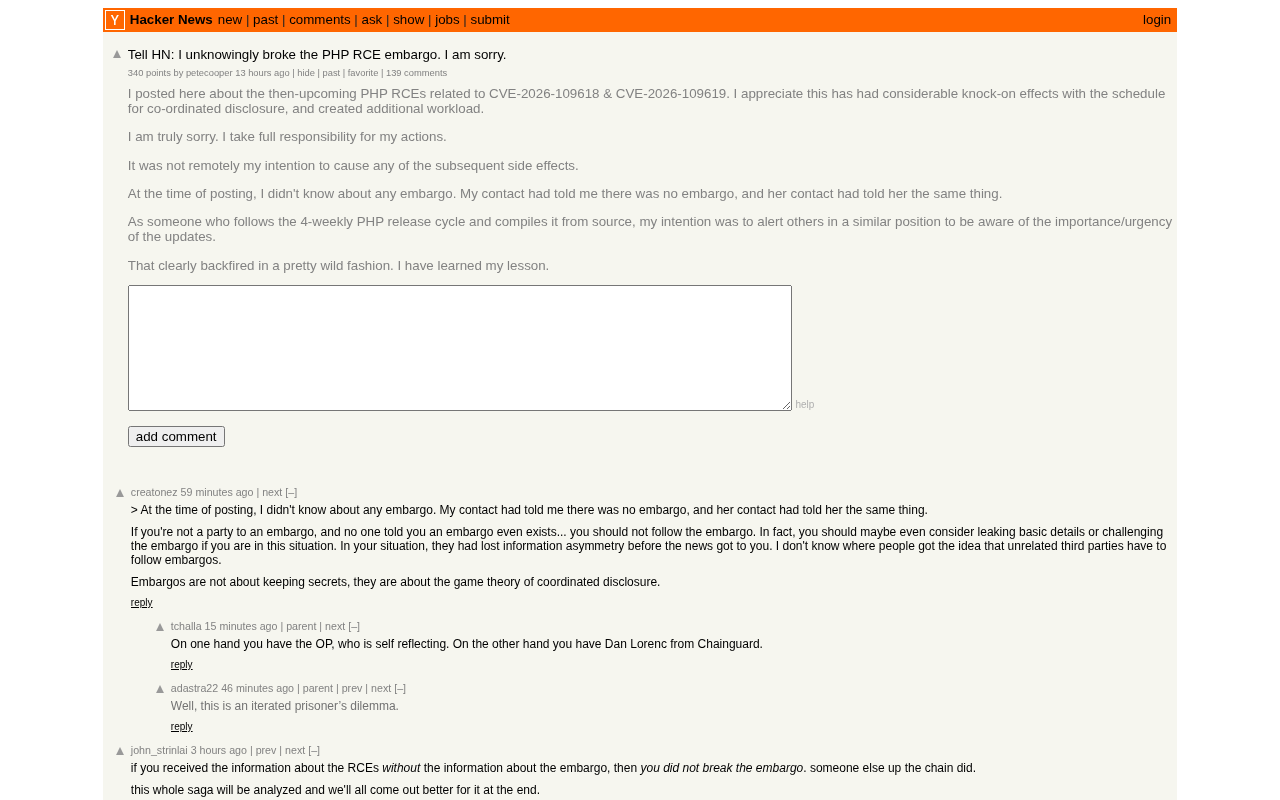
A developer inadvertently disrupted a coordinated disclosure plan by prematurely publishing information about a PHP remote code execution vulnerability, and posted a public apology on Hacker News. What appears to be an individual mistake reflects the fragility of the information chain in the vulnerability disclosure process.
Event Recap: A Chain Reaction Triggered by One Post
According to a Hacker News post (ID 50193416), the poster had previously published an article about an upcoming PHP remote code execution (RCE) vulnerability, involving CVE-2026-109618 and CVE-2026-109619. The post caused significant knock-on effects on the disclosure timeline and added extra workload for the teams involved.
The poster stated explicitly: "I am deeply sorry for this and take full responsibility for my actions." He emphasized that the subsequent side effects were not intentional. The post received 328 upvotes and 131 comments, indicating the community's high attention to such disclosure incidents, with discussions quickly unfolding around accountability and process gaps.
CVE (Common Vulnerabilities and Exposures) is a public vulnerability numbering system maintained by MITRE, where each ID corresponds to a confirmed security flaw in the format CVE-year-number. The CVE-2026-109618 and CVE-2026-109619 mentioned in the article have unusually long serial numbers, which do not match the typical digit count of standard CVEs (usually 4-7 digits); such numbers are often seen in pre-allocated or vendor-specific internal tracking IDs. RCE (Remote Code Execution) refers to an attacker's ability to execute arbitrary code on a target system without local access, typically rated as Critical severity because successful exploitation often allows direct takeover of the server. As a widely deployed server-side language, PHP's RCE vulnerabilities affect a large number of websites, making disclosure timelines particularly sensitive.
Why Does "Not Knowing There Was an Embargo" Become a Justification?
The poster's explanation is that at the time of publication, he was not aware of any embargo. His source told him there was "no embargo," and the source's own contacts said the same. Information became distorted layer by layer in transmission, ultimately turning an unverified judgment into a public action.
This is not simply passing the buck. Embargo information in vulnerability disclosure often relies on private communication and lacks verifiable written confirmation. When an intermediary relays "no embargo," the recipient can hardly distinguish whether this is confirmation or speculation. As a long-time follower of the PHP release cycle who habitually compiles from source, the poster's intent was to remind similar users of the urgency of updating—a reasonable motive, but the verification step was missing.
The Fragility of Coordinated Disclosure: A Single Point of Failure in the Trust Chain
Coordinated disclosure relies on multiple parties remaining silent until an agreed-upon time. Any misjudgment in this chain can expose the entire plan prematurely. In this incident, the problem was not malicious violation by the poster, but rather that the key information of "no embargo" was not cross-verified.
Judging from community reactions, the 131 comments included both criticism and sympathy. Critics argued that for high-risk vulnerabilities like RCE, at least a second confirmation with official channels should be made before publication; sympathizers pointed out that if an intermediary explicitly stated "no embargo," it would be difficult for an ordinary developer to question further. Both views point to the same conclusion: the disclosure process needs clearer confirmation mechanisms rather than relying solely on verbal communication.
Coordinated Disclosure is the mainstream paradigm in current vulnerability governance, referring to an agreement among vulnerability discoverers, vendors, and coordinating bodies (such as CERT/CC, MITRE) on a public disclosure date, before which all parties keep information under wraps so that vendors have a window to develop and distribute patches. Compared with "full disclosure" and "permanent confidentiality," coordinated disclosure attempts to balance users' right to know with repair time. Its operation relies on an implicit contract: any party leaking early will compress the vendor's response window and may allow attackers to exploit the vulnerability before a patch is available.
Embargo is a core mechanism in coordinated disclosure, referring to a temporary agreement prohibiting public discussion of vulnerability details before an agreed date. Embargoes are typically confirmed verbally or in writing via private emails or security announcement platforms (such as a vendor's security.txt, PSIRT channel). The lack of a unified, verifiable registry system is precisely the institutional root cause of this incident, where a source claimed "no embargo" yet caused a chain reaction.
Lessons for Developers: A Self-Check List Before Publishing Vulnerability Information
This incident serves as a reminder for all developers who follow security updates. Before publicly discussing an unpatched vulnerability, at least a few confirmations should be completed: verify the disclosure status directly with the project's security team or the CVE numbering authority; keep written communication records rather than relying on secondhand accounts; and be more vigilant about negative information such as "no embargo," because the cost of being wrong is far higher than mistakenly believing there is an embargo.
The poster wrote at the end: "This obviously backfired in a rather spectacular way. I have learned my lesson." The weight of this statement lies not in the apology itself, but in the often-overlooked fact it reveals: the success or failure of security disclosure often depends on the weakest retelling in the information chain.
Conclusion
An unintentional mistake disrupted the disclosure rhythm of a PHP RCE vulnerability and brought the process flaws of coordinated disclosure into the spotlight. For content creators and technical communicators, cross-verification before publication is not bureaucratic red tape, but a basic respect for others' work and user safety.
One-line Summary
A developer mistakenly believed there was "no embargo" and prematurely disclosed a PHP RCE vulnerability, disrupting coordinated disclosure and issuing a public apology.
Paragraph Summary
A developer who has long followed the PHP release cycle posted an apology on Hacker News, stating that because a source told him there was "no embargo," he prematurely published information about PHP remote code execution vulnerabilities involving CVE-2026-109618 and CVE-2026-109619, unintentionally disrupting the coordinated disclosure timeline and adding extra workload for the teams involved. The post received 328 upvotes and 131 comments, with divided community reactions: critics argued that high-risk vulnerabilities should be second-confirmed with official channels before publication, while sympathizers pointed out that information asymmetry caused by verbal relay is difficult for ordinary developers to resolve alone. The incident exposed the fragility of coordinated disclosure's reliance on private communication and lack of verifiable written confirmation, prompting the author to call on developers to verify directly with project security teams or CVE authorities and keep records before publicly disclosing unpatched vulnerabilities.
Related articles

Amphibious Transforming Drone: Beyond 100x Power Savings, What Are the Real Needs?
Is the amphibious transforming drone just a gimmick? Starting from the 100x power difference of the M4 Morphobot, explore real application scenarios and thesis topic ideas, analyzing boundary conditions where pure drones and pure ground robots both fail.

Warhound Raises $200 Million: Genetically Engineered "War Dogs" Paired with Anduril Gear
Warhound raises $200M, backed by Ben Lamm and Palmer Luckey, to genetically engineer dogs for military and law enforcement use and equip them with Anduril gear. This article analyzes its technology direction, funding logic, and ethical controversy.

Claude API Comes to Google Cloud: IAM Integration and SDK Access Guide
Anthropic hosts the full Claude API on Google Cloud with IAM-controlled permissions and unified billing. This guide covers the Vertex AI and Anthropic-hosted entry points, IAM role configuration, and SDK access.