NVIDIA RTX Spark: Running Code, Testing, and Deployment End-to-End on a Single Machine

NVIDIA RTX Spark brings the AI Agent's coding, testing, and deployment loop back to a single local GPU machine.
The article covers NVIDIA's RTX Spark proposal: as AI Agents handle most coding, the bottleneck shifts from typing to verification, and cloud queueing delays stretch feedback loops to minutes. RTX GPUs' VRAM and inference power make local medium-scale coding models, testing, and containerized deployment viable, compressing generate-verify-fix into one session. Boundaries remain: VRAM is a hard limit, and multi-service orchestration, large-scale concurrent testing, and production deployment still need the cloud.
AI Agents are changing the way software is built. Developers are shifting from writing code line by line to directing Agents to handle most coding tasks. A NVIDIA developer blog introduces a solution called RTX Spark, aimed at consolidating code writing, testing, and deployment onto a single machine equipped with an RTX GPU, so that individual developers and small teams no longer need to rely on complex cloud pipelines.
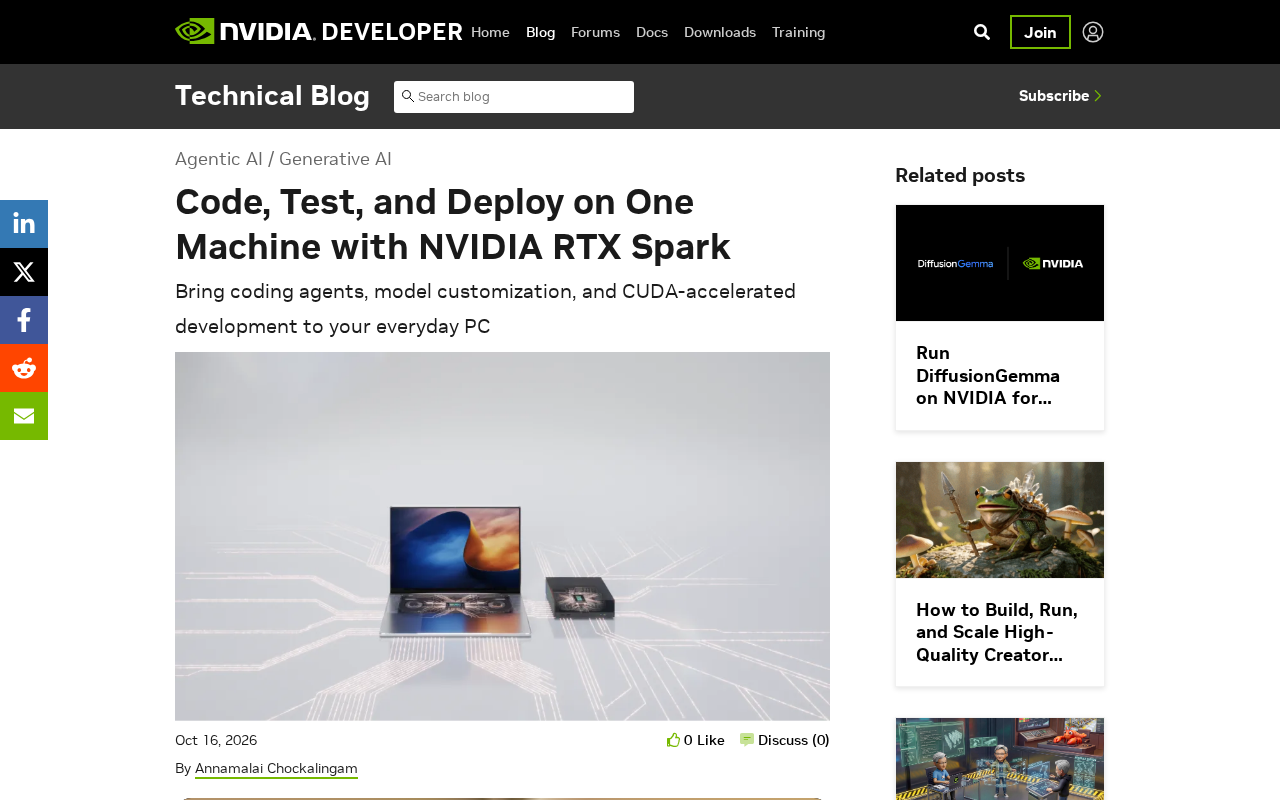
Why Bring the Development Loop Back Locally
When Agents take on a large share of code generation work, the bottleneck in development pace is no longer typing speed but verification speed. An Agent can generate hundreds of lines of code in seconds, but if every change requires waiting for a remote environment to rebuild and queue up tests, the feedback loop stretches to the minute level.
The core judgment NVIDIA puts forward in this blog is: local compute is now sufficient to support steps that previously had to be handed off to the cloud. The memory capacity and parallel computing power of RTX GPUs make local inference, local model fine-tuning, and even local containerized deployment feasible. The history of development, testing, and deployment being split across different environments is being replaced by a single-machine integrated workflow.
This approach is not meant to deny the value of the cloud, but to redraw the boundaries—keeping high-frequency iteration steps local and delegating low-frequency, heavy-load tasks to the cloud.
What Problems Does RTX Spark Actually Solve
The Compute Foundation for Local Agent Inference
Agents writing code rely on large model inference. In the past, running a usable coding model locally either ran out of VRAM or was so slow it hurt the experience. The VRAM capacity and inference optimizations of the RTX platform make running medium-scale coding models locally a reality. Models don't need internet access and code never leaves the machine, which is especially important for teams dealing with sensitive business logic.
The blog mentions that developers can shift from writing every line of code by hand to reviewing and guiding the Agent's output. The prerequisite for this role shift is that the local environment can respond instantly to the Agent's requests.
Why large model inference is VRAM-hungry: When running a coding model, the model weights themselves occupy VRAM—a 7 billion parameter (7B) model, even with 4-bit quantization, takes up roughly 3.5–4GB for the weights alone. Add the KV Cache that caches attention keys and values during inference, intermediate activations, and the overhead from context length, and actual usage is often 1.5–3 times the weights. This is why running models locally in the past either blew out VRAM or forced the use of extremely small models that degraded code quality. The significance of the RTX platform is that its large VRAM capacity (consumer flagship cards can reach 24GB or more) and tensor cores optimized for inference allow medium-scale coding models to fully reside in VRAM and respond at interactive speeds.
Localizing the Testing Step
Testing is often the most cloud-resource-hungry step. Unit tests, integration tests, and end-to-end tests stack up layer by layer, and a CI queue can get backed up for tens of minutes. Running tests on a local GPU machine brings the biggest benefit not in saving money but in shortening the feedback cycle.
Code generated by the Agent needs to be verified immediately—if it's slow, it's as good as unverified. Local testing lets the "generate—verify—fix" loop complete within a single session, which is when the Agent's self-correction capability truly comes into play.
CI and the feedback loop: CI (Continuous Integration) refers to the pipeline that automatically triggers builds and tests after code is committed. Its value is ensuring code quality, but the cost is queueing and scheduling latency—at larger team scales, a single commit may take tens of minutes before test results come back. For Agent programming, this latency is fatal, because the Agent's self-correction depends on immediate verification: it generates a piece of code, runs tests, and adjusts based on failure messages, and it needs to complete multiple rounds within one or two minutes. Local testing compresses this loop to the second level, boosting the Agent's iteration efficiency by an order of magnitude—which is the more central benefit of "localized testing" compared to "saving cloud costs."
Deployment No Longer Requires Switching Between Multiple Environments
In the traditional workflow, once code is written it must be packaged, images pushed, environments provisioned, and networks configured—each step can go wrong. RTX Spark emphasizes completing the entire process from code to a running service on the same machine. For prototype validation, internal tools, and edge scenarios, this single-machine deployment path is more direct than setting up a full CI/CD pipeline.
Containerized deployment and CI/CD: Containers (such as Docker) package an application and its dependencies into a portable image, solving the "environment inconsistency" problem; CI/CD strings build, test, and deployment into an automated pipeline. Traditionally, this system requires a separate orchestration platform, image registry, and network configuration—overly heavy infrastructure for small projects. The single-machine deployment path installs the container runtime directly on the development machine, so writing code, building an image, and starting the service can all be done on the same machine, eliminating steps like pushing images and configuring networks across environments. Its applicable scenarios are prototypes, internal tools, and edge deployments—not production systems that need elastic scaling.
The Practical Impact on Developers
The most direct change is a shift in the center of gravity of the workflow. Developers spend less time on environment setup and pipeline debugging, and more time designing Agent instructions, reviewing generated code, and defining test standards. This is a shift from "operator" to "commander."
The second layer of impact is the recombination of the toolchain. When local compute is sufficient, editors, Agents, testing frameworks, and container runtimes can be integrated more tightly rather than stitched together through network calls. With lower latency, interaction patterns will also change—real-time suggestions, instant testing, and running while writing become possible.
The third layer of impact involves team collaboration. A single-machine reproducible development environment reduces the communication cost of "it works on my machine." After new members pull the environment, they can run the complete workflow locally, rather than relying on a set of configuration instructions in the docs that may already be outdated.
Where Are the Boundaries of the Single-Machine Model
The applicable scope of this solution needs to be viewed objectively. The single-machine loop suits scenarios with frequent iteration, sensitive data, and controllable scale. Once it involves multi-service orchestration, large-scale concurrent testing, or production deployment requiring elastic scaling, cloud infrastructure remains irreplaceable.
VRAM is still a hard constraint. The scale of models that can run locally and the number of test containers that can run simultaneously are both limited by single-machine resources. For large projects, the more realistic approach is for the local machine to handle high-frequency iteration while the cloud handles full regression and formal releases.
Additionally, the maintainability and observability of single-machine deployment still lag behind mature cloud platforms. Getting a service running is easy; keeping it stable and easy to troubleshoot is another matter.
Observability: Refers to the ability to observe a system's internal operating state through logs, metrics, and tracing. Cloud platforms typically build these capabilities in, with ready-made dashboards and alerts when services have problems. In single-machine deployment, developers need to build log collection, monitoring, and troubleshooting tools themselves—otherwise, getting a service to "run" is easy, but "knowing why it crashed" is hard. This is precisely the root of the gap in maintainability between single-machine solutions and cloud platforms mentioned in the article, and one reason it's better suited to small-scale, temporary workloads.
What Trend Does This Represent
The signal this NVIDIA blog conveys goes beyond a single tool. It reflects a direction for development infrastructure in the AI era: compute moving downward, loops tightening. When model inference, code generation, and test verification can all be done locally, the initiative in development returns to developers' hands.
For individual developers, this means they don't need to set up a cloud environment first to start building a complete product. For small teams, it means they can validate ideas quickly at lower coordination cost. For platform vendors, it means the center of value in development tools is shifting from "connecting to the cloud" to "making good use of local compute."
Agents have changed how code is produced, and local compute is changing how code is verified and delivered. The combination of the two is the real significance of single-machine full-process development.
One-line Summary
NVIDIA RTX Spark advocates using local GPU compute to bring the AI Agent's coding, testing, and deployment loop back to a single machine, shortening the feedback cycle.
Paragraph Summary
The article introduces the RTX Spark solution proposed in a NVIDIA blog: once AI Agents handle most coding work, the development bottleneck shifts from typing speed to verification speed, and the queueing delay of cloud pipelines stretches the feedback loop to the minute level. The VRAM and inference capabilities of RTX GPUs make running medium-scale coding models locally, running tests, and doing containerized deployment a reality, compressing "generate—verify—fix" into a single session. The article also points out the boundaries: VRAM is a hard constraint, and the single-machine solution suits scenarios with frequent iteration, sensitive data, and controllable scale, while multi-service orchestration, large-scale concurrent testing, and production deployment still require cloud support. The developer role thus shifts from writing code line by line to commanding Agents, defining test standards, and reviewing output.
Related articles

Random Pruning of the DPO Computation Graph: 1.4x Training Speedup and Lower Peak Memory
DPO training too slow and memory-hungry? This paper proposes a random pruning framework for the DPO computation graph, sampling independently across position, sequence, and branch dimensions; branch pruning achieves a 1.426x step-time speedup and cuts training time by about 30%, with in-depth attribution of memory and time gains.

Why Does JEPA Underperform MLM in Longitudinal EHR Representation Learning?
New study compares JEPA and MLM for longitudinal EHR representation learning on MIMIC-IV: three JEPA variants train stably without collapse but underperform MLM; target size, not heterogeneity, drives prediction error.

Transfer Learning + Visible Light Communication: A New Approach to Energy-Efficient Indoor Positioning
A study proposes a transfer learning-based visible light communication indoor positioning method, achieving 47% accuracy improvement on the BOSCH factory dataset, 67.5% model efficiency under high noise, and introducing the ME composite metric for energy-efficient positioning in energy-constrained industrial IoT scenarios.