Nvidia's Dilemma: How the Commoditization of the Compute Market Is Turning Against Its Creator

How the commoditization of compute is turning against Nvidia, the very company that created the market.
Despite rising revenue expectations, Nvidia's stock has dropped ~15% from its peak. This article examines the double-edged sword of compute commoditization: as supply catches up and cloud giants like Google, Amazon, and Meta build their own chips, Nvidia's pricing power faces pressure—while CUDA remains its strongest moat.
A Counterintuitive Phenomenon
Nvidia is undoubtedly the biggest winner of this wave of AI. Yet an intriguing phenomenon is quietly unfolding: despite continuously rising revenue expectations, Nvidia's stock has fallen roughly 15% from its peak in May of this year.
This divergence of "earnings up, stock down" is often a signal of a deep disagreement between market sentiment and fundamentals. When financial data remains impressive but capital markets choose to vote with their feet, what investors are truly worried about is usually not the "present," but the "future"—the sustainability of the business and its long-term bargaining power.
It's worth noting that the way capital markets price tech stocks is essentially a "discounted expectations" mechanism, grounded theoretically in the DCF (Discounted Cash Flow) model—a stock price reflects the total value of future cash flows discounted to the present, not current financial data. For high-growth tech companies, most of the weight in their stock valuation comes from expectations of cash flows in the distant future. This means that even a small downward revision to growth assumptions can, through the mathematical terminal-value compression effect, have a disproportionate impact on the current stock price. When analysts have already given optimistic forecasts for Nvidia's revenue growth over the next three to five years and fully priced them in, even if quarterly figures exceed historical averages, the stock will come under pressure as long as it fails to surpass the market's "expectation ceiling." On Wall Street this phenomenon is called "Buy the rumor, sell the news," and high-growth tech companies are especially prone to falling into this valuation trap—the better they are, the higher the bar of expectations the market sets for them.
This article analyzes this core contradiction: Is Nvidia becoming a victim of the very "compute market" it created?
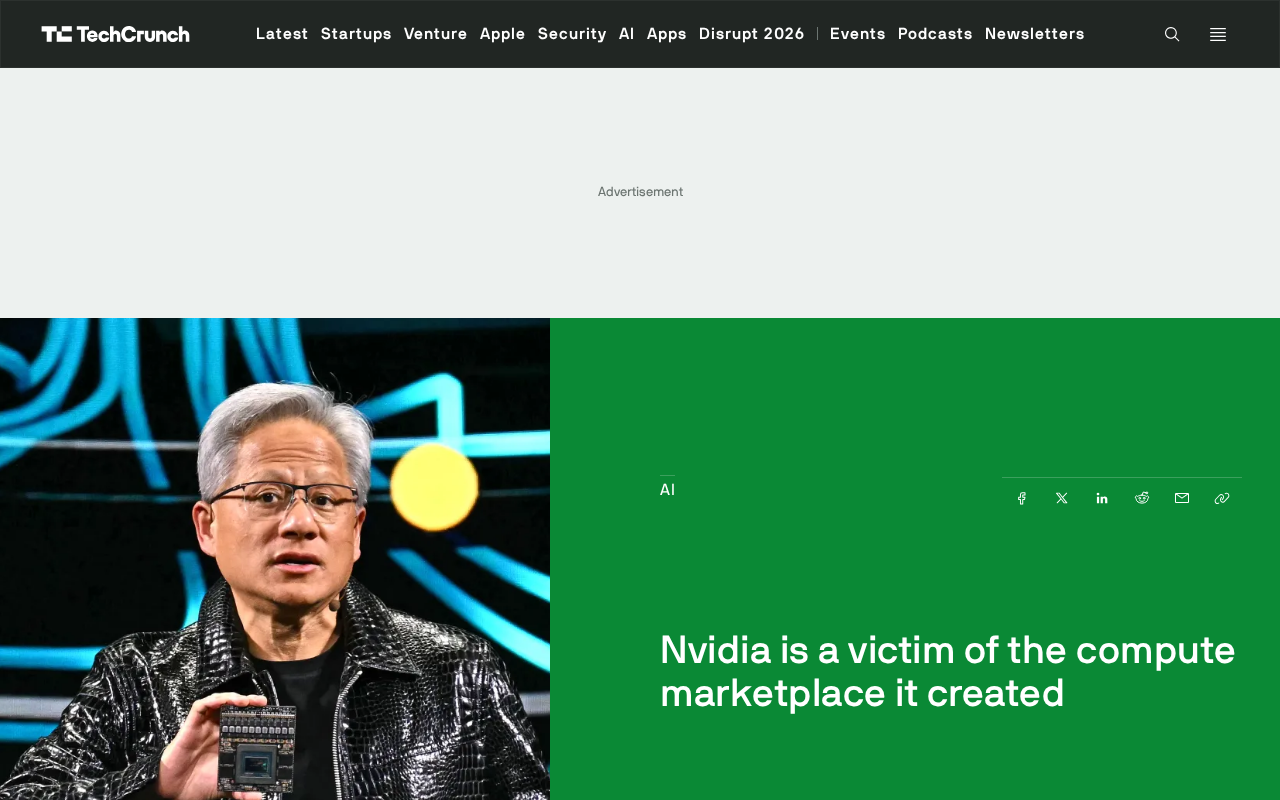
How Nvidia Created the Compute Market
Nvidia's success lies not merely in selling large volumes of GPUs, but in building an entire ecosystem around accelerated computing. From the CUDA software stack to data-center-scale full-system solutions, Nvidia has essentially defined the infrastructure standards for modern AI training and inference.
CUDA (Compute Unified Device Architecture) is the parallel computing platform and programming model that Nvidia launched in 2006. Before CUDA appeared, GPU programming remained the exclusive domain of a small number of graphics experts. Through CUDA, Nvidia exposed the GPU's thousands of parallel computing cores to general-purpose developers, allowing them to directly harness the GPU's parallel computing power using a C-like language, dramatically lowering the barrier to GPU programming. After nearly 20 years of deep accumulation, CUDA has formed a highly layered technology stack: the low-level PTX assembly instruction set; the middle layer including cuDNN (an acceleration library deeply optimized for core deep neural network operations such as convolution and normalization), cuBLAS (a library for basic linear algebra operations such as matrix multiplication), and NCCL (a multi-GPU/multi-node communication library); and the upper-level TensorRT inference optimization engine. Mainstream frameworks like PyTorch and TensorFlow are deeply and natively integrated with CUDA as a first-class citizen, and tens of thousands of academic paper benchmarks are by default run in CUDA environments, forming an extremely deep software moat.
The depth of this ecosystem far exceeds what appears on the surface. The migration cost for developers includes not just rewriting code, but also re-tuning, re-validating numerical precision, and abandoning years of accumulated CUDA-specific optimization techniques. An even deeper obstacle lies in the "muscle memory" accumulated by millions of AI researchers and engineers worldwide within the CUDA environment: tuning intuition, familiarity with debugging toolchains, the accumulated community knowledge base, and the reproducibility of experimental results in published papers. This path dependency at the knowledge level is often far more durable than the technical barrier of code migration. Even if a competitor matches chip performance, it must still face the enormous obstacles of developer migration costs and ecosystem rebuilding—this is precisely where Nvidia's true core competitiveness lies, rather than in the chip hardware itself.
In this process, Nvidia effectively gave rise to a vast "compute commodity market." Cloud service providers, hyperscale data centers, and AI startups scrambled to purchase GPUs, treating compute as a strategic resource that could be rented, resold, and stockpiled. GPUs evolved from a hardware product into a strategic asset akin to a commodity.
The Double-Edged Sword of Commoditization
The commoditization of compute greatly amplified Nvidia's demand curve in the early days. When compute became "hard currency," nearly all players had an incentive to lock in supply in advance, which directly drove up Nvidia's order volume and pricing power.
But commoditization itself also planted the seeds of trouble. Anything that becomes commoditized ultimately follows three laws: supply catches up with demand, prices trend toward transparency, and substitutes keep emerging. This is not the first time this history has played out—in the 1990s, Intel's x86 processors went through a similar cycle in the PC market: initially existing as a scarce, high-margin product, then continuously seeing margins compressed as competitors like AMD rose and capacity expanded.
The DRAM memory chip industry provides an even more extreme cautionary tale. In the 1970s, Intel pioneered the modern semiconductor memory market with its 1103 DRAM chip, when product gross margins were extremely high. However, the Japanese government-led "VLSI Project" concentrated support for NEC, Toshiba, Hitachi, and other companies to enter the DRAM race on a large scale between 1976 and 1979. Riding on rapid catch-up in manufacturing processes and policy subsidies, Japanese manufacturers quickly used price wars to compress margins to near zero. In 1985, Intel made a strategic decision that changed its fate—completely exiting DRAM and betting all its resources on x86 microprocessors. Subsequently, mass production by Korean and Taiwanese manufacturers pushed DRAM margins to the extreme. This structural shift profoundly influenced the strategic thinking of an entire generation of the semiconductor industry, making "differentiation" and "ecosystem lock-in" the core survival challenges for high-margin hardware companies. These precedents show that hardware commoditization is an almost irreversible historical trend—the only difference is speed and path. Once compute is treated as a tradable resource, the market's focus shifts from "who produces it" to "who can offer equivalent compute at lower cost."
Why the Market Is Beginning to Turn Against It
Behind the stock's pressure lies the market's repricing of several key questions.
Continuous Catch-Up on the Supply Side
As capacity continues to ramp up and various alternatives advance, the market has begun to question whether the current "compute shortage" is merely a cyclical phenomenon. Once supply catches up with demand, the premium Nvidia enjoys as a seller may be compressed. Historically, nearly all high-margin hardware businesses have eventually undergone a process of margin reversion to the mean.
Customers as Potential Rivals
More subtly, Nvidia's largest customers—the major hyperscale cloud providers—are simultaneously becoming its potential competitors. Google's TPU (Tensor Processing Unit) has advanced to its fifth generation, and its Systolic Array architecture is optimized specifically for matrix-multiplication-intensive neural network computation: data flows synchronously in a beat-by-beat fashion through a regularly arranged array of processing units, without repeatedly reading intermediate results from memory, greatly reducing memory bandwidth pressure and power consumption. In certain batch inference scenarios, its energy efficiency can rival Nvidia's flagship products. Amazon AWS's Trainium2 uses the NeuronCore architecture and reportedly delivers about 40% more compute per dollar than Nvidia's H100 when training large language models, while the Inferentia chip specializes in low-latency inference scenarios. Microsoft partners with AMD and develops its own Maia AI chip; Meta has also announced its roadmap for its in-house MTIA inference chip.
Behind these in-house chips lies cloud providers' relentless pursuit of "Total Cost of Ownership (TCO)", and the financial logic is very clear: take Meta as an example—if it could switch 30% of its inference workloads to an in-house solution via self-developed chips, this alone could save billions of dollars per year. Even at the cost of some generality, they aim to dramatically amortize the per-unit compute cost in large-scale deployments. While these in-house chips temporarily lag Nvidia GPUs in generality, they can already achieve significant cost optimization in specific scenarios, marking that cloud providers' strategy of "reducing dependence on Nvidia" has moved from the planning stage to substantive implementation. When buyers have enough capital and technology to build alternatives, the seller's long-term pricing power inevitably comes under pressure.
This is the core logic of "being turned against by the market you created": Nvidia taught the entire industry the value of compute, and it also made the entire industry realize that the strategic significance of controlling compute supply is too great to be permanently monopolized by a single company.
The Structural Misalignment Between Growth and Valuation
It's worth emphasizing that revenue growth and stock performance are not always in sync. Capital markets price the "marginal change in expectations," not the "absolute level of the present."
When a company's growth has been fully or even excessively anticipated by the market, even if actual data remains strong, valuation may correct first as soon as growth peaks or uncertainty emerges in its outlook. What Nvidia currently faces may be exactly this valuation pressure of being "excellent but no longer exceeding expectations."
A 15% correction is not uncommon among high-volatility tech stocks, but the signal it conveys warrants caution: the market is switching from "blindly bullish on compute" to "re-examining the depth of the compute business's moat."
Implications for the AI Infrastructure Industry
Nvidia's situation offers an important sample for reflection for the entire AI infrastructure industry.
First, any business model that depends on a single scarce resource must beware of value revaluation once that scarcity disappears. Second, building an ecosystem is a double-edged sword—it can both create demand and breed competitive forces that erode one's own position. Third, a truly lasting moat often lies not in the hardware itself, but in the software ecosystem, developer stickiness, and hard-to-replicate system-level integration capabilities.
For Nvidia, the CUDA ecosystem and system-level advantages remain its most solid line of defense. The code assets, tuning experience, and workflows accumulated by millions of developers on CUDA constitute a migration barrier that competitors find extremely hard to overcome—this stickiness will not collapse instantly just because a substitute chip of comparable performance appears. Just as AMD launched processors of equal or even superior performance across multiple product cycles from the 1990s to the 2000s (such as the K6 and Athlon 64), it still could not translate its performance advantage into a decisive breakthrough in market share—the fundamental reason being that the massive software, operating-system-level optimizations, and developer habits accumulated around the x86 ISA (Instruction Set Architecture) constituted an independent moat completely decoupled from hardware performance. The inertia of a software ecosystem is often far slower than hardware generational turnover. Whether Nvidia can hold this line of defense will determine whether it continues to dominate the market it created, or gradually becomes just another commoditized participant within it.
Conclusion
The proposition that "Nvidia is a victim of the compute market it created" may seem slightly exaggerated, but it precisely points out a structural tension: when you turn something into a commodity everyone craves, you also place yourself into the game of value redistribution across the entire market.
Short-term stock fluctuations will eventually pass, but whether Nvidia can continuously prove its irreplaceability amid the long-term trend of compute commoditization is the true key to determining its future value.
Key Takeaways
Key Takeaways
Key Takeaways
Related articles

Gaussian Process Bandit Optimization: Exploration Strategies and Inference Regret Guarantees
Cumulative regret guarantees in Bayesian optimization fail to reflect final recommendation quality. This article examines a new study that provides inference regret guarantees for Gaussian process bandit optimization through exploration query strategies and fill distance analysis, validated on hyperparameter optimization and control tasks.

The Most Detailed Codex Guide on Bilibili: From Installation to Real-World Practice
The most detailed Codex guide on Bilibili: from app store installation to daily work mode configuration, with a real coffee shop project demonstrating file organization, data extraction, dashboard creation, and other practical tasks. Learn to use Plan Mode and desktop pets to leverage Codex efficiently.

Appearance Compensation in Volume Rendering: Why RGB Accuracy Cannot Guarantee Density Correctness
Volume rendering research reveals that volumetric data perfectly reproducing external RGB views may still contain density errors: appearance compensation can double central density and keep external rays unchanged even when L2 error exceeds 14.52%. Density recovery depends on appearance capacity, spatial resolution, and measurement design.