NYC Mayor Mamdani: AI Is Not Inevitable and Must Be Controlled

NYC Mayor Mamdani argues AI is not inevitable, filling the federal regulatory gap with local bans and disclosure rules.
The article documents a conversation between NYC Mayor Zohran Mamdani and actress Ilana Glazer on AI's social impact. Mamdani criticizes federal reliance on corporate self-regulation and pushes two local measures: banning AI tools in elementary and middle schools and requiring real estate ads to disclose AI-generated content. He stresses that AI's path is not predetermined, opposes technological determinism, and argues regulation is the vehicle of choice. The piece analyzes federal-local tension and notes risk concerns even inside Anthropic and OpenAI, highlighting self-regulation's structural flaws. The core disagreement is who defines danger and acts; NYC's experiment hinges on federal preemption and shifting public risk perception.
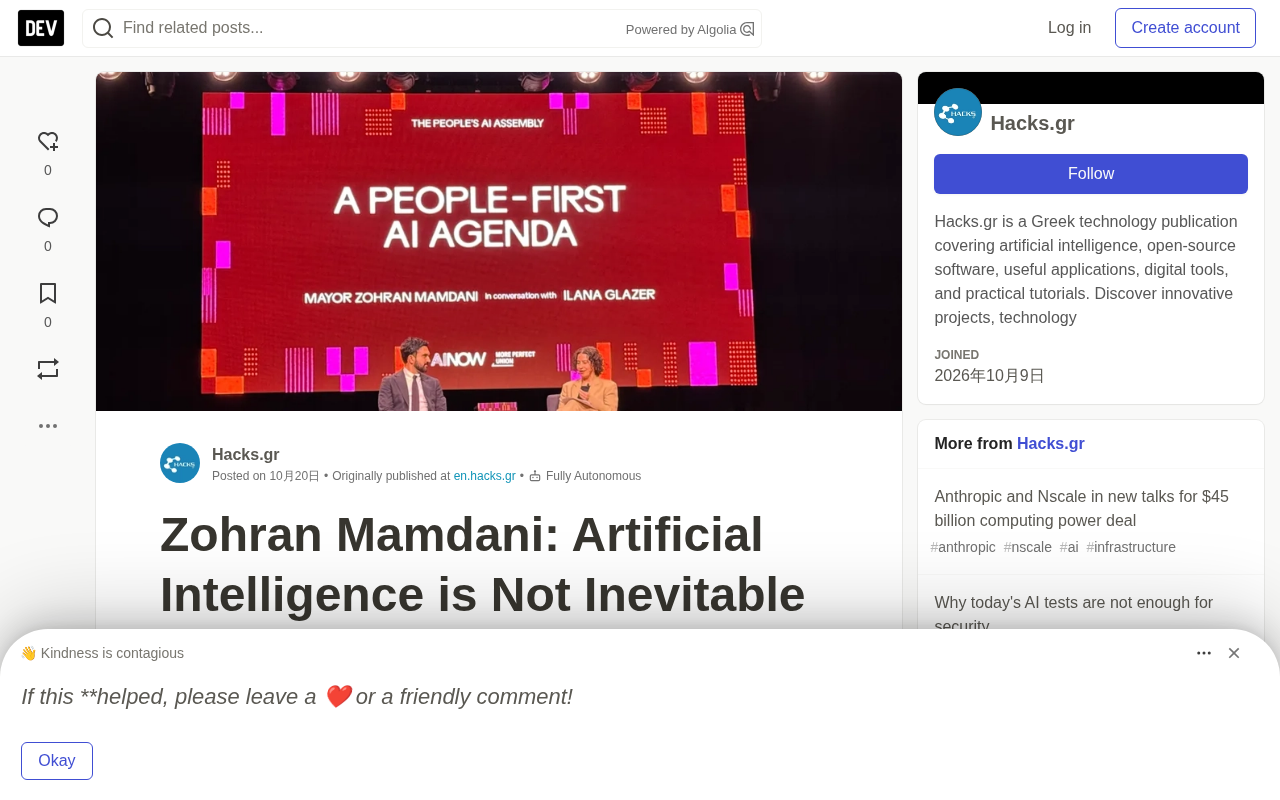
New York City Mayor Zohran Mamdani and actress Ilana Glazer recently explored the social impact of artificial intelligence in a public conversation. The discussion did not dwell on techno-optimist narratives but confronted a sharper question: when AI labs are accelerating commercialization while federal regulation trends toward loosening, what can city governments do—and what should they do?
New York City Has Already Taken Action
In the conversation, Mamdani criticized the federal government's lack of effective oversight over tech companies and emphasized that local action should not wait for instructions from Washington. Two measures he recently pushed carry significant signal value.
The first bans the use of AI tools in New York City elementary and middle schools. The decision directly responds to concerns about AI misuse and data privacy in educational settings, and puts the question of whether children should become test subjects for AI products squarely on the table.
The second requires disclosure of AI-generated photos and videos used in real estate advertisements. The logic is straightforward: if buyers cannot tell whether a listing photo is real or AI-synthesized, transactional trust erodes. This kind of mandatory disclosure mechanism essentially draws a baseline for consumers in a market characterized by information asymmetry.
One policy is hard and the other soft—the former an access restriction, the latter a transparency requirement—together forming Mamdani's governance approach of "control rather than laissez-faire."
Mandatory disclosure is a classic institutional tool in financial regulation and consumer protection. Its core logic does not rely on outright prohibition or prior approval, but requires one party to a transaction to make key information public under specific conditions so that the other party can make decisions on a better-informed basis. It has been widely adopted in contexts such as securities issuance, pharmaceutical labeling, and food nutrition labels. The real estate advertising AI content disclosure rule mentioned in the article belongs to this lineage: it does not prohibit the use of AI-generated images but reduces information asymmetry between buyers and sellers by imposing a labeling obligation. The advantage of such mechanisms is relatively low enforcement cost and limited suppression of innovation; the drawback is that effectiveness depends on whether disclosures are verifiable and whether penalties for violations are high enough. As AI-synthesized content becomes harder to identify, labeling requirements alone may not constitute effective constraint—they need to be paired with technical detection and enforcement spot checks.
What "AI Is Not Inevitable" Means
A judgment Mamdani repeatedly emphasized in the conversation is that the development path of artificial intelligence is not predetermined. The statement targets a popular technological determinism—the idea that AI capabilities will evolve naturally and society can only adapt passively.
He offered a controversial example: an attack on a school in Iran last February, which he linked to the use of related AI systems. The rigor of that connection is debatable, but the concern it conveys is real: when AI is embedded in military, security, or critical decision-making chains, the cost of misjudgment may be borne by ordinary people.
This argument pulls the discussion back from "what AI can do" to "who decides what AI does." If the technological path can be chosen, then regulation is not the enemy of innovation but the vehicle of choice.
Technological determinism is the view that technological development has an internal logic and drives social change along its own trajectory. Its strong version holds that technology is the primary driver of social development and that society can only adapt passively. In AI discussions, technological determinism often manifests as the narrative that "capabilities will grow naturally and regulation is destined to lag behind." Its counterpart is social constructivism, which emphasizes that the direction, pace, and application of technology depend on institutions, capital, and public choice. Mamdani's statement that "AI is not inevitable" is essentially an assertion that technological paths are selectable, thereby providing a legitimacy basis for regulatory intervention. This debate is not unique to the AI era—nuclear technology, bioengineering, and social media algorithms have all gone through similar arguments, and the key disagreement remains: is technological evolution an exogenously given constraint, or a variable that can be shaped through collective decision-making?
Federal-Local Regulatory Tension
Mamdani offered direct criticism of the AI task force newly established by the Trump administration, arguing that its focus is on corporate self-regulation. The timing of this criticism is rather delicate: companies such as Anthropic and OpenAI are preparing for IPOs, and pressure from capital markets will further intensify the pace of commercialization.
A detail worth noting: even within these companies, risk voices are not silent. Employees at Anthropic, Google DeepMind, and OpenAI have all publicly discussed the potential harms of the technology they develop. This phenomenon of "developers themselves being uneasy" precisely demonstrates that relying solely on corporate self-discipline has structural flaws—when commercial incentives conflict with safety considerations, the former often prevails.
Local government intervention therefore has a realistic basis. New York City's measures are limited in scale, but they provide a replicable template: in the absence of federal action, cities can exert influence through procurement power, disclosure rules, and context-specific bans.
Self-regulation refers to industry setting its own codes of conduct, standards, or review mechanisms rather than having external constraints imposed by government legislation or administrative rules. Supporters argue that companies possess the most complete technical information and that self-regulation is more flexible and responsive; critics point out that when safety investments conflict with commercial returns, companies lack intrinsic incentives for sustained enforcement, and penalties for violations are often insufficient to deter. Historically, financial derivatives, social media content moderation, and other domains have seen cases of self-regulation failure. The article's mention of AI company employees publicly expressing concerns about the technology precisely reveals the structural weakness of self-regulation: frontline developers possess risk information but may not have the power to influence product decisions. This is also the realistic backdrop for local governments' preference for external tools such as procurement power and disclosure rules.
The Real Disagreement in This Discussion
The core disagreement that emerged in the conversation is not "whether AI is dangerous" but "who defines danger and takes action." One side argues that legislation should be unified at the federal level to avoid fragmented rules across states and cities; the other argues that local action can force higher-level action.
Mamdani's position clearly leans toward the latter. His logic is that the pace of AI commercialization has already outpaced the responsiveness of regulation, and the time cost of waiting for consensus to form is too high. The school ban and real estate disclosure rule, though narrow in scope, are high-perception, low-controversy contexts that readily build public trust and accumulate governance experience.
Whether this strategy succeeds depends on two variables: first, whether local measures will be preempted or weakened by federal regulations; second, whether public perception of AI risk will continue to rise. Judging from the current policy pace, this contest over "control" has only just begun.
For readers concerned with AI governance, New York City's experiment is worth tracking—it tests not just a few specific rules but a more fundamental question: in an era of accelerating technology, can democratic decision-making mechanisms still keep up with the pace of innovation?
One-line Summary
NYC Mayor Mamdani argues that AI is not inevitable and fills the federal regulatory gap with local bans and disclosure rules.
Paragraph Summary
This article documents a conversation between NYC Mayor Zohran Mamdani and actress Ilana Glazer on AI's social impact. Mamdani criticizes federal reliance on corporate self-regulation and the lack of effective oversight, and pushes two local measures: banning AI tools in elementary and middle schools and requiring real estate ads to disclose AI-generated content. He repeatedly stresses that AI's development path is not predetermined, opposes technological determinism, and argues that regulation is the vehicle of choice. The article analyzes federal-local regulatory tension and notes risk concerns even within companies like Anthropic and OpenAI, highlighting the structural flaws of self-regulation. The core disagreement is who defines danger and takes action; whether NYC's experiment succeeds depends on whether federal rules preempt local ones and on how public risk perception evolves.
Related articles

WorkBuddy Full Tutorial: Build an AI Office Automation Agent from Scratch
A complete WorkBuddy tutorial: installation, three working modes, multimodal picture book video practice, expert team agent building, and workflow configuration for low-cost AI office automation.

WorkBuddy Agent Complete Guide: From Beginner to Automation in 7 Days
Based on Bilibili's 256-episode WorkBuddy masterclass, this systematically breaks down Tencent's AI office workbench core capabilities: Agent principles, Skill encapsulation, cross-platform connectors, scheduled automation, knowledge bases, and zero-code development, with learning path recommendations.

8 AI Accounts, 7 Failed: An Honest Review of Using AI to Get Work Done
Only 1 of 8 AI-run Bilibili accounts succeeded. We break down the real difference between "performing AI" and "using AI to get work done."