Oats: A Fully Open-Source, Locally Running, Free AI Meeting Notes Tool
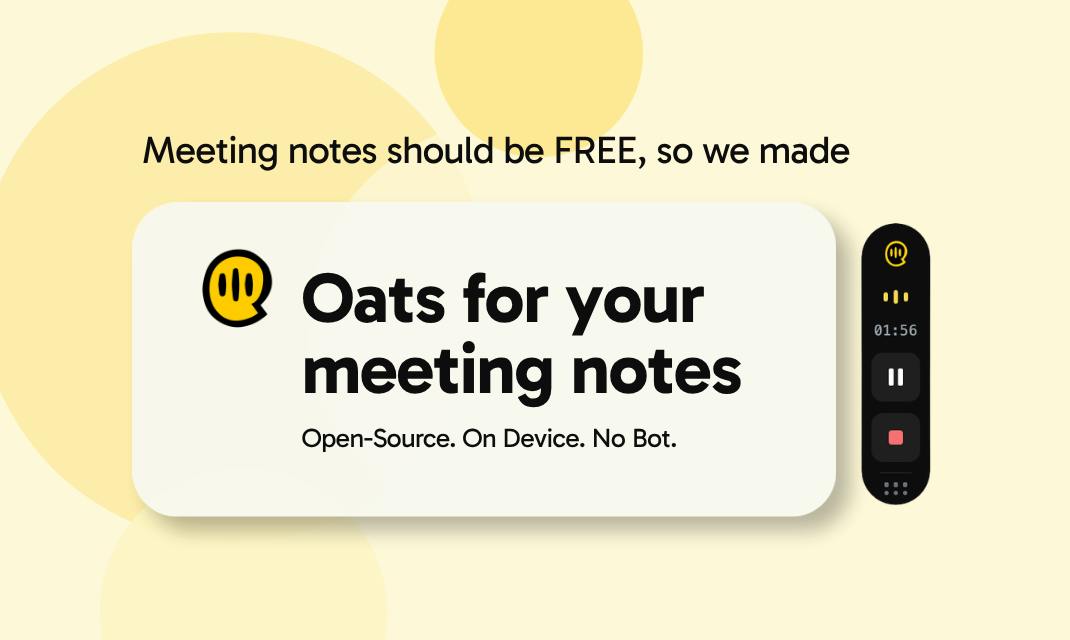
Oats is a free, open-source, local-first AI meeting notes tool — no bots, no subscriptions, full privacy.
Oats is an open-source AI meeting notes tool built around three core principles: no bots, no subscriptions, and local-first operation. It captures and processes audio directly on your device using an on-device LLM, ensuring meeting content never leaves your computer. The tool uses a two-tier design: the local mode is completely free, while the ariso.ai cloud backend offers advanced features like speaker recognition, multilingual support, and coaching-style feedback. Oats earned 116 upvotes on Product Hunt and fills a clear market gap for privacy-conscious, budget-limited users.
Taking meeting notes has always been one of the most persistent pain points in productivity — yet most solutions either require a paid subscription or rely on an awkward "bot attendee" sitting in your meeting room and uploading sensitive conversations to the cloud. The open-source project Oats offers a different path: a fully local, free, no-subscription AI meeting notes tool. It recently launched on Product Hunt, earning 116 upvotes, 47 comments, and a #5 ranking for the day.
A Local Solution with No Bots, No Subscriptions
Oats' core selling point is that it doesn't disrupt your meetings. Most AI transcription tools join as virtual attendees, adding an unfamiliar "participant" to the screen — something that feels out of place in formal settings and often raises privacy concerns. Oats takes a purely local approach: it captures and processes audio directly on your device without injecting any bot into the meeting.
This is especially important for teams and individuals who care about data sovereignty. All transcription and processing can happen locally, running on an on-device LLM, so sensitive meeting content never has to leave your computer. The project supports both macOS and Windows, covering the vast majority of office environments.
Two-Tier Design: Free Locally, Enhanced in the Cloud
Oats takes a pragmatic layered approach. When running entirely locally with an on-device large language model, it's completely free — no subscription required. This addresses the core concern of many lightweight users: they don't want to pay, and they don't want to compromise on privacy.
For users who need more powerful capabilities, Oats offers advanced features through the ariso.ai cloud backend, including enhanced transcription, multilingual support, speaker recognition, meeting assessments, coaching-style feedback, and auto-tracking of follow-ups.
This "good enough locally, enhanced in the cloud" combination is a classic evolution pattern for today's AI tools — using free, open-source local capabilities to lower the barrier to entry and build trust, then monetizing through optional cloud services for a premium experience. Users can freely choose between the two modes based on their privacy requirements and feature needs.
Speaker Diarization/Recognition is one of the technically challenging components of meeting transcription. Its goal is to distinguish different speakers in a recording and attribute each segment of speech to the correct person. This technology typically relies on voice-print feature extraction and clustering algorithms, which are computationally intensive, and accuracy is significantly affected by microphone quality, ambient noise, and the number of speakers. This explains why Oats places speaker recognition in the cloud-enhanced tier rather than as a default local feature — achieving high-accuracy multi-speaker separation on resource-constrained devices is extremely challenging, especially for long meetings with many participants and frequent overlapping speech.
What Open Source Really Means Here
Oats is categorized on Product Hunt under Open Source, Meetings, Artificial Intelligence, and GitHub, indicating that its code is publicly available. For a tool that handles sensitive meeting data, the transparency that comes with being open source is itself a form of trust — users can verify where their data actually goes and whether it truly stays local.
Open source also reduces the risk of vendor lock-in. Even if the cloud service changes its policies in the future, the local version remains fully usable. For developers, it also means the ability to extend functionality and integrate the tool into custom workflows.
Things Worth Watching
The real-world performance of on-device LLMs is the critical factor in whether tools like this actually deliver. Running locally means being constrained by the user's hardware — transcription accuracy, processing speed, and support for long meetings will all fall short of cloud-based solutions. This is precisely why Oats offloads demanding tasks like speaker recognition and multilingual support to the cloud backend: the purely local mode is better suited as a "good enough" baseline.
From a positioning standpoint, Oats precisely targets the "privacy-conscious + budget-limited" user segment. At a time when more and more competing products emphasize cloud capabilities and subscription models, a free, open-source, local-first option genuinely fills a market gap. Whether it can match the transcription quality of commercial solutions will determine whether it remains a niche choice for privacy enthusiasts or grows into a tool with broader appeal.
On-device LLM refers to a language model that runs directly on the user's local hardware, without sending data to remote servers. Currently popular locally-runnable models include Meta's Llama series, Mistral, and quantized versions optimized for edge devices (such as the GGUF format). These models typically reduce their size through parameter compression and quantization techniques, allowing them to run on ordinary consumer-grade CPUs or GPUs — though inference speed and output quality are generally lower than large-parameter cloud models. Whisper (OpenAI's open-source speech recognition model) is the most commonly integrated solution for local transcription scenarios. It can deliver reasonably high-quality speech-to-text without an internet connection, making it a key piece of infrastructure for tools like this to achieve true local operation.
Related articles
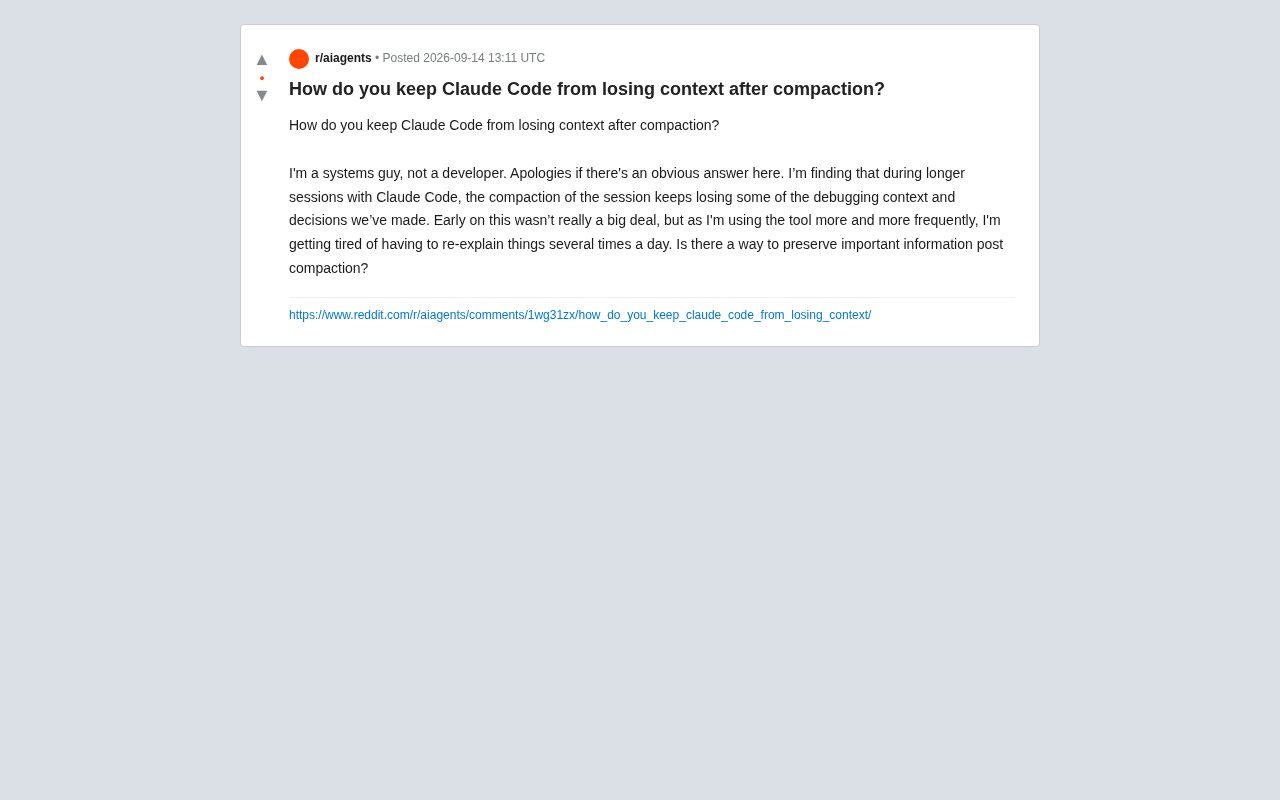
Losing Memory After Claude Code Context Compaction? Practical Solutions Explained
Claude Code losing debugging context after compaction? Learn how CLAUDE.md persistent memory, manual /compact control, session splitting, and external records solve the problem.
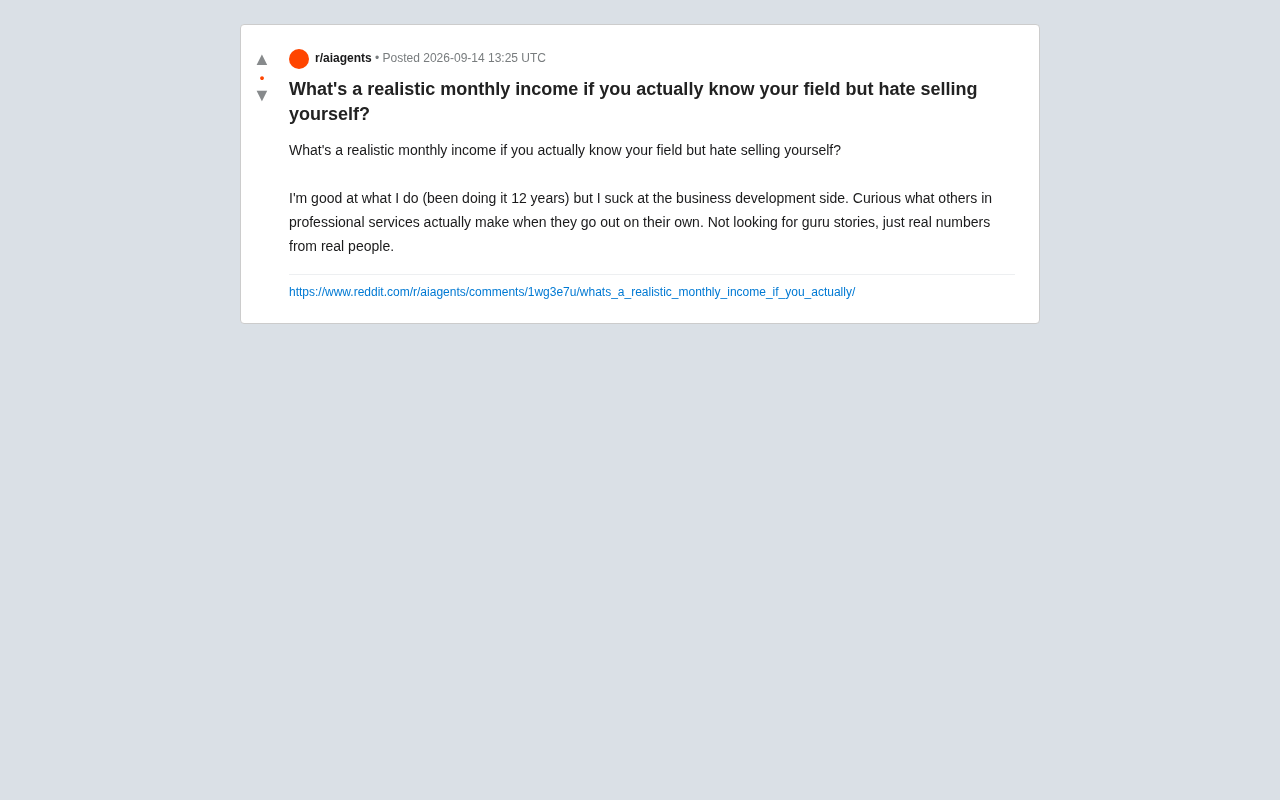
Great at the Work, Bad at the Hustle: A Realistic Look at Monthly Income for Independent Professionals
Can a 12-year professional who hates self-promotion earn well independently? Explore real Reddit insights on income expectations and non-sales client acquisition paths.

COGEXT: A Verification Layer That Gives AI Agents a "Lie Detector"
COGEXT is a verification layer for AI Agents like LangChain that extracts commitments and cross-checks them against Gmail, GitHub, and other external systems to catch agents lying about task completion.