OccupySaaS: Developers Push Back Against Subscription Software Dominance

OccupySaaS uses Occupy-style naming to critique SaaS subscriptions, sparking heated developer debate on software ownership and control on Hacker News.
The OccupySaaS project earned 245 points and 150 comments on Hacker News, using "Occupy"-style naming to target the SaaS subscription model and resonating with developers. The article examines the core controversy: users lose access when they stop paying, data and feature updates are unilaterally controlled by vendors, and control shifts from users to vendors. Community discussion shows a clear divide—some call for self-hosting, perpetual licenses, and open-source alternatives, while others emphasize SaaS's practical value in deployment, maintenance, and collaboration. The author notes that this event reflects growing developer sensitivity to software ownership and control, and that subscription is no longer the default correct answer for product pricing.

A project called OccupySaaS has sparked heated discussion in the developer community, earning 245 points and 150 comments on Hacker News. The link, sourced from an RSS aggregation feed, points to occupysaas.com—a site that takes direct aim at the SaaS (Software as a Service) subscription model. Its very name is a declaration: occupy SaaS, or rather, reclaim the software autonomy that the SaaS model has long occupied.
A Single Title Ignites Deep-Seated Resentment
The naming of OccupySaaS evokes the Occupy Wall Street movement, and this rhetorical choice is no accident. It frames the SaaS subscription model as a kind of "hegemony" that developers have been forced to accept, while the project itself attempts to serve as a banner of rebellion.
Judging by the heat of the Hacker News discussion, this topic has clearly struck a nerve with a large number of developers. 150 comments means this is not an obscure post that nobody noticed—it's an issue that resonates with a community. Developers' dissatisfaction with subscription software has been building for some time—from personal tools to infrastructure, nearly all software is shifting to monthly payments, while the "ownership" users receive grows increasingly thin.
You may have noticed that the original material doesn't elaborate on OccupySaaS's specific positions in detail, but the project's name and the intensity of discussion are enough to convey its core thrust: questioning and resisting the SaaS subscription economy.
Why Subscriptions Have Become a Target
The business logic of the SaaS model is clear: a continuous revenue stream, a predictable financial model, and an iteration cadence that can continuously push new features to users. For vendors, this is an ideal business model. But for users and independent developers, the problem lies in the transfer of control.
You no longer "own" the software you pay for. When the subscription stops, access disappears with it. Data is stored on someone else's servers, feature updates are unilaterally decided by the vendor, and price adjustments are also up to them. This structural dependency makes many developers uneasy, especially teams that have built their workflows on third-party SaaS tools.
OccupySaaS emerges at this moment, echoing a spreading sentiment: software should return to a form that users can control. This doesn't necessarily mean completely rejecting SaaS, but at minimum it's a public challenge to the "everything-as-a-subscription" trend.
Self-hosting refers to users deploying and running software on their own servers or local environments rather than relying on a vendor's cloud instance. Typical forms include deploying open-source applications (such as Nextcloud, Gitea, Plausible) on your own VPS, or setting them up with one click through containerization tools like Docker. Its fundamental difference from SaaS is that data, configuration, and runtime environment are entirely under the user's control, and subscription fees are typically converted into server costs or one-time licenses. The cost of self-hosting is the operational burden—backups, security patches, and version upgrades all need to be handled yourself, which is precisely why many teams still choose SaaS. In the context of OccupySaaS, "reclaiming autonomy" largely points to this path.
Divisions Revealed by Community Discussion
The comment section around OccupySaaS displays a typical divide within the technical community. One camp agrees with the critique of subscriptions, arguing that developers should re-examine the value of self-hosting, perpetual licenses, or open-source alternatives. The other camp points out that the SaaS model became popular because it genuinely solves real problems in deployment, maintenance, and collaboration—simple "occupy" slogans cannot replace engineering reality.
This divide itself has value. It shows that the problem with subscription software is not a black-and-white moral judgment but an open discussion about trade-offs: how to balance convenience against autonomy, and business sustainability against user control.
Since the original material only provides a link and discussion heat data, it's impossible to confirm whether OccupySaaS has proposed specific alternatives or an action agenda. Judging from the project's naming and community reaction, it seems more like a symbol that aggregates dissatisfaction than a complete solution.
Implications for the Developer Ecosystem
Regardless of whether OccupySaaS ultimately evolves into a movement, a toolset, or merely remains at the level of discussion, the signal it reflects is worth noting: developers' sensitivity to software ownership and control is on the rise.
Open-source tools, self-hosted solutions, and independent software with one-time purchases—these directions have repeatedly appeared in community discussions in recent years. The popularity of OccupySaaS can be seen as another manifestation of this trend. For teams building products, this means that the choice of pricing model and delivery method will increasingly come under user scrutiny—subscription is no longer the default correct answer.
For content creators and tool users, this is also a reminder: before relying on any SaaS tool, think clearly about how high the exit cost is.
Background Notes
Perpetual License is another mainstream pricing path besides SaaS subscriptions: users pay a one-time fee to obtain permanent usage rights to the software, rather than renewing on a time-based cycle. Traditional desktop software (such as early Adobe Creative Suite, Sublime Text) mostly adopted this model. Its advantage is that costs are predictable and the software remains usable after payment stops; its disadvantage is that vendors lack continuous revenue to support long-term updates, often needing to charge again through major version upgrades. In recent years, some independent developers have revived the perpetual license model as a response to subscription fatigue. Understanding the trade-offs between perpetual licenses and subscriptions is key background for grasping the sentiment behind OccupySaaS.
Related articles

64 Releases in 40 Days: How Strata Uses Release Velocity to Define Its AI Local Inference Roadmap
Strata shipped 64 releases in 40 days with 460k+ characters of notes. From 0.1.0 to 0.2.10, a three-step path: make it run, make it fast, make it trustworthy.
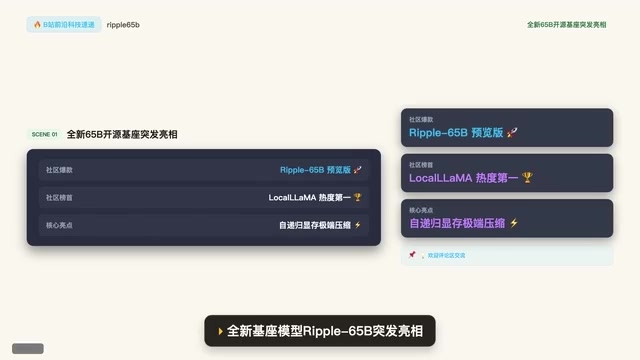
Ripple-65B Open-Source Model Tops Community Charts
Ripple-65B open-source LLM debuts atop community charts, using a self-recursive architecture to slash long-context KV cache for low-latency hundred-billion-scale inference on ordinary GPUs, with preview weights, quantized files, and one-click Olema & VLM deployment.

Deploy Open-Source Video Model MiniMax H3 Locally in 5 Minutes and Skip Cloud Generation Fees
Bilibili creator tests local deployment of open-source video model MiniMax H3: three-step ComfyUI install, 5-minute setup, no coding. Same prompt generates in 2 minutes locally vs 4 minutes online with queuing, saving about 30 RMB per 15-second 720P video. Includes VRAM requirements and RTX 5080 test results.