Odyssey 3: A Foundation World Model That Simulates Physics in Real Time

Odyssey 3 is a real-time physics world model that generates interactive environments and adapts to embodied AI tasks.
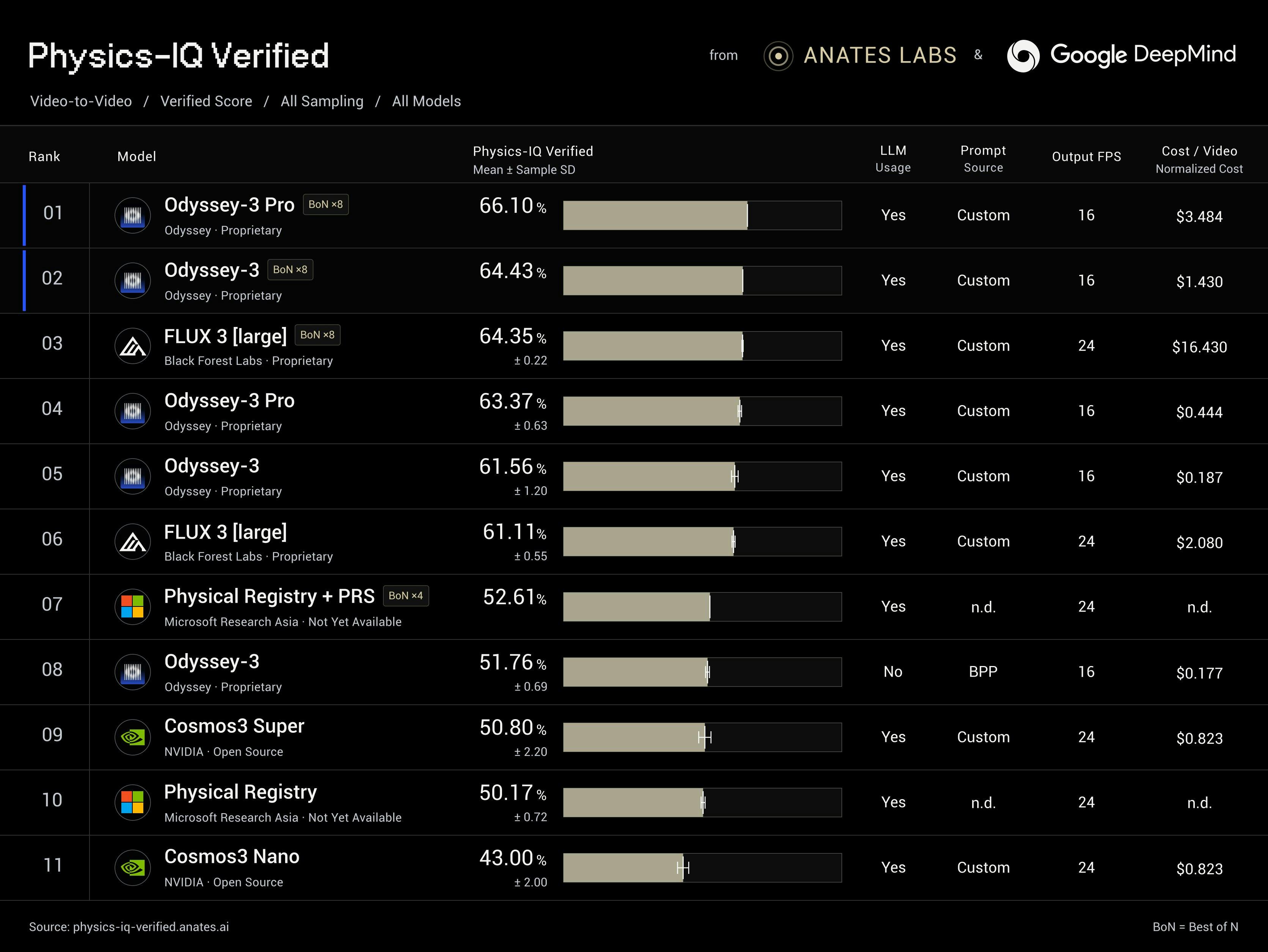
Odyssey 3 is a foundation world model that generates physically accurate, interactive environments from text prompts in real time, instantly reflecting the actions of users or agents. Unlike offline video generation tools, its key strengths are physical consistency and real-time interactivity — the Pro version self-reports a top score of 66.1 (best-of-8) on Physics-IQ Verified. More notably, the model has been adapted to robotic arm control, humanoid robots, autonomous driving, and agent training, signaling ambitions as a cross-task foundation model. It currently operates as a research preview with API access available by contacting the team.
What Is Odyssey 3
Odyssey 3 is a world model that generates interactive environments from text prompts and predicts in real time how those environments respond to actions taken by a user or an agent. Unlike traditional video generation models that simply output a fixed clip, the core of a world model is prediction — it understands the physical rules of a scene and can reason about what happens next.
The product ranked #5 in the AI category on Product Hunt with 111 upvotes, drawing considerable attention. The technical direction it represents — enabling models to build genuine internal representations of how the world works — is one of the most promising frontiers in AI today.
The concept of a world model traces back to cognitive science and reinforcement learning. In classical RL, agents must interact extensively with real environments to learn policies. The world model approach lets agents first "imagine" environmental dynamics internally, then use that internal simulation to guide decisions — dramatically reducing the need for real-world samples. In recent years, as diffusion models and video generation technology have matured, world models have evolved from abstract latent-variable spaces into pixel-level visual simulations. Notable examples include DeepMind's Genie, Google's GameNGen, and Tesla's internal world model for FSD. Odyssey 3 emerges from this wave of development, treating both interactivity and physical accuracy as first-class requirements.
Why Real-Time Physics Simulation Matters
The value of a world model lies in combining two key properties: real-time and physics-accurate. Most generative video tools are offline renderers — you submit a prompt and wait for the result. Odyssey 3 emphasizes real-time interaction: your actions or an agent's decisions are immediately reflected in how the environment changes.
This means it isn't just a content generator — it's closer to a "playable world" that can be explored and interacted with. To achieve this, the model must have a sufficiently accurate understanding of physical behaviors like collisions, gravity, and inertia. Without that, interactions produce physically nonsensical artifacts.
The Reference Value of the Physics-IQ Score
According to official information, the Pro version of Odyssey 3 achieved a score of 66.1 (best-of-8) on the Physics-IQ Verified video-to-video benchmark — the highest reported score to date. Physics-IQ is a benchmark class that measures how well generative models understand physical laws; higher scores indicate that the model's predicted frames better match real-world physical behavior.
To be objective: this is a vendor-reported "highest score," and best-of-8 means selecting the best result from eight generations. Stable, consistent performance still needs third-party verification. That said, this figure at least signals that the team has made physical consistency a core optimization target, rather than purely chasing visual aesthetics.
The Physics-IQ benchmark was designed specifically to test whether generative models truly "understand" physical laws rather than just performing statistical fitting at the pixel level. The test set covers phenomena including fluid dynamics, elastic collisions, gravitational freefall, and rigid-body rotation — the model must correctly predict object trajectories and deformations given an initial frame. This differs from traditional visual quality metrics like FID (Fréchet Inception Distance), which measures perceptual realism. Physics-IQ measures causal reasoning correctness. A model that scores well here is therefore theoretically better suited as an underlying engine for robot control and simulation training — not just a tool for generating visually "pretty" content.
From Environment Generation to Robot Control
One of the most noteworthy claims about Odyssey 3 is that the same model has already been adapted to multiple downstream tasks: controlling robotic arms, operating humanoid robots, driving vehicles, and training agents.
This is the ambition behind the "foundation world model" framing. If a model has genuinely built an internal understanding of the physical world, it shouldn't be limited to a single scenario — it should, like a foundation large language model, be capable of cross-task transfer. Robot control and autonomous driving both depend heavily on predicting environmental dynamics, and a sufficiently general world model could serve as the underlying engine for these embodied AI applications.
A Virtual Sandbox for Agent Training
Using a world model to train agents is a compelling direction. Collecting data in the real world is expensive and risky, whereas a virtual environment that accurately simulates physics lets agents iterate through trial and error at low cost. This "train inside the model" paradigm has received growing attention in robot learning research in recent years.
This paradigm is formally known as Model-Based Reinforcement Learning (MBRL). Compared to model-free methods, MBRL allows agents to accumulate experience by "spinning" inside the world model, potentially improving data efficiency by orders of magnitude. More advanced variants — such as the Dreamer family of work — take this further, enabling agents to learn policies entirely within latent space without rendering actual pixels. For robot learning in particular, the value of a world model as a virtual sandbox is especially pronounced: hardware wear, safety risks, and data collection costs all constrain the scale of real-robot training. If a high-fidelity virtual environment can narrow the sim-to-real transfer gap, it could dramatically accelerate the deployment of embodied AI systems.
How to Access It Today
Odyssey 3 is currently available as a research preview. Developers and enterprises seeking API access can contact the team directly. This signals the product is still in an early stage with meaningful distance remaining before large-scale commercial deployment — though the direction is clear.
For practitioners working in embodied AI, robotics, and generative environments, developments in this class of world models are worth tracking closely. They could become production tools for next-generation games and simulation content, or foundational infrastructure for robot and autonomous driving training.
Summary
Odyssey 3 combines "real-time physics simulation" and "cross-task generality" to demonstrate the potential of world models evolving from content generators into foundational platforms for embodied intelligence. Its self-reported Physics-IQ high score and multi-task adaptation examples are encouraging — but the best-of-8 evaluation condition and early research-preview status are reasons to stay measured. The real test will come when third parties and a broader range of real-world scenarios get involved: can it consistently deliver on its claimed understanding of the physical world?
Related articles

FastAPI: A High-Performance Python Framework and a Production-Ready API Development Powerhouse
FastAPI is a high-performance web framework based on Python type hints, supporting async and automatic OpenAPI docs. With over 100k GitHub stars, this article analyzes its core strengths, production readiness, and selection advice.

Tesla Optimus Begins Mass Production: Can the Goal of 20,000 Units Per Week Be Achieved?
Tesla Optimus officially begins mass production as Musk sets a target of 20,000 units per week. This article analyzes the supply chain challenges behind mass production, the real gap in capacity ramp-up, and the competitive landscape for humanoid robots.

PCL: A Minecraft Launcher with 8.5k Stars — Why Was It Written in VB.NET?
An in-depth analysis of PCL, the GitHub Minecraft launcher with 8,500+ stars: why it chose VB.NET, its features and China network advantages, and the limits of Windows-only.